Monday, March 18, 2013

MoCo tops 1 million residents; region's core growing more than edges

Even More Like A Big City, 2012
Who has two thumbs and lives in a place with 1 million people? You. You are that person.

After years of rapid population growth, Greater Washington might be slowing down. However, the real story is where most regional growth is happening: not on the suburban fringe, but in and around the Beltway. As a result, Montgomery County has now topped 1 million residents.

Yesterday, the Census Bureau released their population estimates for the region, which is defined as the District and 27 surrounding counties and independent cities in Maryland, Virginia and West Virginia. While the Washington Post focused on slightly slower population growth than in previous years, there are much more interesting trends occurring.

Regional growth still among the highest in the nation

The Census Bureau estimates that the Washington-Arlington-Alexandria Metropolitan Statistical Area, which is what they call Greater Washington, had just over 5.8 million residents in 2012. If you include Greater Baltimore, our combined region has 8.6 million people, making it the fourth-largest metropolitan area in the country, behind New York, Los Angeles and Chicago.

Greater Washington added 89,000 new residents between July 2011 and July 2012, which the Post notes is fewer people than we added the year before. It calls this the "twilight hour of a remarkable phase in the Washington region" during which Americans flocked to the area in search of jobs, adding to the area's population. Yet we've still had the fifth-largest increase in population of any metropolitan area in the country. We added more people than traditionally fast-growing Sunbelt cities like Atlanta and Phoenix.

Inside-the-Beltway communities among the nation's fastest-growing

fastest growing communities
The ten fastest-growing communities in the DC area. Four of them are inside the Beltway.
Our region is also home to several of the nation's fastest-growing counties and independent cities, notably the District of Columbia, which after decades of population loss is now growing rapidly. It's now the 61st fastest-growing "county" in the United States, having grown by 5.1% and adding over 30,000 residents between 2010 and 2012.

The District now has 632,000 residents, about what it had during the 1980's. For the first time ever, Washington now has more people than Baltimore City, which has also started gaining residents for the first time in decades.

Joining the District on the list are several jurisdictions in Northern Virginia, including Arlington and Loudoun counties and the cities of Alexandria, Falls Church and Fredericksburg, which grew at a rate of 12.44% between 2010 and 2012, making it the region's fastest growing community.

Places like Loudoun are no stranger to the list of fastest-growing counties, having transitioned from farms to suburbia in less than a generation. However, the addition of inside-the-Beltway communities like Arlington and Alexandria is impressive. DC, Arlington and Alexandria have all sought to encourage smart infill development around Metro as a way to revitalize older neighborhoods, and it's clear they've been really successful.

Meanwhile, first-ring suburban counties haven't been slouching. Between 2010 and 2012, Montgomery and Fairfax counties grew by 3.39% and 3.41%, respectively, just below the region's average of 3.98%. In 2012, Montgomery's population reached 1 million for the first time, making it and Fairfax the only jurisdictions in the region with a 7-figure population. The county now has 1,004,709 residents.

Majority of region's growth happening in and around the core

regional share
First-ring counties like Montgomery County have the region's largest share of residents and accept the largest share of its growth.

Not only are the core and inner-ring suburban counties continuing to grow, but they're carrying most of the region's growth. Of the 224,000 people who moved to Greater Washington between 2010 and 2012, 62% of them moved to the city and inner suburbs. As a result, the core and inner ring now contain 69% of the region's total population.

Roughly 1 in 7 new residents moved to the District of Columbia, while 22% moved to either DC, Arlington or Alexandria. Though the inner suburban counties, Montgomery, Prince George's and Fairfax, are growing at a slower rate than both the core and "second-ring" counties like Loudoun and Prince William, they received about 40% of the region's population growth. Another 30% occurred in the second-ring counties, while 7% went to rural counties in Maryland, Northern Virginia and West Virginia.

We don't have any data for where growth is specifically occurring in the inner ring, but judging from the building boom in places like Silver Spring in Montgomery and Merrifield in Fairfax, it's likely happening in the same kinds of places and for the same reasons as in the District, Arlington and Alexandria.

Growth is occurring unevenly

largest communities 2
The 10 largest communities in Greater Washington by population. Montgomery County is #2.

While most close-in communities are growing at a fast clip, Prince George's County isn't doing as well. It grew at a rate of just 2% between 2010 and 2012, placing it among the region's slowest-growing counties. This is not only unfortunate for Prince George's, which for decades has lagged neighboring counties in drawing people and businesses, but for the region as a whole.

DC's resurgence and the continued growth of older suburban counties like Montgomery suggest that people want to live close in. Presumably, Prince George's should benefit from that demand, but for a variety of reasons it's being directed to further-out areas, which results in more traffic, more destruction of natural or agricultural land, and the ongoing disinvestment of older neighborhoods. Directing more investment to Prince George's should be a regional priority, as it will further add to the strength of other communities around the Beltway.

Yes, Greater Washington is growing a little more slowly than it used to, and that's okay. The big news is that unlike many metropolitan areas in the United States, we're growing at the center, not at the fringe. Not only does it make our region stronger and more sustainable, but it shows that other places around the country don't have to accept unending suburban sprawl as a given.

Tuesday, March 12, 2013

where do young adults live in montgomery county?

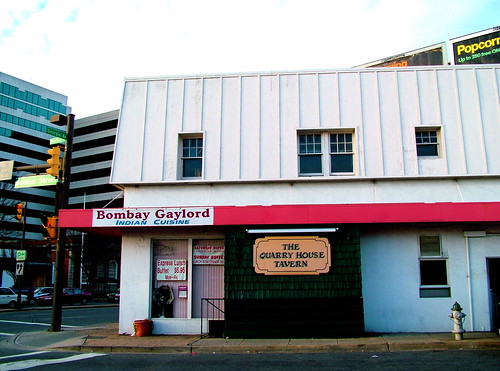
Bombay & Quarry House
Young people in MoCo choose to be near jobs, hangouts and transit. Photo by katmere on Flickr.
Montgomery County community leaders want to draw more Millennials, members of the generation born between 1982 and 2000, hoping that they'll stick around when they're older. As they explore ways to attract twenty- and thirtysomethings, from new transit projects to more nightlife, it's worth looking at where they live in Montgomery County today.

According to the 2010 Census, Montgomery County has about 186,000 residents between the ages of 20 and 34, making up about 19% of the county's population. In a recent Washington Post article about the county's Night Time Economy Initiative, reporter Bill Turque notes that young adults make up a lower share of Montgomery County's population than other places in Greater Washington.

Why is that? Trends show that Millennials want an urban lifestyle, but are often stymied by limited funds and a dearth of affordable housing. As a predominantly suburban, affluent county, Montgomery doesn't seem like the kind of place where young adults would want to live.

However, if you look at individual neighborhoods, you'll find substantial concentrations of Millennials, suggesting a way forward for Montgomery County as it seeks to draw more of them.

Millennials flock to areas near transit, jobs, affordable housing

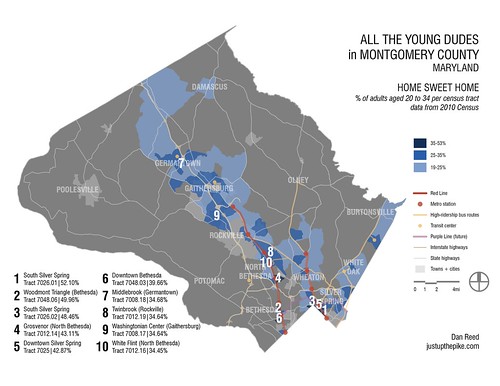
all the young dudes ranked
Where Millennials live in Montgomery County. Click on the image for a bigger version, or click here to see it without the rankings.

Here's a map of Census tracts where the percentage of 20-to-34 year old residents is higher than the county's 19% average in the 2010 Census. The county's largest concentrations of Millennials are along the Red Line in places like White Flint, downtown Bethesda and downtown Silver Spring, where young adults are a slim majority. Notably, these are also the places where walking, biking and taking transit to work are most common.

Young adults also seem to gravitate towards shopping and entertainment districts like the Washingtonian Center in Gaithersburg. Even though it's not near a Metro station or major bus route, Washingtonian Center is a pretty walkable area where one can shop or grab dinner without a car.

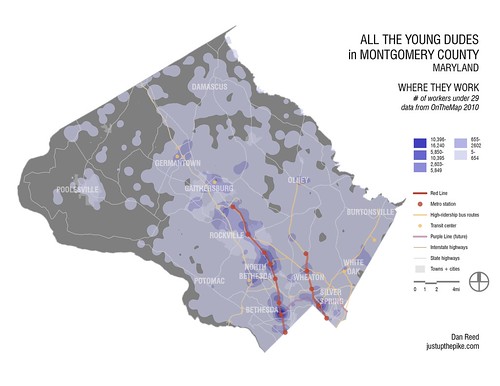
We can also conclude that many Millennials are trying to live as close as possible to their jobs. Here's a map of where people under 29 work in Montgomery County:

where they work-01
Where Millennials work in Montgomery County.

Compare it to the first map and you can see that clusters of young people coincide with the county's biggest job centers, White Flint, Bethesda and Silver Spring. Yet there are also large concentrations of Millennials in places with fewer jobs, like Briggs Chaney in East County and Germantown in the Upcounty.

Not surprisingly, these communities are also more affordable. According to the 2006-2011 American Community Survey, the median monthly rent is $1565 in Census tract 7048.06 in Bethesda's Woodmont Triangle, compared to $1344 in Census tract 7008.18 in the Middlebrook section of Germantown.

Both of these neighborhoods have some of the county's largest concentrations of Millennials, suggesting that there may be more to it than affordability. If we take a closer look at different segments of the county's young adults, we can get a better understanding of why they live where they do.

Educated and single Millennials move closer in

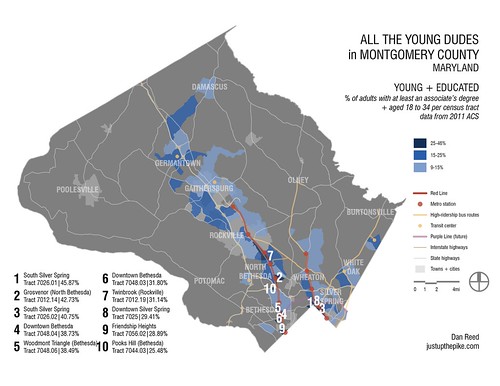
Here's a map of 18-to-34-year olds with at least an associate's degree:

young and educated ranked-01
Where college-educated Millennials live in Montgomery County. Click on the image for a bigger version, or click here to see it without the rankings.

The general distribution of young people is the same, but there's a slight shift towards the Downcounty. College-educated people tend to have higher incomes, which might explain why there are more of them in expensive areas like Bethesda and Friendship Heights.

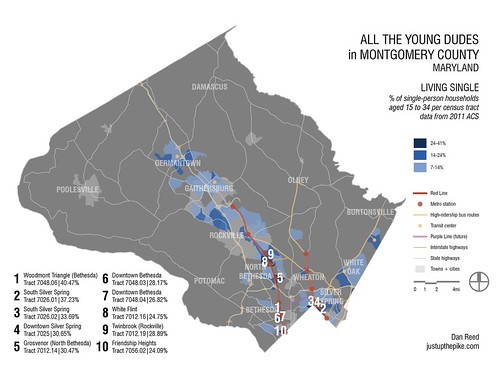
living single ranked-01
Where single Millennials live in Montgomery County. Click on the image for a bigger version, or click here to see it without the rankings.

However, the county's single Millennials have decidedly chosen to live closer in, settling in and around downtown Silver Spring, downtown Bethesda, Friendship Heights and White Flint. These neighborhoods have almost everything that a young single person would want: they're close to Metro, major employers and the District, they contain a fair number of bars and restaurants, and they have a variety of housing options. Silver Spring in particular has a number of group houses.

Millennials with families move further out

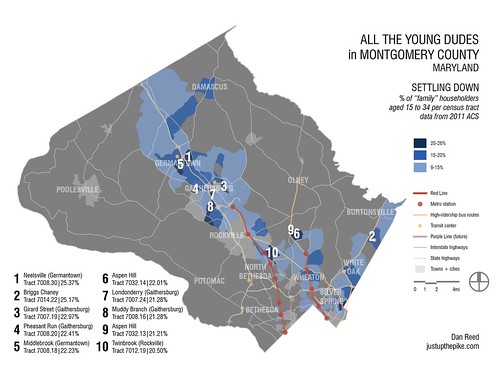
settling down ranked-01
Where young families live in Montgomery County. Click on the image for a bigger version, or click here to see it without the rankings.

While singles are flocking to closer-in neighborhoods, Montgomery's young families, defined here as households led by individuals under 34 and related by marriage, blood or adoption, are moving further out. All ten of the county's largest concentrations of young families are well outside the Beltway, particularly in Gaithersburg and Germantown. Just one is near a Metro station, Twinbrook.

This fits the long-held stereotype that once you get married and have kids, you move to the suburbs in search of larger, more affordable housing. Not only is it cheaper to rent in the Upcounty, it's cheaper to buy: the median home value in Middlebrook is just $294,000, compared to $516,800 in the Woodmont Triangle.

Yet families who choose to move farther out will pay considerably more for transportation than they would elsewhere. That might explain why young families appear to have settled in neighborhoods like Fallsgrove in Rockville, which were designed to encourage walking and biking, near shopping areas like Washingtonian Center or employment areas like the Shady Grove Life Sciences Center.

Meanwhile, young families still make up one-tenth of all households in downtown Bethesda and downtown Silver Spring, suggesting that some are interested in an urban lifestyle. This isn't a new trend: I grew up in an high-rise apartment building in downtown Silver Spring in the 1990's, and there were plenty of kids around. Of course, my mother chose to live there because it was "affordable and quiet," which I'm not sure characterizes the area today.

What does this mean?

These maps have implications not just for Montgomery County, but the whole region. They show that the District and Arlington aren't the only places that can attract Millennials, so long as they can be near neighborhoods near transit, shopping and jobs. While many young families are choosing to live further out, they're still seeking a semi-urban experience.

They also show that one of Montgomery's greatest strengths remains its diversity of neighborhoods, allowing it to attract both singles and families. However, two distinct challenges lie ahead. One is to preserve a supply of affordably-priced housing in the county's urban areas, both established places like Bethesda or emerging ones like White Flint. The other is to create more walkable neighborhoods and improve access to jobs, shopping and transit in the Upcounty and East County, where young families continue to settle.

Of course, Millennials aren't the only ones who want an urban or semi-urban lifestyle. But if Montgomery County wants to attract a new generation of residents, it needs to start listening to young adults. Without us, the county doesn't have much of a future.

Crossposted from the Friends of White Flint.

Thursday, March 7, 2013

the wheaton plaza t-shirt (is almost ready)

UPDATE: The Wheaton Plaza T-shirt is done and for sale! Check it out on the JUTP online store. If you buy one, send me a photo at justupthepike at gmail dot com and you might see it on the blog!

Last fall, I wrote about my attempt to recreate the 1960's-era sign for Wheaton Plaza and turn it into a T-shirt. After putting it aside for a few months, I tweaked the design and finally had a shirt printed up. Check it out:

The Wheaton Plaza Shirt
It's not called Wheaton Plaza anymore, but it's still open tonight til 9:30.

I'm pretty satisfied with it. The design printed clearly, can be recognized from far away, and closely resembles the original sign. I've even got a small, tasteful plug for Just Up The Pike in the corner.

Last night, I decided to wear it to Greater Greater Washington's 5th birthday party. I've been contributing to GGW for the past 4 years, and I'm always amazed to see the community David Alpert's built both online and in person. It was a big gathering, but somehow my shirt and I made their way into a number of photos, including hiding behind D.C. mayor Vincent Gray and hobnobbing with my fellow contributors.

GGW 5th birthday 15
That's me on the right, talking with GGW contributor Bradley Heard. Photo by Aimee Custis.

One person who lived in D.C. asked me if there were people "obsessed enough with Montgomery County" to want a Wheaton Plaza shirt, but judging from the mall's 800 fans on Facebook, I wouldn't be surprised. To many people who grew up here back in the day, the mall was an important place in their life and arguably a part of our local culture that's worth celebrating.

Though Wheaton Plaza isn't called that anymore, and the sign has been gone probably as long as I've been alive, people remember it. Both of my parents used to shop at Wheaton Plaza back when it was a "whole new shopping scene" and when I showed them the sign, their eyes lit up like they'd seen a long-lost friend.

Besides, even if you've never been to Wheaton Plaza or care about it, thee design that pays homage to midcentury modern design, which has its fans in Montgomery County and beyond.

A number of commenters expressed interest in buying my Wheaton Plaza shirt, so I'm setting up a store on Spreadshirt to sell it; in case you don't like grey, I'll have it in a couple of different colors. I'd like to make a few changes to the design before making the store public, but I hope to to have it ready soon. I'll let you know when it's done! If it's successful, I might make designs for other local landmarks.

Friday, March 1, 2013

chevy chase lake plan a compromise between developers, neighbors

2008 07 16 - 6011 - Chevy Chase - MD 185 at Manor Rd
Chevy Chase Lake today. Photo by thisisbossi on Flickr.
The disagreement over what should happen in Chevy Chase Lake wasn't surprising: developers wanted taller buildings and higher density, while neighbors wanted the opposite. What's surprising is that both sides found a compromise in the Chevy Chase Lake Sector Plan, now going before the Montgomery County Council.

Located on Connecticut Avenue just south of the Beltway, Chevy Chase Lake was originally an amusement park at the turn of the 20th century, built by developer and Senator Francis Newlands at the end of the streetcar line he built down Connecticut to downtown DC. Newlands also used the streetcar to draw homebuyers to several neighborhoods he built along Connecticut Avenue, including Chevy Chase.

The lake, the amusement park and the streetcar are all gone, and in their place are a couple of strip malls, some garden apartments, and a lot of traffic on Connecticut Avenue.

The Montgomery County Planning Department recently finished work on a sector plan for Chevy Chase Lake in anticipation of the Purple Line, which when built will have a stop there. They envision creating a compact, but dense neighborhood around the station, with housing, shops and a new urban park, and a stretch of Connecticut Avenue into a real main street.

Disagreement over future of Chevy Chase Lake

The Chevy Chase Land Company's 2011 vision for Chevy Chase Lake.

However, the size and scale of that neighborhood was up for debate. In 2011, the Chevy Chase Land Company, which was originally founded by Senator Newlands and still owns several offices and shops in Chevy Chase Lake, proposed building up to 4 million square feet of new development there, including up to 3000 new homes and several buildings up to 19 stories tall.

Transit advocates supported their vision, arguing that concentrating housing around the future Purple Line will help alleviate congestion in the future, but some neighbors were upset about the amount of development, fearing it would cause traffic. They found common ground with county planners, who sought a more nuanced approach to development in Chevy Chase Lake.

"There is no transit system in the world that creates 18-story buildings at every transit stop," wrote then-planning director Rollin Stanley. "Not every transit station has to be downtown Silver Spring or Bethesda. In reality, the best transit systems have a very diverse network of transit stops."

Site Plan, Chevy Chase Lake Development
What Chevy Chase Land Company proposes today. Image courtesy of the Chevy Chase Land Company.

The resulting plan, which was approved by the Planning Board in January, calls for 2.2 million square feet of new development, including about 1300 new homes, in the entire commercial district. Most of it won't be built until after the Purple Line is funded and built; until then, most properties would either stay the same or be allowed slightly more density than there is today.

Instead of 19-story buildings throughout the commercial district, there would be three buildings between 100 and 150 feet tall adjacent to the Purple Line station. Elsewhere, building heights would be restricted to 55 to 80 feet, while townhouses would form a transition to adjacent single-family homes.

Connecticut Avenue would be transformed from a traffic sewer into a main street, with on-street parking, new traffic signals, and sidewalks with streetscaping. New bike paths, trails and improved connections to the Capital Crescent Trail would knit the commercial center into the community, making up for the area's disconnected street network.

Proposed Plaza, Chevy Chase Lake
Mid-rise buildings and a plaza would replace the Chevy Chase Lake Shopping Center.

Meanwhile, the Chevy Chase Land Company's plans have been downsized, with just 1.5 million square feet of development and fewer than 900 apartments, and broken up into three phases. The first, which would occur before construction of the Purple Line, would replace the Chevy Chase Lake Shopping Center at Connecticut Avenue and Manor Road with 3 buildings containing a mix of apartments and retail space around a half-acre park.

Once the Purple Line is built, later phases would replace their headquarters building at Connecticut Avenue and Chevy Chase Lake Drive and the Lake West shopping center across the street with additional retail, apartments and townhouses, and a new headquarters.

Neighbors use Purple Line to discourage development

purple line at east-west highway
The Purple Line and Capital Crescent Trail in Chevy Chase.

While this is much less than what the Land Company first wanted, not everyone's satisfied. Some neighbors formed a group called Don't Flood the Lake, raising concerns about traffic and calling the plan "wildly out of scale with the area." They also question whether we should allow new development around the Purple Line when there's no money for it yet.

It's unclear whether this group has any connection with Save the Trail, an anti-Purple Line group that's campaigning against funding for the Purple Line and other transportation projects. But not building the Purple Line or development associated with it won't fix traffic. No Purple Line means people have fewer alternatives to driving, while no new housing in Chevy Chase means people working next door in Bethesda, one of the region's largest job centers, have to commute from further away.

1300 new homes in Chevy Chase Lake will be far less of a burden on Connecticut Avenue than the influx of thousands of workers, patients and visitors who currently drive on Connecticut Avenue to the new Walter Reed National Military Medical Center in Bethesda.

Legation Street, Chevy Chase DC
Single-family homes and mid-rise buildings coexist in Chevy Chase, DC. Why not in Chevy Chase Lake?

Besides, the scale proposed at Chevy Chase Lake isn't much different than what Senator Newlands built around streetcar stops just a few miles down Connecticut Avenue in Chevy Chase, DC: mid- to high-rise apartments interspersed with shops and offices and steps away from quiet streets lined with single-family homes. If this could work a century ago, why can't it work today?

Traffic is a big issue in Greater Washington and will continue to be so as the region grows. Yet the answer, in Chevy Chase Lake or any other neighborhood, isn't to stop anyone new from moving there. If neighbors don't want to see more traffic on Connecticut Avenue, they should join groups like Get Maryland Moving to ensure that the Purple Line gets the funding it needs.

And they should support the Chevy Chase Lake Sector Plan, which will not only give them a great town center within walking distance and allow others to live in a place where they don't have to drive everywhere.

The Montgomery County Council will hold a public hearing on the Chevy Chase Lake Sector Plan next Tuesday, March 5 at 7:30pm. To sign up to testify or to send written comments, visit the County Council's website.