Showing posts sorted by relevance for query greenberg. Sort by date Show all posts

Friday, January 20, 2012

lenny greenberg, dreaming of wheaton beyond the strip mall

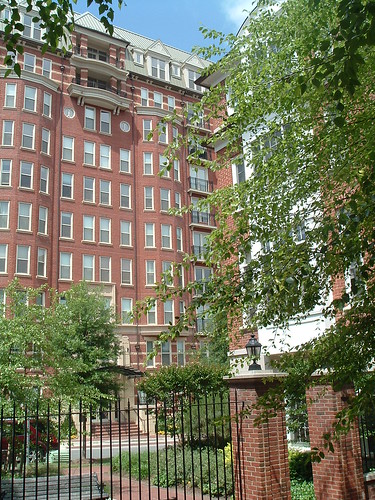
The Edgemoor
Leonard Greenberg developed these buildings in Bethesda. And he'd do the same in Wheaton if given a chance.

While County Executive Ike Leggett wants to give developer B.F. Saul $40 million of public funds to build on public land in downtown Wheaton, one developer's been building here with minimal help from Montgomery County. His name is Leonard Greenberg, and since the mid-1980's, his company Greenhill Capital has acquired nearly a third of downtown Wheaton, dreaming of what the area could become. When the county's zoning restrictions forced him to sit out the real estate boom, Greenberg decided to keep waiting while hatching bigger and grander schemes.

JUTP hasn't always been kind to Greenberg's work, but after having a lengthy phone call with him earlier this week, I wanted to offer his side of the story. (This is a long post, but I promise it's worth it.)

"Wheaton should be more of an Adams Morgan"
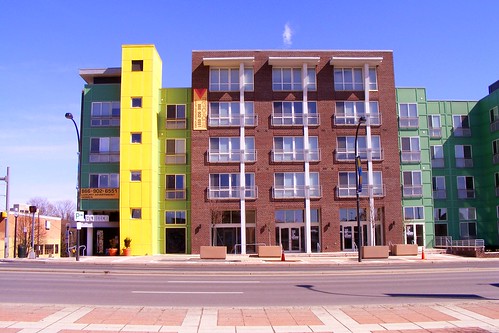
MetroPointe
New apartments like these on Georgia Avenue, says Greenberg, will help local businesses in Wheaton.

Greenberg grew up in the D.C. area, living briefly in Wheaton during the 1950's. After working for a Boston-based real estate investment firm on their D.C.-area projects, he struck out on his own and founded Greenhill Capital in 1974. In the 1980's, he began buying and developing properties in Wheaton, anticipating the opening of a new Metro station.

"It was the last [central business district] that was scheduled to be developed" after Silver Spring, Bethesda and Friendship Heights, says Greenberg. "Plus, it was human scale. And there’s something about the small proprietors."

Most of Greenberg's properties in Wheaton are single-story retail buildings, many of which were designed by Rockville architect Steven Karr. But he's always itched to do something greater. As he told the Gazette last week, Greenberg sees Wheaton as the next Adams Morgan, a vibrant hub for entertainment, shopping and culture. Not only that, but he knows how to do it.

"I’m a johnny-one-note. I've been saying this for 25 years, to get people on the street. I'm an urbophile. I'm a believer in 'city.' I get it."

If Greenberg had his way, he'd change liquor licenses to allow up to 75% of a venue's total sales to be alcohol, drawing bars and clubs. He wants a "county sponsored lease plan and economic program" to fill empty stores with theatres, artists and even university ventures. And he would've made sure that businesses displaced by redevelopment stayed in the area, unlike Barry's Magic Shop, which was condemned by the county to build a pedestrian walkway and received $260,000 to move to Rockville.

Finally, Greenberg would build lots of housing, both downtown and in surrounding neighborhoods, to create more foot traffic that can support local businesses. He's not convinced that B.F. Saul's plan to build offices over the Wheaton Metro will pencil out. "It costs as much to build in Wheaton as it does in Friendship Heights, but the rent multiplier is significantly higher," he explains.

In other words, tenants will pay more for an office in Friendship Heights than in Wheaton, no matter how nice it is. Meanwhile, rents for apartments in Wheaton are the same as those elsewhere in the county. "The county will have to heavily subsidize that office building," Greenberg told me on Monday, two days before Leggett's announcement.

After our talk, I e-mail Greenberg to ask what he thought about the $40 million subsidy B.F. Saul could receive. "Development would have occurred in Wheaton with bolder (even traditional urban) planning, but the county was too lazy and too anti-business for change to naturally evolve," he replies. "We never considered a [government] subsidy . . . on any of our other projects."

"We're not apologizing"
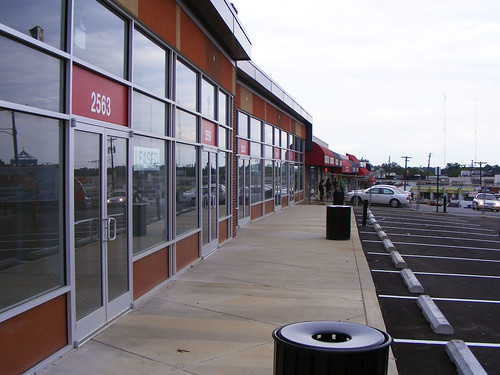
Sidewalk, Triangle Park
Triangle Park, a shopping center developed by Greenhill, shown in 2010 before being leased.

According to Greenberg, any attempts to take Wheaton beyond the strip mall have been stifled by local opposition and red tape. "Boy, do I try to do more and better there," says Greenberg, "and you cannot imagine the resistance we have."

In 1990, the county passed a plan for downtown Wheaton that instituted a "Retail Overlay Preservation District." (See a map of it here.) The district was supposed to protect small businesses while ensuring that new construction was of high quality. However, by limiting the density of new development and requiring that all new buildings be reviewed by the Planning Board, even ones that complied with the zoning code, it actually repelled investment.

"I absolutely abhor what the county has been doing all these years" in Wheaton, says Greenberg. "What they needed to do is have more density, more people to walk and support the urban core."

Upon buying the Anchor Inn restaurant at Georgia Avenue and University Boulevard in 2004, Greenberg envisioned redeveloping it with new housing and shops. It was the height of the real estate boom, when new apartments and townhouses were being built at the edges of downtown Wheaton. However, his proposal to build a 600,000 square feet mixed-use development on the site went nowhere because the county took too long to finish a new plan for the downtown, which was finally approved last year. "They wouldn't repeal the overlay district" in time, he grumbles.

In a Gazette article from 2006, Greenberg lamented that Wheaton "missed the train" on the economic boom. Instead, he built what zoning allowed: the smaller Georgia Crossing project, a series of one-story retail buildings that one resident called underwhelming.

"In the 1950's and 60's, Montgomery County was the standard by which suburbia was to be developed," Greenberg says. "The Wedges and Corridors [Plan], blah blah blah. But as we became more urbanized, they . . . tried to impose suburban standards on urban locations, without consideration to alleys and deliveries and urban edge and human scale, doors at the urban edge and creating a liveliness that was required."

That said, Greenberg isn't doing terribly in Wheaton. He calls me out for using the above photo of Triangle Park, a shopping center at the intersection of Ennalls Avenue and Veirs Mill that he rebuilt after a large fire in 2008. The photo was taken in 2010 and shows the complex when it was new and empty. "That space has been leased for 18 months," says Greenberg. "We’re getting mid-$30's [the leasing rate per square foot] and the parking lot is always full."

Not all of his tenants have been happy, though. In 2010, the Gazette interviewed several disgruntled former tenants who spoke of broken contracts and unfairly high rents. One of those tenants was Eddie Velasquez, whose DeJaBel Café at Greenberg's Georgia Crossing shopping center opened in 2008 and closed 14 months later. Greenberg says it's simple why DeJaBel closed.

"If you owned a coffee shop, when would you open?" he asks me. "I guess 6 or 7 am, for people going on their way to work," I say.

"He opened at 9," Greenberg replies. Nonetheless, he says, Greenhill Capital got Velasquez a liquor license so the cafe could stay open at night, but even that wasn't enough to keep them in business. Cavan Wilk, who writes for GGW, suggests that it was a lack of foot traffic that killed DeJaBel Café, which wouldn't have been a problem if Greenberg had been able to build apartments on top.

"We're not apologizing" for the work Greenhill does, Greenberg says. "Think about the jobs we’ve created. We start people in businesses and we keep people in business."

"No one asked me to do it"
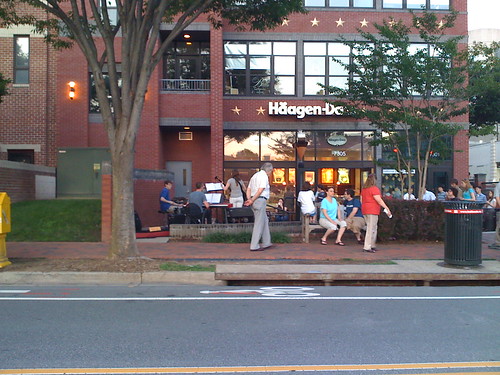
Where Haagen-Dazs Used to Be, Woodmont Avenue, Bethesda
Greenhill Capital developed this office and retail building in downtown Bethesda, shown in 2009.

One place where Greenberg sees the county doing something right is in downtown Bethesda, where Greenhill Capital's headquarters are located. The difficulty of doing business elsewhere in the county, whether it's Wheaton's retail overlay district or limits on procuring liquor licenses, sends people here, Greenberg says.

Not surprisingly, the handful of projects Greenhill has built here are much better than those in Wheaton: buildings close to the street, a mix of uses, and little aesthetic flourishes here and there. And no parking lots.

On Cordell Avenue, a pizzeria he developed features trompe l'oeil, or an optical illusion of fountains along the sidewalk. "No one asked me to do it," Greenberg says. "I did it." Over at Woodmont Avenue and Elm Street is what Greenberg calls "the Haagen-Dazs building" after its former ground-floor tenant, which has since moved down the street. The building remains a nice, and fully-occupied, piece of urbanism: it's a mix of retail and office space, has lots of windows facing the street, and a little plaza in front that is occasionally used for concerts.

Then there's the Edgemoor shown above, a complex of condominiums and townhomes on Montgomery Lane that was developed by Greenberg and built by three local builders. He rattles off a list of high-end features: "Real copper gutters and downspouts, slate roofs on the end units, oak doors," he says. "And until they screwed it up, Georgian gardens. I had these really nice Georgian gardens, but they took out all of the benches." Greenberg also lives in the high-rise building, which looks like an old-school New York apartment house.

"I wanted something between the Dakota and the Plaza," he says.

Yet these accomplishments generally go unnoticed east of Rock Creek Park, where Greenberg's been depicted (including on this blog) as an unscrupulous landlord and purveyor of strip malls. "Nobody talks about the stuff that we’ve given or the contributions we’ve made," he says. "To put your name on the line for a construction project is far different than throwing spitballs at it."

As a result, Greenberg is content to wait. "We got so frustrated with the process [in Wheaton] that we said we’ll go forward and we’ll wait for the next generation to take it to the next level," he says. "We are constrained by a non-business friendly environment, and Montgomery County's paid the price for that. Developers are not willing to take the risk."

And they'll sit on their substantial holdings in Wheaton until everyone else comes around. "We have enough ground for 1.5 million square feet" of development under current zoning, he says. "We’re interested in the right kind of deal. We’re not interested in selling."

He adds, "We’ll see if Wheaton's time is now."

Wednesday, January 11, 2012

how to make wheaton into the next adams morgan (or not)


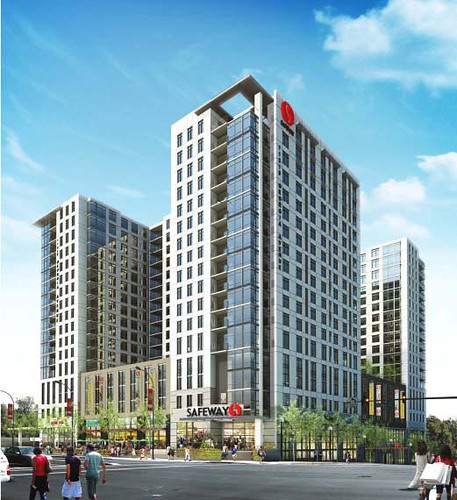
New Wheaton Safeway Rendering
Several new apartment buildings are being built in downtown Wheaton, including the Exchange at Georgia Avenue and Reedie Drive.

Last week, the Gazette reported on an "apartment boom" in Wheaton, where hundreds of new rentals will be built in the coming years. That's great for Wheaton, whose small businesses will benefit from having more people living in the area, walking around and patronizing their shops.

The most interesting part of the article, however, is this quote from developer Leonard Greenberg, who owns over a dozen properties in downtown Wheaton:

Leonard Greenberg, chief executive officer of Bethesda-based Greenhill Capital, planned to build 600,000 square feet of shops, apartments and office space in 2004 when he bought property at the intersection of Georgia Avenue and University Boulevard. He said the county council was too slow in approving zoning changes that would have allowed for taller buildings on the property, which is now a row of retail shops with a number of vacant properties.

“To me, Wheaton should be more of an Adams Morgan, more of a village-like environment,” said Greenberg, who added the many apartment projects were an encouraging sign. “The reasons why places like Adams Morgan are popular is that they are high-demand areas where there’s lots of activity. You have young people living in accessible locations. Wheaton needs to be a place where people want to go, not just go to work and leave at the end of the day.”

So let's be clear:


Adams Morgan and Madam's Organ
Photo by Jason Pier in DC on Flickr.

This is the real Adams Morgan: shops and restaurants at street level (most of which are locally-owned), apartments above, buildings hugging the street. The result is lots of activity and lots of people, just as Leonard Greenberg describes.


Sidewalk, Triangle Park

And this is what Leonard Greenberg built. More specifically, this is just one of several one-story, single-use strip malls he's built around downtown Wheaton over the past 25 years.

I'm sympathetic with Greenberg's argument that the county dropped the ball on allowing more development in Wheaton when the economy was strong. He understands that you need housing and retail to make a neighborhood vibrant like Adams Morgan. Nonetheless, Greenberg still went ahead and built not one, but several new retail buildings in downtown Wheaton, all of which have several vacancies and whose former tenants complain of unfairly high rents.

That wouldn't be a problem if, when the market improves, you could just drop apartments on top of his strip malls. But it's not that simple. Instead, we have sizable chunks of downtown Wheaton that are stuck as strip malls and parking lots, and they will continue to be until those buildings wear out, which is probably several decades from now.

I can't blame Leonard Greenberg for doing what he wants with his property. But I've never been clear what, exactly, he sought to accomplish with it.


View Larger Map
The Computer Building.

Another interesting quote is about the Computer Building, located on Georgia Avenue south of Reedie Drive. Developer Lowe Enterprises wants to convert that building from offices to apartments, which would require displacing their current tenants:

Stuart Cohen would have to move his Environmental & Turf Services company, which he said relies on its proximity to the Wheaton Metro station for access to Washington, D.C. Michael Trembley runs the American Career Institute, a vocational school and one of the Computer Building’s biggest tenants. Trembley said finding new office space near a Metro station would be a top priority for the school’s nearly 300 students.

It's ironic that Wheaton's "apartment boom" will displace existing offices, given that the county and developer B.F. Saul, which have partnered to develop several acres around the Wheaton Metro station, want to build nearly a million square feet of new offices in the downtown. However, that space will likely command higher rents than offices in the Computer Building, making it difficult for Environmental & Turf Services or the American Career Institute to relocate there.

Vibrant urban neighborhoods come from a mix of uses like housing, retail and offices. Hopefully, the new Wheaton Sector Plan and zoning code rewrite will allow Leonard Greenberg to build what he wants, not just strip malls.

Vibrant neighborhoods also come from a mix of old and new. If we want downtown Wheaton to become Montgomery County's answer to Adams Morgan, we should retain existing businesses, be they a pupusa shop or a vocational school. Perhaps the county and B.F. Saul could work out some kind of subsidy for displaced businesses who'd like to locate in a new office building.

If we can do all of these things, we can ensure that Wheaton becomes an even better place to live or visit without sacrificing what already makes it so great.

Tuesday, August 11, 2009

wheaton's "town architect"

Reader Dave Dildine sent me this tip about the redevelopment of the Triangle Park shopping center on Ennalls Avenue in Wheaton, formerly home to El Pollo Rico and Ranger Surplus. At the Wheaton Redevelopment Advisory Committee's meeting in June, board members discussed developer Leonard Greenberg's ongoing plans to build a new shopping center on the site, which is currently being cleared. The meeting minutes say "Some committee members expressed concerns regarding the appearance of the new building," which is clad in yellow concrete panels.

Sounds a lot like Georgia Crossing, the recently-built shopping center a block away at University Boulevard and Georgia Avenue also clad in yellow concrete panels. The architect for both projects is Steven A. Karr, who Dildine calls Wheaton's "town architect." I can't think of another local architect who's had as big an impact on East County, whether through renovating old buildings or starting new. Working with Greenberg, whose Greenhill Capital Corporation owns most of the retail in Downtown Wheaton, Karr has designed dozens of buildings in Montgomery County's central business districts over the past twenty-five years. Sixteen of those buildings are in Wheaton alone.

In 1986, he designed new façades for the Wheaton Shopping Center on Georgia Avenue (left). Three years later, he turned the original Gifford's ice cream parlor at Georgia and Sligo into a child care center. And in 1990, he even renovated the Anchor Inn, which would be razed and replaced with Karr's Georgia Crossing last year. His trademarks are easy to spot: simple geometric forms, bright colors, and neon accents. While some of his projects can look quite garish, Karr's work is much friendlier than the drab, grey buildings they replaced.

see a map of Karr's work in Wheaton AFTER THE JUMP . . .


View steven j. karr: east county's "town architect" in a larger map

In 2004, Karr did a design study for Greenberg that envisioned a 600,000 square-foot mixed-use complex on the former Anchor Inn site at Georgia and University. While there was general support for the zoning change needed to make that happen, by 2006 Karr complained that Wheaton had "missed the boat" for redevelopment as the economy slowed. Hence Georgia Crossing, a series of one-story strip retail buildings completed in 2008 and still mostly vacant as the recession bottoms out.

I've had a love-hate relationship with Georgia Crossing. Urbanistically, it outdoes the Anchor Inn, which hid behind a parking lot and covered its windows with heavy curtains. The new shopping strip cozies up to the sidewalk, with lots of big, open windows, awnings, and chairs and tables for eating. But aesthetically, it's classic Karr: bright colors slapped on an otherwise basic strip-mall box. Window dressing, if you will.

Projects like this may not be setting the best precedent for future buildings in Wheaton: just look at the recently-completed MetroPointe apartments at Georgia and Reedie. Seeking to make a large block look like several smaller buildings, architects Torti Gallas and Partners took Karr's enthusiasm for color and went to town with it. As a result, there are too many colors, slammed together in combinations that are occasionally pleasing but too often unsettling. (Were they embarassed? A Google search suggests you can't find it on their website.) MetroPointe sought to create a neighborhood in one big move; Karr and Greenberg, meanwhile, created a neighborhood over three decades with several smaller moves.

If there's anything that will separate Wheaton's downtown from those of Rockville, Bethesda and Silver Spring, it's that the success of Wheaton has never been dependent on a large urban renewal-type project like Bethesda Row and Downtown Silver Spring. Whether or not you like what Karr and Greenberg have done aesthetically, they built an urban neighborhood the way one is supposed to develop - one piece at a time, with small buildings that attract and sustain small businesses. Here's hoping that we keep that in mind as the revitalization of Wheaton continues.

Thursday, January 19, 2012

will wheaton fail without $40m of county subsidies? (updated)

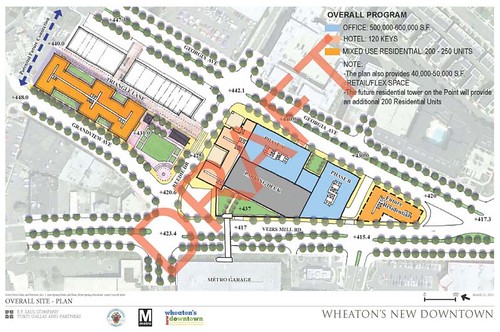
Draft plan for downtown Wheaton, Winter 2011
Draft site plan for the redevelopment of the Metro bus turnaround and Parking Lot 13 in downtown Wheaton.

In yesterday's Gazette, County Executive Ike Leggett says the only way to revitalize downtown Wheaton is by giving $40 million in public funds to developer B.F. Saul, which already has the rights to build on several county-owned parcels in the area:

“Don't bemoan the fact that we're going to make an investment,” Leggett said. “You have to make an investment, otherwise it would have worked already and it has not.”

Maybe I misread this statement, but it sounds like Leggett's saying that Wheaton is so awful we have to pay people to build here. This isn't the first time we've heard this line. But it raises a few questions:

- Is the kind of development Montgomery County wants to see in Wheaton, like high-end offices, the kind of stuff the market wants in Wheaton? (Check out this draft plan from B.F. Saul, shown above.) Are there other kinds of development (I don't know what) that may be more economically feasible, but haven't been considered?

- Are developers actually scared to build in Wheaton? And if so, is it because of financing, or because of other factors? For instance, are they worried about access to existing activity centers like Bethesda or Rockville, or the area's reputation (real or perceived) for crime? Or the difficulty of obtaining a liquor license in Montgomery County, which makes it difficult restaurants to open?

- And if we really need to "invest" public funds in Wheaton, should it go to a large developer, or to local businesses? This is the question raised by the Coalition for the Fair Redevelopment of Wheaton (an offshoot of the Latino Economic Development Corporation), a coalition of area nonprofits that includes the Latino Economic Development Corporation, which wants to see a Community Benefits Agreement as part of the county's deal with B.F. Saul.

I'm not totally sure if I'm down with the Coalition's list of priorities, but I agree that the solution or "fix" for downtown Wheaton is a little more complicated than the County Executive allows. Clearly, private development is already happening in Wheaton, albeit with some county help: the Leesborough project on the former site of Good Counsel High School, the Exchange, which will include a new Safeway, and the renovation of the 1960's-era Wheaton Place apartments on Amherst Avenue, now called the Encore. All of these projects suggest that Wheaton isn't really a lost cause, and that even without $40 million, the downtown would probably continue to grow and improve on its own.

Of course, one developer who's been investing in Wheaton without much help from the county has been Leonard Greenberg, who I wrote about last week for his claim (though it wasn't the first time I've heard it) that Wheaton could be "the next Adams Morgan." Earlier this week, I had a lengthy phone conversation with Greenberg, who asked to give his side of the story.

Come back tomorrow for a detailed look at Greenberg's work, his ideas for Wheaton, and one possible reason why developers have shied away from the area.

Monday, January 7, 2019

here are 13 reasons why Montgomery County has to make budget cuts this year

Montgomery County will soon start working on its budget for next year, and officials already expect that they'll need to make big cuts. While the county's population is growing, its tax base has been shrinking, which means that we're trying to pay for more services with less money. How did this happen? Here are several reasons.

1) 6116 Executive Boulevard

6116 Executive Boulevard
This Montgomery County office building has been totally vacant for five years. All photos by the author unless noted. 

This eight-story building, built in 1989, has been totally vacant since the National Institutes of Health left in 2013. As a result, its value has fallen 64% over the past decade and the building went into foreclosure in 2014 because the owners weren't collecting rent. It's one of 19 office buildings in Montgomery County that are either fully vacant or will be soon, all of which are outside the Beltway.

2) One Discovery Place
'Suburbia'
Discovery Communications' soon-to-be-former headquarters.

Twenty years ago, Discovery Communications moved from Bethesda to Silver Spring and helped usher in downtown's revitalization with a huge new headquarters that consumed four blocks and employed 2,500 people. However, they've slowly been shedding workers, and will move from Montgomery County to Tennessee and New York next year, with about 200 people remaining in Silver Spring. While the building has a new owner, no new tenants are on the horizon.

3) White Flint Mall


This was Montgomery County's fanciest mall, and it was slated to become a fancy open-air town center until department store Lord & Taylor sued the Lerners, which own the mall, for knocking it down–and they won. More recently, the county offered the 45-acre property for Amazon's new headquarters, and we know how that went. Today it's a big pile of dirt, though Lord & Taylor is still there.


Tuesday, December 6, 2011

offices aren't enough to turn downtown wheaton around

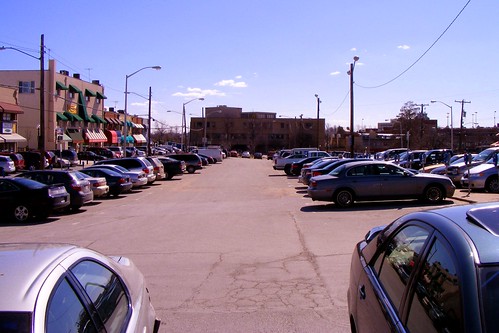
Wheaton Lot 13
Moving Park and Planning here won't help Wheaton much.

County Executive Ike Leggett says the best way to kick-start the revitalization of downtown Wheaton is by moving the Park and Planning Commission there. Will government offices be enough to get the ball rolling? Past experience says it's unlikely.

In October, the Commission received a $200,000 grant to study moving its offices. Its 400 employees work at three offices in and around downtown Silver Spring, including their headquarters (we call it "the Fortress of Planning") at 8787 Georgia Avenue, which dates to the 1950's and is both cramped and obsolete. Eight years ago, the department proposed building a new headquarters on the site called SilverPlace, but it stalled due to a lack of funding.

Enter developer B.F. Saul, which wants to redevelop six county-owned properties in downtown Wheaton totaling eleven acres. They propose building a 120-room hotel, 40,000 square feet of retail space, between 250 apartments, in addition to 900,000 square feet of office space. B.F. Saul and the county are reaching out to government tenants, like the Park and Planning Commission, to fill those offices.

Not everyone's convinced a market for offices in Wheaton even exists. Downtown Wheaton's not too close to established job centers, and its 10,000 current workers pale in comparison to other places throughout the county, such as Bethesda-Chevy Chase (87,000 jobs), Rockville (74,000 jobs), and even Silver Spring (38,000 jobs). Previous visions have instead focused on entertainment or housing in the downtown, while strip mall developer Leonard Greenberg complained Wheaton couldn't support offices back at the height of the real estate boom in 2006.

Even if you could build and rent high-end offices in Wheaton, they won't do much for the local economy. As Richard Layman has pointed out, office workers don't spend much and don't go to a variety of stores.

A rule of thumb is that one worker needs about 250 square feet, so with 900,000 square feet of office space, we can assume that 3,600 people will work there. Retail consultant Robert Gibbs says one worker can support 2 square feet of retail, meaning they'll only be able to support a space of 7,200 square feet, about half the size of a CVS. Gibbs says they can also support 5 square feet of restaurant space, which would equal 18,000 square feet. By comparison, a typical "quick-service restaurant" like Noodles & Company or Chipotle needs about 2,000 square feet, and a sit-down place needs about 6,000 square feet.

It would take 3,600 office workers to keep a Red Lobster, a few Chipotle-like restaurants and half a CVS in business. So how are 400 Park and Planning workers supposed to revitalize Wheaton?

Leasing Sign, Triangle Park
Empty stores on Ennalls Avenue in downtown Wheaton.

We've seen the folly of relying on office tenants, especially government offices, to "fix" an area. In 1986, the Reeves Center was supposed to revitalize U Street with an influx of D.C. government workers, but it really took lots of new residents to turn the neighborhood around. At University Town Center in Hyattsville, the presence of federal agencies wasn't enough to prevent shops and restaurants from closing. Though Alexandria hoped the Patent and Trademark Office would bring Barnes & Noble to town, instead they got fast-food places. (So many, in fact, that my friend who lives there calls it the "Sandwich District.")

The same Planning Department that Ike Leggett wants to move to downtown Wheaton also produced the recently-approved Wheaton Sector Plan, which recognizes that the area can't draw and won't support  a lot of office development. As a result, the plan allows for just 3,000 additional jobs, not just in office buildings but in all fields of employment.

Meanwhile, it calls for 6,600 new homes in downtown Wheaton. Housing would do a lot more to turn Wheaton around, because unlike office workers who are only obliged to be there 40 hours a week, residents are there almost all the time, meaning they can spend a lot more money.

wheatonsafewaygaelevation
New apartment buildings like the Exchange, currently being built at Georgia Avenue and Reedie Drive, could help downtown Wheaton more than offices.

Another boost might come from the new campus of Ana G. Mendez University, a Puerto Rico-based institution that will start offering classes at Westfield Wheaton Wheaton Plaza this winter. The school offers associate's, bachelor's and master's degrees to working adults and classes offered in both English and Spanish. Though its projected enrollment of 600 students within five years means it won't have a big impact on local businesses, the school's evening and weekend classes will bring people to the area at times when most office buildings are dark.

Promoting office development in Wheaton is a good thing. I've written before that it might be a good location for companies with back-of-house operations that don't need a fancy Bethesda address. At the same time, it's not a justification for moving the Park and Planning Commission out of Silver Spring especially when its departure will just leave a vacant lot with no prospects for reuse.

Offices are just part of a strong, vibrant community, and it'll take a lot more to turn Wheaton around. I hope the County Executive is patient enough to embrace all forms of development there, rather than going after a perceived "quick fix."

Wednesday, November 17, 2010

meeting on downtown wheaton's future tonight

New Wheaton Safeway Rendering
Reader purplemoonshoes and Wheaton Calling remind us that there's a meeting tonight to discuss the future of downtown Wheaton. Local developer B.F. Saul's been given the reins to build in an 8.2-acre area around the Wheaton Metro station, bounded by Veirs Mill Road, Georgia Avenue, and Reedie Drive. While Robert Wulff of B.F. Saul told the Gazette that you won't see shovels in the ground until 2015, he's looking forward to the "listening tour" the developer, the county and WMATA are kicking off to get the community's opinions.

Certainly, there's been no shortage of meetings on the revitalization of Wheaton over the past several years, and it's understandable for local stakeholders to feel tired of the whole thing. After all, why wait for your new downtown when one's already waiting for you down the road? Yet this is the closest we've come to major changes in Wheaton in a long time, ignoring the rather disappointing new strip malls being built by the unscrupulous developer Leonard Greenberg.

After all, an eighteen-story high rise (above) has already been approved on the site of the Safeway at Georgia and Reedie, something that would've been unthinkable five years ago. There's no better time to take up your signs and pitchforks and start clamoring for something more.

Once again, that meeting is tonight at 7pm at the Crossway Community Center, 3015 Upton Drive in Kensington. B.F. Saul, WMATA and the county even have a nifty website with maps and more information.

By the way: Are you the type that thinks eighteen stories is too much for downtown Wheaton? I thought about the same myself and, through the magic of Photoshop, decided to see what it would look like with just nine floors.

lowrisegaelevation

Friday, October 12, 2012

glenmont arcade reveals MoCo's commercial history

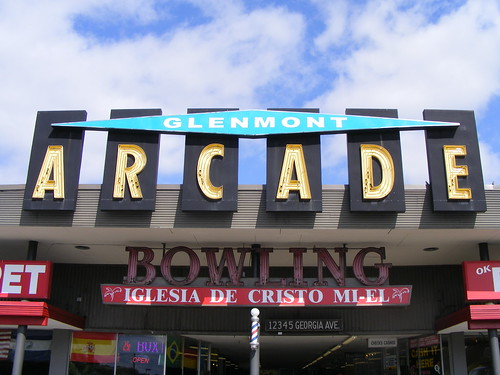
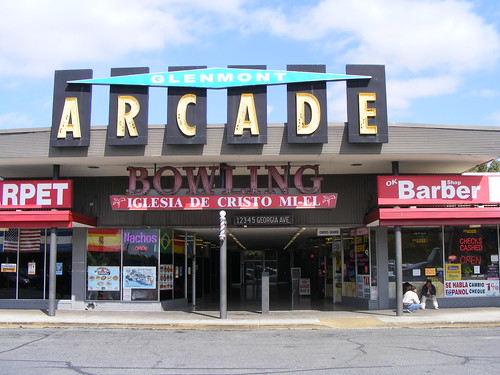
Glenmont Arcade Sign
How much longer will this be around?
With its distinctive sign, the Glenmont Arcade was a local landmark and an emblem of Montgomery County's suburbanization after World War II. But as the county prepares to redevelop Glenmont, will it still have a place in the community?

Located in the Glenmont Shopping Center at Georgia Avenue and Randolph Road, the Glenmont Arcade is like a little mall-within-a-strip mall. The arcade was built in 1952 by the Glenmont Land and Development Company, which built many of the surrounding residential neighborhoods. It was the first part of the Glenmont Shopping Center, which was completed in little pieces over the following decade.

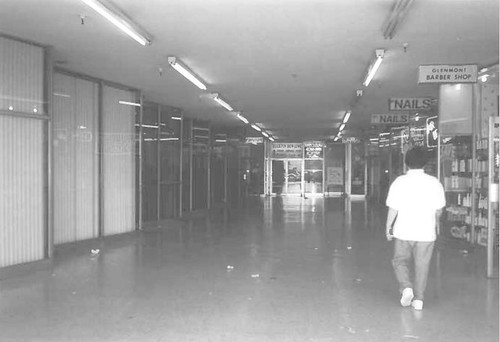
The arcade consists of a short, enclosed hallway lined with shops that ends at the entrance of a bowling alley, a beloved local institution that closed in 2002. Unlike a mall or other arcades where the shops are placed in a straight line, each of the shopfronts are angled towards the parking lot, so you can see what's inside without actually having to go inside. According to this 2001 study of the site's history, the arcade originally contained 11 "one-person businesses" in small shops.

Glenmont Arcade, 2001
The Glenmont Arcade in 2001. Photo from Anne Bruder, Maryland State Highway Administration.
Though I've lived in Montgomery County most of my life, I'd never actually been to the Glenmont Arcade before last weekend, when I talked to Scott Whipple, a historic preservation planner at the county's Planning Department, at their open house. He's particularly interested in commercial areas from the mid-20th century, like the Flower Shopping Center in Long Branch, which is currently being studied for preservation.

"It's not often that we get to do something like that," he said. There aren't many remaining examples of architecture from the 1950's and 60's; many buildings have either been torn down, remodeled beyond recognition, or under constant threat from the wrecking ball. One of them is the Glenmont Arcade, which could be demolished under a new plan the county's working on.

Unassuming as it may seem, the Glenmont Arcade comes from a long line of shopping arcades, which first originated in Paris over two hundred years ago before coming to the United States at the turn of the 20th century. They first appeared here in 1925, when the Chevy Chase Arcade was built on Connecticut Avenue in the District. Arcades also served as the inspiration for modern shopping malls like Wheaton Plaza, which was built 7 years after the Glenmont Arcade, and other strip malls around the country.

'Checks Cashed'
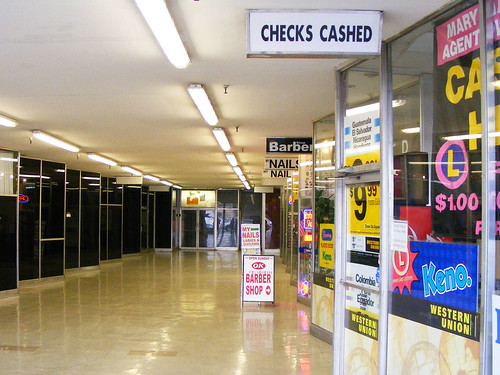
Inside the Glenmont Arcade today.
Stepping inside the arcade feels kind of like a time capsule. There are linoleum floors, bright-white and shiny, though they replaced the original terrazzo floors. Fluorescent lights reminiscent of a high-school cafeteria hum quietly. There's an old address sign (for "12345 Georgia Avenue"), which appears to have been hand-painted and a barber pole rotating slowly outside the barbershop that's been there since the arcade opened.

Nonetheless, the space has seen better days. The bowling alley was eventually replaced by a church, which papered over their entrance; all of the shops on the left-hand side were combined into one restaurant, which also papered over their windows. And the two storefronts at the very back, which were probably the most sought-after spaces when next to a busy movie theatre, are now both empty. There are no people in the arcade, save for four teenagers hanging out and smoking, and the occasional customer walking from a check-cashing place out to the parking lot.

Outside, I try to take a photo lining up the Glenmont Arcade sign with the water tower a few blocks away, when I'm approached by a guy wearing oval-rimmed glasses and three coats. He asked what I was doing. "I like the sign," I replied.

"Yeah, it's a nice sign," he said. "It's a shame what happened to the Arcade," he adds, voice trailing off as he shuffles away.

Glenmont Arcade Head-On
Men hang out in front of the Glenmont Arcade, which has seen better days.
The Planning Department is currently working on the Glenmont Sector Plan, which will chart a course for turning Glenmont's business district around. However, the Planning Board chose not to study the Glenmont Arcade for its historical merit. Since the Glenmont Shopping Center was built in several pieces, it's broken up into 15 different lots and has 13 different owners. That will make both redeveloping the shopping center hard, but preserving any part of it even harder.

The arcade itself has just one owner, Greenhill Capital, a Bethesda-based company that owns a third of downtown Wheaton. There are no current plans for redeveloping the Glenmont Shopping Center, though Greenhill may be sympathetic to calls for preserving all or part of the arcade. Company head Lenny Greenberg, who I interviewed earlier this year, has stressed the importance of preserving Wheaton's local culture. When he redeveloped the Anchor Inn, a once-popular restaurant there, he chose to save the 1950's-era sign.

Whipple told me that there's "nothing like" the Glenmont Arcade in Montgomery County, and he's right. As he wrote in a recent blog post, it's better to "reuse buildings than to throw them in the trash." Do we have to throw the Glenmont Arcade in the trash to improve this community? We won't know unless we give this building a fair shake and at least study it for historic preservation.

Check out this slideshow of the Glenmont Arcade, then and now.