Thursday, November 4, 2010

before langley park was langley park

langley park shopping center drawing, 1954

I'm currently writing a paper about the history of shopping centers before the rise of the shopping mall (to complement the paper I wrote about history of shopping malls three years ago). One of the major experts on this topic is George Washington University professor Richard Longstreth, who uses this drawing of a proposed shopping center in 1954 for his article "The Diffusion of the Community Shopping Center Concept During the Interwar Decades."

Look familiar? That's the Langley Park Shopping Center, located at New Hampshire Avenue and University Boulevard, while on the drawing board. At the time, Langley Park was a new, if modest, neighborhood at what was still the edge of suburban Montgomery and Prince George's counties. The shopping center was designed by architects Abbott, Merkt & Company, then a nationally-renowned firm in the field of shopping center design.

Here's a bird's-eye view of the shopping center today from Bing Maps:

Wednesday, November 3, 2010

maryland's got that purple pallor (still)


Four years ago, I called former Governor Ehrlich's office to congratulate him on losing. Much as I would like to do it again, I'd rather celebrate the legacy of his single (and now only) term in office. Not the InterCounty Connector, of course - the Purple Line, which got pretty roughed up by Ehrlich but is still muddling on under Governor O'Malley.

Here's the video I made for Purple Line NOW!'s fundraiser back in March, featuring a slate of elected officials from Montgomery and Prince George's counties who all support the project - and, thankfully, were re-elected (or in the case of Karen Montgomery, promoted) yesterday.

Tuesday, November 2, 2010

fun at the arcade

It's nice to encourage the creation of fun, walkable urban places, but it's not always fun to walk around when it's really hot or really cold or raining outside. There's one thing the mall will always have over downtown, and that's a climate-controlled environment. But urban places can strike a nice compromise by creating arcades, or covered sidewalks.
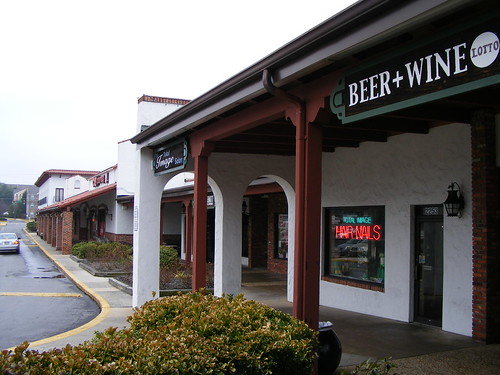
Arcade, Plaza del MercadoMost strip shopping centers have arcades, like this one at Plaza del Mercado in Layhill. This is nice: you can walk here and be sheltered from the sun, rain or snow. But you can't really occupy this space. There are no benches or tables for sitting or eating, and like most shopping centers, loitering is generally discouraged.
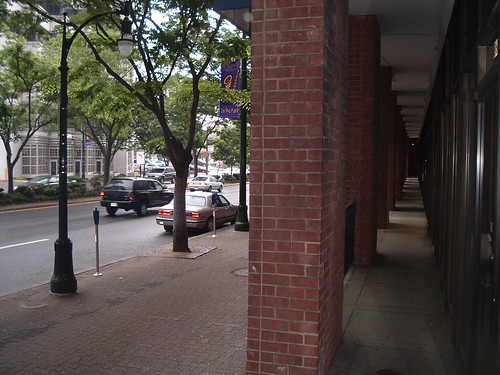
Twin Towers ArcadeThis is the arcade under the Twin Towers Apartments at Georgia Avenue and Fidler Lane in downtown Silver Spring. It's a pretty miserable space, barely wide enough to walk through and very dark. Note that it's also elevated above the sidewalk, meaning that passersby can't really look in any of the shop windows (are there even still shops here anymore?)

Traditionally, an arcade would cover the entire sidewalk, not just a portion of it, as it's meant to be a public space. Why doesn't it here? Perhaps zoning, or the Department of Public Works - fearful that the building would prevent them from widening Georgia Avenue in the future (God forbid) prevented any portion of the building from extending over the property line.
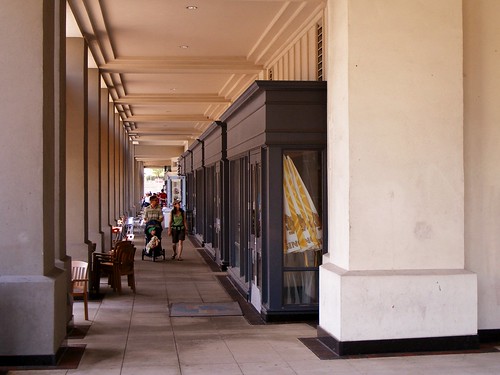
Arcade, East Montgomery AvenueThis arcade is along East Montgomery Avenue in Rockville. The building behind it houses several shops and restaurants and the Regal 16 Cinemas and, as a result, the space has lots of life and activity. It also covers the entire sidewalk, creating a sort of long, outdoor room. There's space for tables and chairs, for benches, with ample room left over for walking and window-shopping.

Long before Rockville Town Square opened, this arcade became a major hangout for local kids and remains so today. The enclosure not only provides shelter from the elements, but it creates a nice, intimate space for interaction. We'd do well to create more arcades like it.
Monday, November 1, 2010

"in the beginning, there was miracle whip, one kind of cheese, and fish came in sticks"

Pho Comida Tipica

Earlier this year, I met with a group of community members who were very concerned about the still-ongoing Kensington Sector Plan. The average age of the ten or so people there was well over 50, and they were uniformly white. They all lived in Kensington, except for one woman who lived in neighboring Capitol View Park - "We have a Silver Spring address, but we're really more like Kensington," she insisted.

Though many of them lived a few minutes' drive from downtown Wheaton, none of them could admit to having been there in years. "There's nothing to eat there," one lamented. "It's too crime-ridden and multi-ethnic," another added.

Of course, anyone with the sense of sight or smell can tell there are lots of restaurants in Wheaton. Most of them, perhaps with the exception of the new Wendy's at Westfield Wheaton Wheaton Plaza, do not serve American food. But for many people in Montgomery County, who grew up eating Wonder Bread and meatloaf, the dining options in Wheaton may seem strange, even scary.


This video from Kids in the Hall, one of my favorite sketch-comedy shows, reminded me of that mindset. Even though it's nearly twenty years old, it's still reflective of how some people in Montgomery County think of food and, by extension, their neighbors who don't look like them.