Showing posts with label takoma park. Show all posts

Thursday, December 17, 2020

two bills could bring rent control and “missing middle” homes to montgomery county

If you’ve tried to find a home in Montgomery County recently, you know things are rough. The county has a housing shortage, with 23,000 homes needed in the next 10 years. The median home price in the county is a half-million dollars, 14% more than last year. Rents are rising more slowly, but some tenants still received 33% rent increases this year. An estimated 20,000 households are behind on rent due to pandemic-related financial hardship, and could get evicted.

Montgomery County could legalize "missing middle" homes, like this triplex and duplex in Silver Spring, within one mile of Metro stations. All images by the author.

This year, county leaders have hustled to find solutions: capping rent increases during COVID-19, tax incentives to build homes at Metro stations, and getting rid of the housing moratorium, which blocked new homes near crowded schools. Last week, County Councilmember Will Jawando introduced two bills dubbed “More Housing for More People” that could go even further.

Friday, May 8, 2020

battles over school boundaries divide candidates for montgomery county school board

Most years, school board races in Montgomery County can be pretty quiet. This spring, a study about school boundaries in this affluent yet diverse county have made the Board of Education election an explosive debate about race and class in public schools. It may be the most important race on the ballot.

Students outside Paint Branch High School in 2013. All photos by the author.

Montgomery County Public Schools (MCPS) comprise a very diverse school system: 72% of MCPS students are non-white, and the system has more students on free or reduced lunch than DC Public Schools has students. It is also growing rapidly. Although it is already the largest school system in Maryland and serves over 165,000 students, more than 2,000 additional students have enrolled each year for the last several years.

The Montgomery County Board of Education oversees MCPS and its nearly $3 billion budget. Eight of its board members are elected in something like a jungle primary: anyone from any political party can run, and the top two vote-getters in the June 2 primary will go to the general election in November. There are three seats up for grabs, one at-large seat and two district seats, which everyone votes for regardless of where they live. Meanwhile, middle and high school students nominate and elect a student as the ninth member, which they’ll vote for on May 20.

We’re talking about school boundaries

School board members in Montgomery County are considered part-time, and receive a very small salary to make decisions from the converted auditorium of what was the county’s black high school in the 1950s. But they have a lot of power. In 2018, student board member Ananya Tadikonda proposed that the school board look at school boundaries, which in some areas haven’t changed in 30 years. The school board hired a consultant, and their research  — which began last fall — affirmed things that many parents or students already knew or assumed:


Tuesday, September 11, 2018

montgomery county says no new homes in silver spring because the schools are full

For decades, school planners assumed that families would move out to the suburbs once they had kids, and made projections for where and how to build new schools based on that. But as that trend begins to shift, Montgomery County is finding school enrollment harder to predict, which creates new challenges in and out of the classroom.

Paint Branch High School. All photos and maps by the author.

Like many places, Montgomery County Public Schools predicts how many students will enroll in local schools for the next several years, and if a school will have enough room or if it’ll be over capacity. Like many places, those projections, along with traffic predictions, can be used to stop new development.

This summer, Montgomery County’s planning department declared a “moratorium” in several areas, including Silver Spring, Wheaton, and part of Bethesda, because some schools are projected to have more students than there is space. This halts new development in those area until enrollment drops, the boundaries are moved, or additional classroom space can be found.

What families want is changing

How did this happen? In a recent Washington Post story, reporter Katie Shaver notes that Montgomery County Public Schools didn’t anticipate changes in how and where families want to live. The school system is seeing a lot of growth in close-in areas like Silver Spring and Bethesda, because more families want to live in urban, walkable neighborhoods where they can walk to shops, jobs, or transit.

These communities are also becoming very expensive because there’s a lot of demand to live there, and outside of a few areas, very few homes are being built there. As a result, many parents can’t afford to buy a house and are instead renting apartments, living with relatives, or even doubling up with other families to make ends meet.


Tuesday, January 30, 2018

this video shows you how to find the right MCPS school for your family

There are over two hundred public schools in Montgomery County, and if you're picking a place to live, it often means comparing the schools in different neighborhoods. How can you find the right school for your family? This video shows you how.


Recently, I interviewed Montgomery County board of education member Jill Ortman-Fouse about the best tools for learning about local public schools. While websites like GreatSchools.com assign each school a point rating based on test scores, they don't tell the full story.

Instead, Jill recommends taking a more hands-on approach. If you're curious about a school, schedule a visit, meet with the principal, or talk to neighbors whose kids attend that school. There are also a variety of online resources, including school websites, Twitter accounts, and Facebook pages, that list events going on at each school and can provide a first-hand look at what happens there.

And of course, Montgomery County Public Schools has a website with lots of information as well. Schools at a Glance is their annual report of data about every school in the system, with everything from test scores to teacher statistics to building information.

Are you trying to pick a school in Montgomery County right now? Have you picked one in the past? What tools did you use?

Saturday, December 30, 2017

ten very silver spring things that happened in 2017

Outside of East County, 2017 was a tumultuous and often disturbing year. But here in East County, we found opportunities to be grateful, to celebrate, and to come together with our families, friends, and neighbors to make our corner of the world a better place. In keeping with our annual(ish) tradition, let's take a look back at the big stories of the past year here in Silver Spring:

IMG_6403
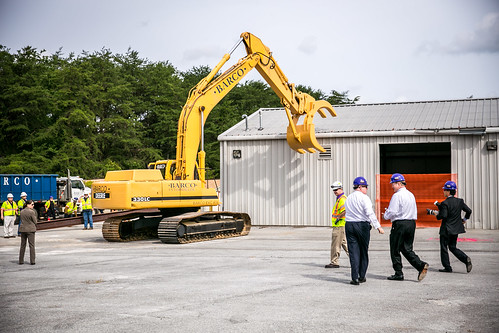
That's Governor Larry Hogan, knocking down a building at the Purple Line groundbreaking. Photo by Aimee Custis on Flickr.

  1. The Purple Line is officially a thing. After a 2014 lawsuit was finally resolved, the light-rail line between Bethesda and New Carrollton finally broke ground in August at a ceremony where Governor Larry Hogan used an earthmover to tear into a building. Construction is well underway in Silver Spring: trees are coming down on the Capital Crescent Trail, the Spring Center shopping center has been roped off and stores have moved out; and Arliss Street in Long Branch will be closed for the next few years. While the work is disruptive, it’ll be worth it. To see all the places the Purple Line will connect, my friend Sean Emerson and I took a trip on the route this summer, which you can watch.
  2. MoCo’s biggest campaign in a long time. Voters approved term limits last year, which means that for the first time ever, three County Council seats and County Executive are all open at the same time. Not only did the 2018 campaign season start early (many candidates announced last summer), but it’s huge, with over 40 people either running or considering a run for County Council alone. To say this is a consequential election is an understatement, as it could bring in a number of new, fresh faces to local politics - or take us a big step backward.

Friday, November 17, 2017

marc elrich compares purple line development to "ethnic cleansing"

As the Purple Line begins construction, many are worried about the potential impact on working-class immigrant neighborhoods. How can we ensure that people can afford to stay in their neighborhood as the land around the line grows in value?

Two candidates for Montgomery County executive presented wildly different visions at a recent forum, with one, Marc Elrich, accusing the Planning Board of promoting "ethnic cleansing" along the corridor.


The 16-mile light rail line, which broke ground in August, will run between Bethesda in Montgomery County and New Carrollton in Prince George’s County. Its 21 stations will serve a series of inner suburban neighborhoods with large working-class, minority, and immigrant populations including Long Branch, which is located near the border of the two counties in Silver Spring.


Monday, October 2, 2017

there's a mismatch between the houses DC area buyers want, and what's on the market

Ten years after the Great Recession, home prices in many parts of the Washington region have reached or even topped their pre-recession peaks. But will this trend continue? A look at a wide sampling of real estate websites says yes – but the mismatch between what buyers can afford and what kinds of homes are available could change that.

New townhomes in Rockville. Photo by the author.

The conventional wisdom appears to say we’re not heading into another recession anytime soon. However, while Millennials are finally settling down and ready to buy homes, they will struggle to afford homes in places like DC due to high costs. In the coming years, climbing home prices will stagnate because buyers' income levels increases aren’t keeping pace with costs.

These three things suggest a recession isn’t coming soon

Real estate downturns tend to happen pretty regularly, notes real estate entrepreneur and Harvard Extension School lecturer Ted Nicolais. Going all the way back to the 19th century, real estate downturns take place about once every 16 to 18 years. Since the last recession occurred between 2006 and 2008, he predicts we can expect another one between 2022 and 2024.


Monday, August 28, 2017

as the purple line breaks ground, let's take a look back

I started this blog 11 years ago to, among other things, talk about the Purple Line. And after a long fight that will one day make a great book, the 16-mile light rail line between Bethesda and New Carrollton finally breaks ground this morning.

purple line in bethesda
A 2010 rendering of the Purple Line in downtown Bethesda from the Maryland Transit Administration.
I'm on my way to cover the groundbreaking (check back this afternoon for a recap). But in the meantime, let's look back at how JUTP has written about this project. Of the 1735 posts published here, about 281 have included the words "Purple Line." Here's an (incomplete) list of the highlights.
  1. This project has been in the works since 1986! Here's how the Purple Line got its start.
  2. These maps show how the Purple Line will dramatically improve mobility around the DC area, particularly for folks in eastern Montgomery County and Prince George's County.
  3. I took a walk with some East Silver Spring neighbors along a potential route in 2006. The following year, I walked the Capital Crescent Trail, part of which will be the Purple Line's route, with both supporters and opponents.
  4. More than a few politicians have taken the bus as a campaign stunt to promote the Purple Line. We rode the J2 with Steve Silverman in 2006, and again with Al Wynn in 2007.
  5. Did you know there's a musical about the Purple Line? In 2008, we interviewed Paul Stregevsky, writer of "Tracks."
  6. In 2008, I convinced my then-roommate Chris to take transit from College Park to Rockville to illustrate how much we need the Purple Line. It was quite a day.
  7. The new Silver Spring Library actually has its own Purple Line stop! Here's a look at the design process from 2010.
  8. The Purple Line will pass through several Montgomery County neighborhoods, and could bring some major changes. Here's what community members in Long Branch, Lyttonsville, and Chevy Chase Lake had to say about it.
  9. The town of Chevy Chase has been a vocal opponent of the Purple Line for decades, but many town residents weren't having it anymore. 
  10. Supporters and opponents squared off at a 2013 event where Governor O'Malley first announced state funding for the project.
  11. President Obama announced federal funding for the Purple Line in 2014, and it looked like full speed ahead.
  12. After his election in 2014, Governor Larry Hogan put the Purple Line on hold, but decided to move forward with a few cost-saving changes, like fewer trains and redesigned stations.
Today, many many people who helped make the Purple Line a reality will be celebrating. But one person won't be here: Harry Sanders, who passed away in 2010. We wouldn't be here today without the decades of hard work and quiet persistence Harry poured into this project, along with his wife Barbara and son Greg, who's currently the president of Purple Line NOW!

Harry was a model for citizen activism, and I continue to learn from his example. I can't say it enough: thank you, Harry, for everything.

Thursday, August 3, 2017

since the great recession, east county's real estate market has diverged

Nearly a decade ago, the Great Recession wiped out house values across the region. Today, booming close-in, urban areas have basically recovered. But many further-out, suburban communities are still struggling. Here’s one example from eastern Montgomery County.
McMansion, Meadowsweet Lane, Sandy Spring
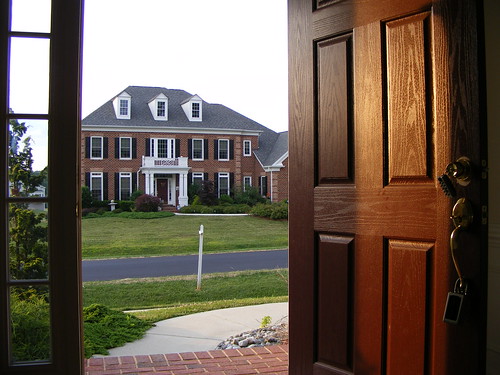
A 2000s-era subdivision in East County. Many of these homes lost value during the Great Recession and have yet to recover. All images by the author.
I grew up in downtown Silver Spring at a time when people were still moving away from urban centers. Twenty years ago, my neighborhood consisted of abandoned buildings and boarded-up stores, and in 1998, my parents started looking for houses outside the Beltway in places like Olney and Burtonsville, which seemed ascendant at the time. Besides, we were already driving to shop there. My parents found a little split-level house a mile from a new shopping center with a Target, Chipotle, and Starbucks.

My high school, Blake, opened that same year, and most of my friends’ parents seemed to have made the same move from Silver Spring and Takoma Park. New subdivisions were popping up with big, luxurious houses, lush lawns, and names like Briarcliff Manor and Hampshire Greens. In the older neighborhoods, houses were sold for the land so big McMansions could rise in their places.
I remember going to a party at the end of high school where we sat in a circle bragging about how much our parents’ houses were worth. I was the odd one out because my parents’ house had appraised recently at a measly $500,000.
Abandoned House in Tanglewood
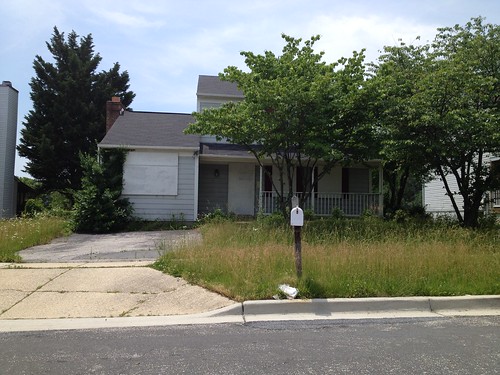
An abandoned house in an East County subdivision in 2014.
But it wouldn’t last; the Great Recession hit East County pretty hard. Burtonsville Crossing, the shopping center where we hung out in high school, is almost completely vacant. Some of my parents’ neighbors, unable to make ends meet, resorted to running illegal auto shops out of their homes, inviting relatives to move in, or renting out their basements.

Meanwhile, downtown Silver Spring had a comeback as more people sought urban living. A major redevelopment project along Ellsworth Drive brought restaurants, shops, movie theaters, and a Whole Foods. Montgomery County poured millions into new public facilities, including a library, the Civic Building, and Veterans Plaza. In response, private developers built thousands of new apartments and condominiums, including the building I live in now, a converted bottling plant that was still operating when I was a kid.

Here's how the real estate market in East County has changed

The real estate market shows how Silver Spring has bounced back from the recession while East County has struggled. Here’s a graph showing average home values in 2012 and 2017 as they compare to 2007 levels. It shows the two zip codes inside the Beltway, 20910 (Silver Spring) and 20912 (Takoma Park), and seven zip codes (mostly) outside the Beltway: 20901 (Four Corners), 20902 (Wheaton), 20903 (Hillandale) 20904 (Colesville, Fairland), 20905 (Cloverly), 20906 (Aspen Hill) and 20866 (Burtonsville).

How 2012 and 2017 home values in East County stack up to 2007 levels. Click on all of these graphs to enlarge them.

Home values all over East County fell during the Great Recession. In zip codes 20903 and 20906, home values fell by nearly half between 2007 and 2012. This year, average home values in the eight zip codes outside downtown Silver Spring are 71% to 85% of what they were a decade ago. But in zip code 20910, which contains downtown Silver Spring, values are actually a little higher than they were 10 years ago.

Home values inside the Beltway have recovered, but remain lower elsewhere. 

Homes inside the Beltway have been more valuable than those outside it for a while now. But the gap in home values has increased over the past 10 years. This graph shows the average home sale price per square foot, as a way to even out differences between houses of different sizes and styles. In the summer of 2007, the price per square foot in zip codes 20910 (Silver Spring) and 20866 (Burtonsville) were fairly close, at $363 per square foot and $304, respectively. Today, they’re $384 and $257; in other words, a difference of 50%.

Those who bought homes in East County before the housing boom, or at the bottom of the market, may have recovered their investments or even made a little extra. But those who bought at the top of the market saw their gains wiped away.
Homes in far-flung zip code 20905 linger on the market longer than homes closer in.

Another measure of demand is the number of days a house sits on the market. During the Great Recession, houses across East County languished for months due to a lack of buyers. In early 2008, the average house in zip code 20905 sat on the market for nearly six months. Demand returned, but not equally. In early 2017, homes in the 20910 zip code spent just 22 days for sale, compared to 59 days in 20905.

There's a huge opportunity in East County, but things need to change

Like many aging suburbs, East County is caught in the middle. The kids I grew up with have either moved to urban areas closer in, or moved farther out to newer suburbs in Olney or Howard County, aided by new highways like the InterCounty Connector that made it easier to commute longer distances. East County is a long drive from Montgomery County’s biggest job and shopping centers, which are all along Rockville Pike and I-270. And the local schools struggle with a negative reputation compared to their counterparts in more affluent areas.
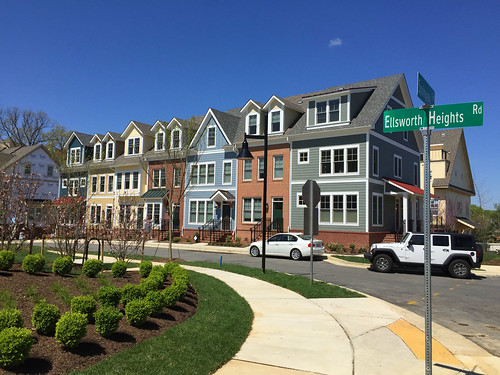
Corner of Springvale Road and Ellsworth Heights Drive
New townhomes in downtown Silver Spring, where home values are higher than they were in 2007. 
Yet the fact that homes here are much more affordable than in other parts of the county could be a big opportunity. Nationwide, some three million Millennial homebuyers have been shut out of the housing market because of high prices and a lack of supply. Millennials are open to living in suburban areas, but want stuff they can walk or bike to.

Providing that lifestyle in East County is imperative to drawing people and investment to this area, just as it did in Silver Spring. Montgomery County’s plans to create a walkable town center and research park in White Oak and a new village center in Burtonsville will bring the amenities people want, while a new BRT line on Route 29 will provide faster, more reliable transit. Combined, the two will give East County access to jobs, shopping, and economic opportunities.

East County has waited decades for the kind of prosperity the rest of Montgomery County takes for granted, and at great cost. Hopefully residents won’t have to wait much longer.
Tuesday, July 25, 2017

this 1958 ad shows how yesterday's luxury apartments became today's affordable apartments

There are thousands of new apartments being built around the DC area today, and most of them are high-cost “luxury” apartments. But they likely won't stay that way. A look at 1950s rental ads shows how yesterday’s luxury housing became today’s affordable housing.

Part of the rental ads in the November 18, 1958 edition of the Washington Post. Image from Richard Friend.


Here's a portion of the classifieds of the November 15, 1958 edition of the Washington Post, courtesy of local graphic designer and historian Richard Friend. There are ads for apartments all over the DC area, including a bunch of then-new apartment complexes in Silver Spring and Takoma Park.

Each ad talks about how swanky the apartments are, boasting of features like air conditioning, modern kitchens and bathrooms, private parking, and swimming pools. Just like today, these ads boast that tenants can walk to nearby shops or transit (which would have been the bus; the Georgia Avenue streetcar, which served Silver Spring, would shut down two years later.)


Tuesday, September 8, 2015

another take on which parts of the DC area are "urban" or "suburban"

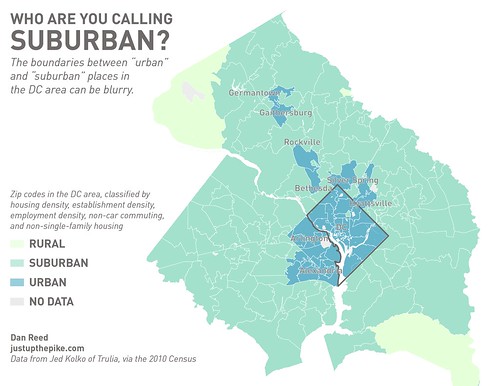
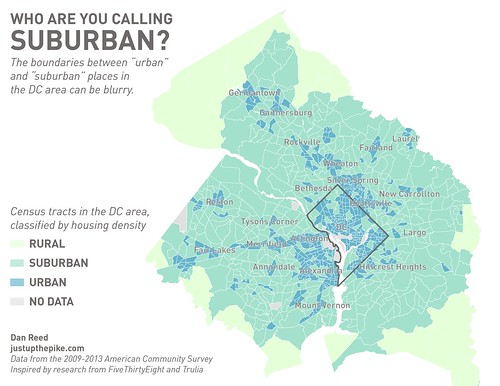
Last month, I used housing density to map the real boundaries between "urban" and "suburban" in the DC area. But what if you took other factors into consideration? This map looks a little different, but still shows that there's more "city" than what's inside the DC line.

Who are you calling suburban? (Jed Kolko's data)
How economist Jed Kolko would classify "urban" and "suburban" parts of the region. Map by the author with Kolko's data.


My maps are based on research from Jed Kolko, chief economist at Trulia, who mapped several other metropolitan areas around the country. He reached out to me with his own data for the DC area, which is available on his website. While I only looked at housing density as a measure of urbanism, Kolko included several other factors, including the density of jobs and businesses, how many people go to work without a car, and the presence of multi-family housing.

Compare Kolko's map to my map below. One big difference is that his analysis only goes to the zip code level, while I used Census tracts. That makes my map is a little finer-grained, focusing on neighborhoods as opposed to larger areas. And while he agrees that there are "urban" places well outside the District, Kolko's analysis finds fewer of them, particularly in Northern Virginia.

Who are you calling suburban? (Updated)
My earlier map, looking solely at housing density.

Kolko classifies all of the District, Arlington, and Alexandria as "urban," even areas that are pretty spread-out and arguably suburban in character, like the Palisades in northwest DC. Like me, he also includes several older communities in Maryland that originally developed around streetcar lines and as a result look very similar to urban neighborhoods in DC, like Hyattsville, Silver Spring, and Bethesda.

My map also identified many newer communities that are gaining more urban characteristics, like White Flint in Maryland or Tysons Corner in Virginia. Kolko includes several of those places in Maryland, but not a single one in Virginia. In fact, he doesn't consider anything in Fairfax County "urban."

I wasn't the only blogger to look at housing density as a measure for urbanism. NextSTL, a St. Louis-area blog, made a similar map and found that "urbanism" can be found on both sides of the city line there too.


What do you see in these maps? What factors do you consider make a place "urban" or "suburban"?

Thursday, July 23, 2015

this map shows which parts of the DC area are really "urban" and "suburban"

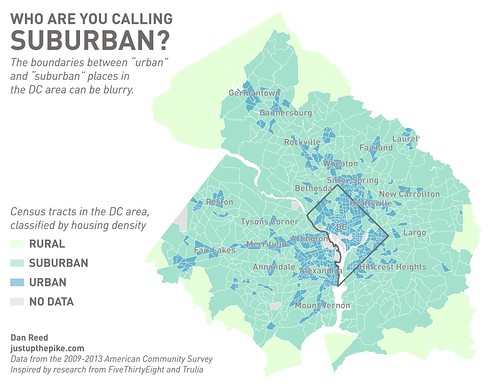
Where does "the city" start and end? Some might say it's the District line. But in reality, the lines between "city" and "suburb" are more unclear than you think.

Who are you calling suburban?
"Urban" (blue) and "suburban" (green) parts of the DC area based on housing density. Map by the author. Click for a high-resolution version.


I got into an argument with someone at a happy hour a few years ago. Why? This dude said I lived in the suburbs, because Silver Spring was outside the District. Even if I was literally 1000 feet from Eastern Avenue.

"But no," I protested, "Silver Spring is an urban place! We have tall buildings! We're a major transit hub! I walk everywhere!" He wouldn't relent, and a normal bar disagreement got way more heated than it needed to be. (Thankfully, nobody got hurt.)

Many people would say the same: DC is "the city," and everything else is "the suburbs." But as our region grows and changes, the lines between "city" and "suburb" can get kind of blurry.

Monday, May 26, 2014

RIP richard jaeggi

The foundation of a place is its local culture: the stories, struggles, and triumphs that those in a community share and cherish. But where does that culture come from? How do we encourage people to be self-aware about their surroundings, to document, create, and ultimately change the course of their world?

'No Human Being Is Illegal'_cropped
An art piece by the Gandhi Brigade on Georgia Avenue in 2007.

It's something that I've thought a lot since I began writing Just Up The Pike nearly eight years ago. But it's also the mission of the Gandhi Brigade, a youth media organization in downtown Silver Spring whose director Richard Jaeggi passed away yesterday. He was an adult with a strong voice in our community, but he gave it to young people who otherwise may not get heard.

The Gandhi Brigade started in 2005, right around the time the revitalization of downtown Silver Spring finally took hold. Their mission was to prepare young people to take part in their communities through the creation of art and media, hence the motto "Youth Media with a Focus."

It was good timing for them, and for Silver Spring, which had newly emerged as a hangout for teens from all over the region. With Richard's guidance, the organization gave those kids access to cameras, art supplies, training on how to use them, and a bully pulpit. From a storefront in the otherwise dead City Place Mall, the Gandhi Brigade has weighed in on everything from skateboarding to gun violence to national immigration policy.

Thus, Richard and the Gandhi Brigade became an integral part of the community and the ongoing debate over the place of young people in downtown Silver Spring. Their annual Youth Media Festival, with an art competition, live performances, and workshops, has taken over downtown streets for years.

There have been occasional missteps, like a 2009 concert on Ellsworth Drive that erupted in fights. But like any good teacher, Richard turned it into a lesson. “I also believe in making mistakes and not giving up and getting it right the second time, or the third time, or the fourth time," he told me.

For a kid, growing up is an iterative process, requiring a willingness to make mistakes and the resilience to get up and try it again. But it's also useful for a community constantly in flux, and sometimes quick to dig in its heels and simply accept things for how they are.

In a posting on the Gandhi Brigade's Facebook page, Richard's family members said that they'll be volunteering at the next Youth Media Festival, returning to the Silver Spring Civic Festival this Saturday, May 31. Silver Spring has a lost a giant, but one who laid the groundwork for more giants to follow. And it's up to us to make sure that happens.

Wednesday, April 2, 2014

see maps of how the purple line corridor is changing

When built, the Purple Line could dramatically improve transit commutes in Montgomery and Prince George's counties. To explore that and other changes the line will bring, researchers created a series of maps including this one of the "commute shed" of each Purple Line station, or how far you can get on transit before and after it's built.

All images from the Purple Line Corridor Coalition.


Tuesday, December 10, 2013

valerie ervin steps down from council; what kind of person should represent district 5 next?

This morning, District 5 County Councilmember Valerie Ervin announced that she's leaving to head the Center for Working Families, a non-profit organization that advocates for social justice issues as they affect families.
2012-11-17 Thanksgiving Parade Silver Spring - Councilmember Valerie Ervin
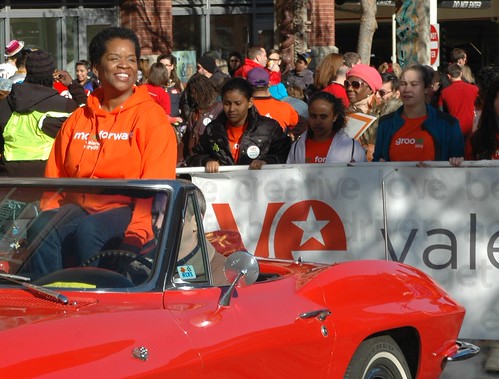
Ervin in the 2012 Silver Spring Thanksgiving Parade. Photo by Edward Kimmel on Flickr.

"After careful reflection and deliberation with my family, friends and supporters, I believe that leading this organization will enable me to have a greater impact on the issues I care about most," Ervin wrote in an email to supporters today. She'll commute from Montgomery County to the center, which is based in New York.

Ervin, who represents Silver Spring, Takoma Park, White Oak, and Burtonsville, took office in 2006. Previously, she served one term on the Board of Education and worked as an aide to at-large Councilmember George Leventhal. She was one year away from the end of her second term.

It wasn't clear before whether Ervin would run for reelection or challenge Ike Leggett for county executive. But now, the race for District 5 is wide open. The Council will appoint a successor in January, who will serve until her term ends in December 2014, and it's likely they'll pick someone who won't run.


Wednesday, October 30, 2013

whither the flower theatre project?

The Flower Theatre today. Photo courtesy of Chip Py.
After being vacant for five years, the Flower Theatre will once again become a church. Owner Greg Fernebok of Bethesda-based Harvey Companies recently told the Voice that he's signed a 10-year lease with a congregation to occupy the long-shuttered Art Deco movie house in Long Branch.

While it's good to see the space occupied again, it's a setback for the Flower Theatre Project, an initiative to bring this long-vacant and underused space back to life. So it seems appropriate to look back of what we've done and what will happen next.

Back in April 2012, I was sitting in the living room of my friends Amanda and Lawrence Hurley, who were telling me about how they wanted more things to walk to in Long Branch. Unemployed and looking for a project, I proposed holding a charrette, or design workshop, to envision what the Flower Theatre could be.

In August, we brought 30 residents, businesspeople and community leaders together to offer their thoughts for what the space could be. We put together a report exploring the social and economic issues affecting the theatre, and laid out potential visions for what it could be.

And our ideas took root. Al Tetrault, a professor at the University of Maryland, had his economic development and historic preservation class look at ways to bring back the theatre that were financially possible. A music promoter in Los Angeles inquired about renovating it and booking shows there, but disappeared soon after.

Friday, September 27, 2013

capital bikeshare arrives in MoCo

On the heels of its third anniversary, Capital Bikeshare makes a big expansion into Montgomery County. Local officials celebrated the first of 50 new stations that will open here today in Rockville with a large crowd of well-wishers.

Crowd at Bikeshare Grand Opening in Rockville
Montgomery County opened its first Capital Bikeshare station today in Rockville. All photos by the author unless noted.

"It's no secret that the Washington area has the worst traffic," said County Executive Ike Leggett. "That's why Montgomery County is committed to increasing its transportation options . . . Bikeshare is another cost-effective option that can help reduce the need to drive, especially for short distances."

Thursday, August 1, 2013

MoCo nervous about density around Purple Line stops

This week, the Montgomery County Council reduced the amount of planned development in Chevy Chase Lake and recommended doing the same in Long Branch, which will both have Purple Line stations. Residents say new development will lead to traffic and, in Long Branch, gentrification. But making it harder to build around transit will only make those problems worse.

Proposed Plaza, Chevy Chase Lake
Rendering of the future Chevy Chase Lake from the Chevy Chase Land Company.

Now that Maryland has a new transportation funding source, work on the $2.2 billion Purple Line between Bethesda and New Carrollton could open as early as 2020 if the state can get matching funds from the federal government. Naturally, people will want to locate near the line, so Montgomery County's working on plans for neighborhoods along the corridor to accommodate new residents, businesses, and public amenities.

This week, they passed a plan for Chevy Chase Lake, while the council's Planning, Housing, and Economic Development committee gave recommendations on a draft of the Long Branch Sector Plan, which the council will vote on this fall. Both plans call for turning the neighborhoods' 1950's-era commercial cores into compact, urban neighborhoods, with taller, mixed-use buildings, new public spaces and streets that accommodate pedestrians, bicyclists and transit riders, not just drivers.

Neighbors in Chevy Chase Lake fought their plan, saying it would exacerbate traffic. In Long Branch, residents worry that redevelopment will push out the area's large immigrant community and destroy local landmarks, like the historic Flower Theatre. So councilmembers have scaled back both plans in the name of reducing traffic and preserving affordable housing.

Wednesday, July 10, 2013

debate over preservation, progress at long branch hearing

The Flower Theatre in Long Branch. Photo courtesy of Chip Py.


The County Council auditorium in Rockville was mostly empty last night as residents, community leaders and business owners offered comments on the Long Branch Sector Plan, which would encourage new housing and commercial development in the neighborhood's beleaguered business district in anticipation of the Purple Line, which could serve the area starting in 2020. Here's a Storify recap of what happened, followed by my testimony.


Tuesday, July 9, 2013

new mapping tool shows spread of poverty in MoCo


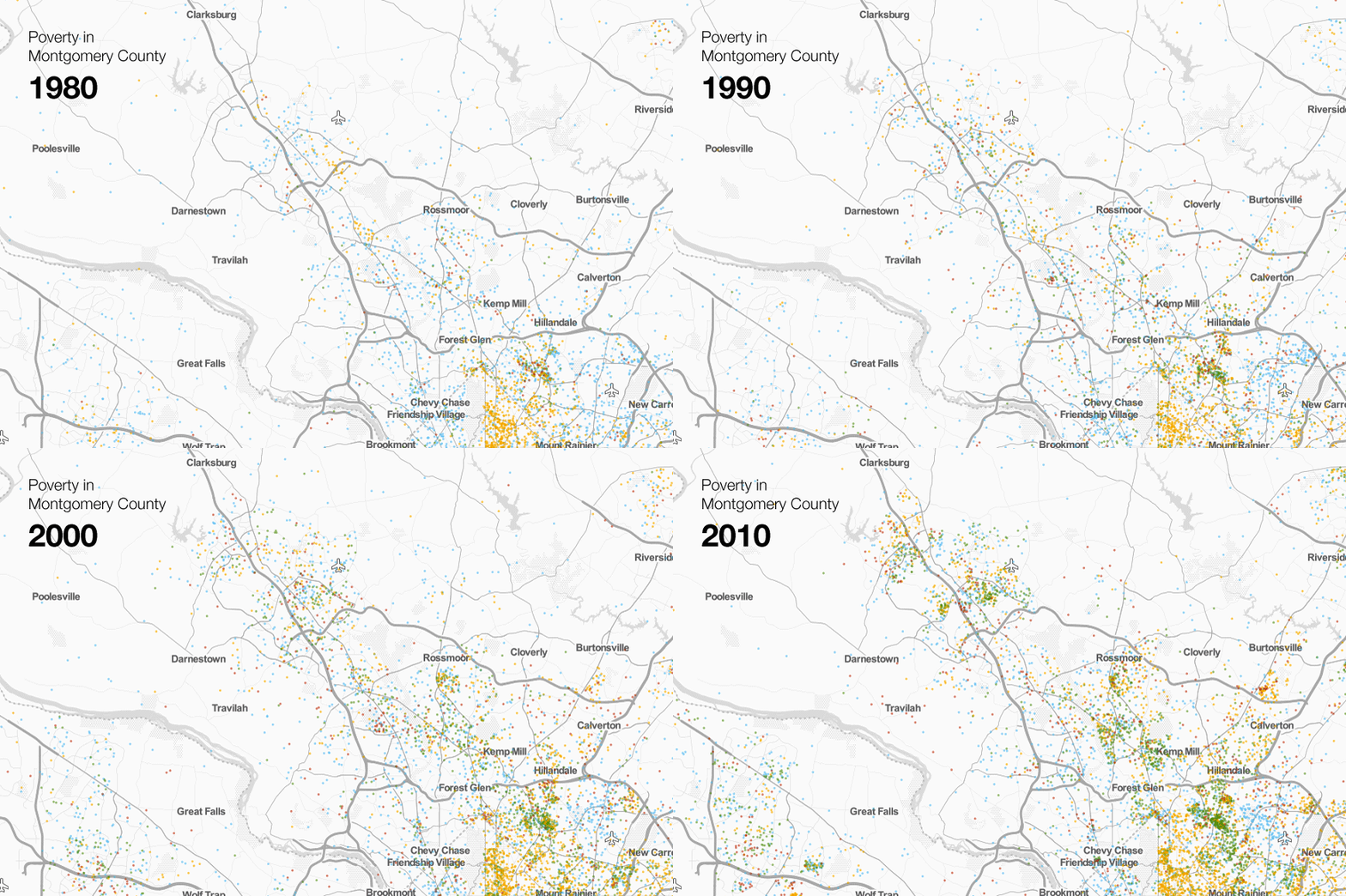
As Montgomery County has become more diverse, it also faces new challenges with poverty. A new mapping tool shows just how much the county's changed over the past 30 years.

Poverty in Montgomery County
Where poverty is in Montgomery County. Each dot represents 20 people. Blue dots are whites; yellow dots are blacks, green dots are Hispanics, and red dots are Asians.

The Urban Institute, a DC-based think tank that looks at social and economic issues, made this awesome mapping tool that shows where very low-income people lived between 1980 to 2010. The Atlantic Cities notes that the maps show dramatic demographic shifts across the country, notably the suburbanization of poverty.

That's especially evident here in Montgomery County. 30 years ago, the county's only significant concentration of poverty was around close-in Langley Park and Long Branch, which had established themselves as immigrant gateways by the late 1970's.

But today, you can also find clusters of poverty throughout East County and the Upcounty, in Wheaton and Aspen Hill, in White Oak and Briggs Chaney, and even along I-270 in Gaithersburg and Germantown. Many of them have only emerged within the past decade.

Meanwhile, communities that have historically been affluent, like Bethesda or Olney, appear to have stayed the same. The area along Rockville Pike between Rockville Town Center and White Flint, where a considerable amount of new, high-end development is happening, seems to have actually become less poor.