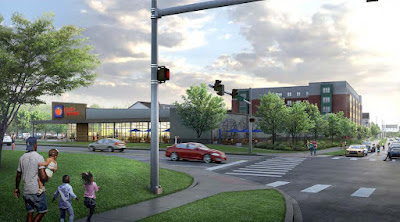
| A rendering of the proposed grocery store and senior apartments, with East Randolph Road on the right. All images from the Planning Board report. |
Monday, April 18, 2022
east county could get a new grocery store and senior housing, and some neighbors fear the worst
Tuesday, August 31, 2021
residents of a rich MoCo neighborhood provide a helpful list of places where cheaper homes can go
![]() |
| A view of Woodside with downtown Silver Spring in the background. Image by the author. |
Montgomery County has a chronic housing shortage, particularly for low- and middle-income people. In Silver Spring’s Woodside Park neighborhood, nearly 200 residents signed a letter listing other places where those homes can go. It’s part of an ongoing campaign to keep affluent neighborhoods from opening up to new homes and new people.
The price of homes in Montgomery County are rising steadily
Home prices in Montgomery County increased 14% last year, and for the first time the median home price topped $500,000. For a single-family home, it’s nearly $800,000. This isn’t unique - jurisdictions across the Washington region and around the nation are struggling with rising home prices. What all of these places have in common is a chronic shortage of new home construction, particularly for lower-priced homes. Montgomery County needs to build over 80,000 homes in the coming decades to fill the gap. In 2020, it permitted just 1500.
It’s easy to lose track of all the things county leaders are doing to address high housing costs: tax incentives, rent stabilization,lifting a ban on new homes near crowded schools, letting people build accessory apartments. Now, they’re targeting what might be the biggest obstacle: in most of Montgomery County’s residential land, you can only build one house per lot due to single-family zoning.
Wednesday, September 16, 2020
flash, maryland’s first bus rapid transit line, is almost finished
![]() |
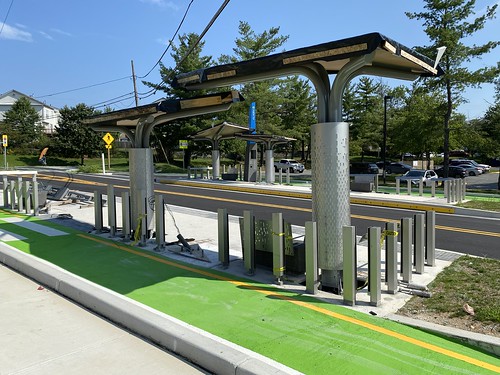
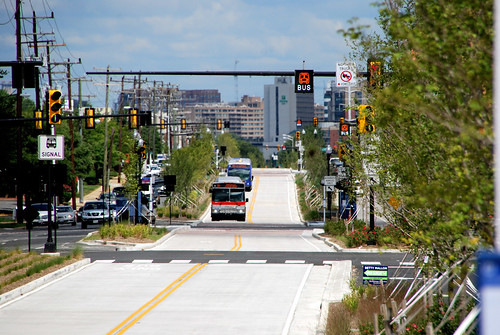
| The April Lane station on Flash, Maryland's first bus rapid transit line. Click here for a slideshow. All photos by the author. |
Under construction since 2018, Flash BRT is an 14-mile line that will run along Route 29 (Colesville Road and Columbia Pike) from the Silver Spring Metro station to Burtonsville, making 11 stops along the way.
It’s the first of three lines Montgomery County is working on - the other two are on Veirs Mill Road between Wheaton and Rockville, and along Route 355 between Bethesda and Clarksburg. Route 29 is one of the busiest bus corridors in the region, and Flash buses will come every 7.5 minutes during rush hour and run from 5am to midnight.
One of the stations will be April Lane, located on Lockwood Drive in White Oak where buses will briefly detour to serve a large cluster of apartment complexes. When I stopped by in August, the station (or stations, since there are platforms on both sides of the street) was almost finished, save for a few signs that hadn’t been installed and some construction debris.
Tuesday, February 27, 2018
montgomery county rejects affordable housing in silver spring and will build it elsewhere
![]() |
| Montgomery County will not build 92 apartments for low-income seniors here. Image by Google Street View used with permission. |
Ever since the Silver Spring Library moved to a new building three years ago, the county has been figuring out what to do with the old 1950s-era library, located four blocks from the Silver Spring Metro station on Colesville Road. County officials identified affordable housing and childcare as two major needs in the community, and put out a call for proposals to provide both on the two-acre site.
Affordable housing developer Victory Housing submitted a plan to replace the library with 92 apartments and a child care center. However, County Executive Ike Leggett just announced that they’ve selected a proposal from child care provider CentroNia and the Gudelsky Foundation to simply turn the library into a child care center. The Gudelskys, who own development firm Percontee, will provide land at Viva White Oak, a mixed-use development they’re building five miles away, where Victory Housing can build the apartments.
This decision appeases local historic preservationists who wanted to see the building preserved, a group of neighbors who opposed building housing (and in some cases, child care), and those who wanted the land turned into a park (despite there already being a park next door).
Tuesday, January 30, 2018
this video shows you how to find the right MCPS school for your family
Recently, I interviewed Montgomery County board of education member Jill Ortman-Fouse about the best tools for learning about local public schools. While websites like GreatSchools.com assign each school a point rating based on test scores, they don't tell the full story.
Instead, Jill recommends taking a more hands-on approach. If you're curious about a school, schedule a visit, meet with the principal, or talk to neighbors whose kids attend that school. There are also a variety of online resources, including school websites, Twitter accounts, and Facebook pages, that list events going on at each school and can provide a first-hand look at what happens there.
And of course, Montgomery County Public Schools has a website with lots of information as well. Schools at a Glance is their annual report of data about every school in the system, with everything from test scores to teacher statistics to building information.
Are you trying to pick a school in Montgomery County right now? Have you picked one in the past? What tools did you use?
Friday, January 26, 2018
housing and transportation are LGBTQ issues, and politicians need to recognize that
![]() |
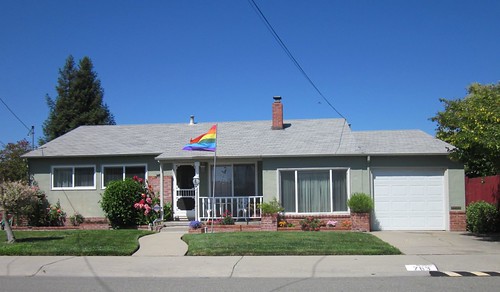
| A pride flag outside a suburban house (though not in MoCo). Photo by mary on Flickr. |
Saturday, December 30, 2017
ten very silver spring things that happened in 2017
![]() |
| That's Governor Larry Hogan, knocking down a building at the Purple Line groundbreaking. Photo by Aimee Custis on Flickr. |
- The Purple Line is officially a thing. After a 2014 lawsuit was finally resolved, the light-rail line between Bethesda and New Carrollton finally broke ground in August at a ceremony where Governor Larry Hogan used an earthmover to tear into a building. Construction is well underway in Silver Spring: trees are coming down on the Capital Crescent Trail, the Spring Center shopping center has been roped off and stores have moved out; and Arliss Street in Long Branch will be closed for the next few years. While the work is disruptive, it’ll be worth it. To see all the places the Purple Line will connect, my friend Sean Emerson and I took a trip on the route this summer, which you can watch.
- MoCo’s biggest campaign in a long time. Voters approved term limits last year, which means that for the first time ever, three County Council seats and County Executive are all open at the same time. Not only did the 2018 campaign season start early (many candidates announced last summer), but it’s huge, with over 40 people either running or considering a run for County Council alone. To say this is a consequential election is an understatement, as it could bring in a number of new, fresh faces to local politics - or take us a big step backward.
Monday, October 16, 2017
see what montgomery county's new BRT stations will look like
![]() |
| What Montgomery County's new Flash bus rapid transit stations could look like. All images from ZGF. |
The new BRT line, dubbed Flash, will run along Route 29 between the Silver Spring Metro station and the Burtonsville Park & Ride. It's the first of what could be a countywide network of rapid bus lines. Flash will contain a variety of features designed to make the bus faster and more reliable, including dedicated lanes for part of the route and special signals that give buses extra green time at congested intersections. The 11-mile line will have just 12 stations, spaced up to two miles apart, and could carry 13,000 people per day.
And those stations won’t look like any bus stops you’ve seen in the area before. Designed by local architecture firm ZGF, the stations are designed to be visually distinctive, while adaptable to the wide variety of urban and suburban neighborhoods along the BRT line.
![]() |
| A plan showing all the features of a BRT station. |
The designers have created a canopy structure for each station with a mix of metal, wood, and glass accents. The stations will also have an iconic “station marker,” which will help riders find each station and provide real-time information and a system map. The stations will all be accessible for riders with disabilities and have ticket machines where riders can pay before getting on the bus, reducing delays.
![]() |
| How the Fenton Street BRT station could look. |
However, no two stations will be exactly alike, as the designers created a “menu” of station features that the county can pick and choose from based on the needs of that specific location. Those amenities include public art, wifi and cellphone charging spots, or low impact design (LID) landscaping, which can collect and distribute rainwater, reducing runoff and pollution.
The stations will be different sizes based on their location. Busier stations might have larger shelters to accommodate multiple buses. Locations in downtown Silver Spring might have smaller shelters to fit on tight sidewalks, while more suburban stations will have more green space around them.
![]() |
| A "menu" of options would allow each station to fit into its surroundings. |
These designs are still preliminary, so we don’t have a lot of details about how much they’ll cost. But one estimate in the designers’ report says that each station could cost between $368,000 and $490,000. The entire BRT line will cost $31 million.
There’s no reason infrastructure can’t be both functional and attractive. Do you think these hit the mark?
Monday, October 2, 2017
there's a mismatch between the houses DC area buyers want, and what's on the market
![]() |
| New townhomes in Rockville. Photo by the author. |
The conventional wisdom appears to say we’re not heading into another recession anytime soon. However, while Millennials are finally settling down and ready to buy homes, they will struggle to afford homes in places like DC due to high costs. In the coming years, climbing home prices will stagnate because buyers' income levels increases aren’t keeping pace with costs.
These three things suggest a recession isn’t coming soon
Real estate downturns tend to happen pretty regularly, notes real estate entrepreneur and Harvard Extension School lecturer Ted Nicolais. Going all the way back to the 19th century, real estate downturns take place about once every 16 to 18 years. Since the last recession occurred between 2006 and 2008, he predicts we can expect another one between 2022 and 2024.
Thursday, August 3, 2017
since the great recession, east county's real estate market has diverged
![]() |
| A 2000s-era subdivision in East County. Many of these homes lost value during the Great Recession and have yet to recover. All images by the author. |
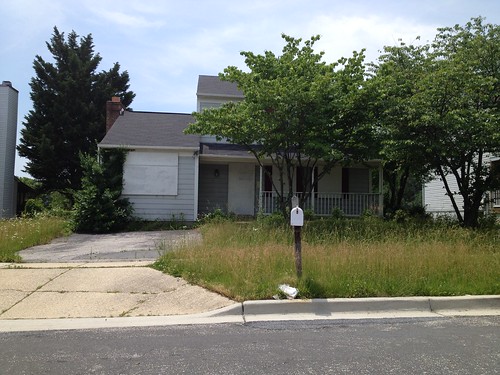
My high school, Blake, opened that same year, and most of my friends’ parents seemed to have made the same move from Silver Spring and Takoma Park. New subdivisions were popping up with big, luxurious houses, lush lawns, and names like Briarcliff Manor and Hampshire Greens. In the older neighborhoods, houses were sold for the land so big McMansions could rise in their places.
I remember going to a party at the end of high school where we sat in a circle bragging about how much our parents’ houses were worth. I was the odd one out because my parents’ house had appraised recently at a measly $500,000.
![]() |
| An abandoned house in an East County subdivision in 2014. |
Meanwhile, downtown Silver Spring had a comeback as more people sought urban living. A major redevelopment project along Ellsworth Drive brought restaurants, shops, movie theaters, and a Whole Foods. Montgomery County poured millions into new public facilities, including a library, the Civic Building, and Veterans Plaza. In response, private developers built thousands of new apartments and condominiums, including the building I live in now, a converted bottling plant that was still operating when I was a kid.
Here's how the real estate market in East County has changed
The real estate market shows how Silver Spring has bounced back from the recession while East County has struggled. Here’s a graph showing average home values in 2012 and 2017 as they compare to 2007 levels. It shows the two zip codes inside the Beltway, 20910 (Silver Spring) and 20912 (Takoma Park), and seven zip codes (mostly) outside the Beltway: 20901 (Four Corners), 20902 (Wheaton), 20903 (Hillandale) 20904 (Colesville, Fairland), 20905 (Cloverly), 20906 (Aspen Hill) and 20866 (Burtonsville).
![]() |
| How 2012 and 2017 home values in East County stack up to 2007 levels. Click on all of these graphs to enlarge them. |
Home values all over East County fell during the Great Recession. In zip codes 20903 and 20906, home values fell by nearly half between 2007 and 2012. This year, average home values in the eight zip codes outside downtown Silver Spring are 71% to 85% of what they were a decade ago. But in zip code 20910, which contains downtown Silver Spring, values are actually a little higher than they were 10 years ago.
![]() |
| Home values inside the Beltway have recovered, but remain lower elsewhere. |
Homes inside the Beltway have been more valuable than those outside it for a while now. But the gap in home values has increased over the past 10 years. This graph shows the average home sale price per square foot, as a way to even out differences between houses of different sizes and styles. In the summer of 2007, the price per square foot in zip codes 20910 (Silver Spring) and 20866 (Burtonsville) were fairly close, at $363 per square foot and $304, respectively. Today, they’re $384 and $257; in other words, a difference of 50%.
Those who bought homes in East County before the housing boom, or at the bottom of the market, may have recovered their investments or even made a little extra. But those who bought at the top of the market saw their gains wiped away.
![]() |
| Homes in far-flung zip code 20905 linger on the market longer than homes closer in. |
Another measure of demand is the number of days a house sits on the market. During the Great Recession, houses across East County languished for months due to a lack of buyers. In early 2008, the average house in zip code 20905 sat on the market for nearly six months. Demand returned, but not equally. In early 2017, homes in the 20910 zip code spent just 22 days for sale, compared to 59 days in 20905.
There's a huge opportunity in East County, but things need to change
Like many aging suburbs, East County is caught in the middle. The kids I grew up with have either moved to urban areas closer in, or moved farther out to newer suburbs in Olney or Howard County, aided by new highways like the InterCounty Connector that made it easier to commute longer distances. East County is a long drive from Montgomery County’s biggest job and shopping centers, which are all along Rockville Pike and I-270. And the local schools struggle with a negative reputation compared to their counterparts in more affluent areas.
![]() |
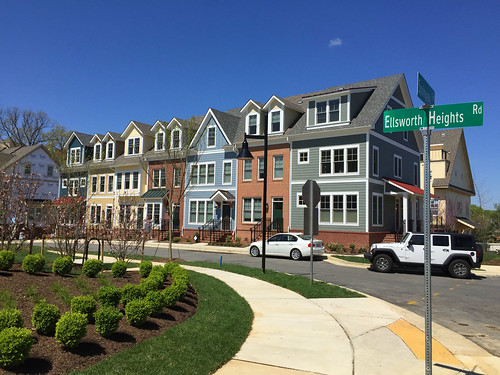
| New townhomes in downtown Silver Spring, where home values are higher than they were in 2007. |
More neighborhood connectors are needed in #EastMoCo to provide options to get to stores when kids demand pancakes at 7 am. @MCBikePlan pic.twitter.com/Op1q3DTMbf— Growing East County (@GrowingEastMoCo) July 15, 2017
Providing that lifestyle in East County is imperative to drawing people and investment to this area, just as it did in Silver Spring. Montgomery County’s plans to create a walkable town center and research park in White Oak and a new village center in Burtonsville will bring the amenities people want, while a new BRT line on Route 29 will provide faster, more reliable transit. Combined, the two will give East County access to jobs, shopping, and economic opportunities.
East County has waited decades for the kind of prosperity the rest of Montgomery County takes for granted, and at great cost. Hopefully residents won’t have to wait much longer.
Thursday, July 27, 2017
plans for viva white oak are finally taking shape
![]() |
| A rendering of Viva White Oak's future "Village Center." All images from Montgomery County unless noted. |
Montgomery County officials hope to change this by turning White Oak into a hub for life sciences research, centered on the Food and Drug Administration, which moved there ten years ago, and Washington Adventist Hospital, which is building a new facility here.
![]() |
| An aerial perspective of Viva White Oak. Most buildings would be a few stories tall, though some could rise as high as 220 feet. |
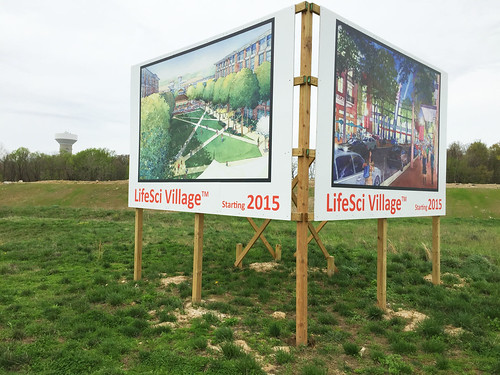
Last year, the county struck a deal with developer Percontee to build Viva White Oak, a new town center and research park near Route 29 and Cherry Hill Road that was originally proposed under the name "LifeSci Village" over a decade ago. The 280 acre site, located between the FDA campus and the new hospital, consists of a shuttered sludge treatment plant the county owns and Percontee’s former concrete recycling center.
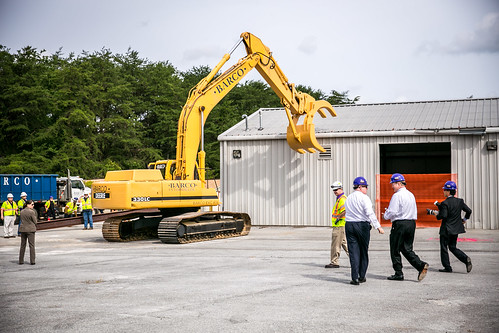
Last week, Percontee (working under the name Global Lifescience Development Corporation) and county officials presented their plans at the White Oak Recreation Center, reports local blog Growing East County. The developers are about to send the Planning Department their sketch plan, which is a more general vision of the development that occur. When the project is ready to begin, the developer will submit detailed plans for specific portions of the project for approval.
Here’s what we know so far
As a result, we only know that Viva White Oak will have roughly 12 million square feet of stuff when it’s completed, including up to 5,000 homes, shops, offices, and research buildings. But the site plans show four distinct “neighborhoods” with different types of activities in them. A grid of streets would thread through the entire project, allowing residents, workers, and visitors to walk or bike, while trails would connect the project to Paint Branch Park. Twenty percent of the 280-acre site (56 acres) would be parks and open space, including several squares and plazas.
![]() |
| Viva White Oak's four neighborhoods. The "West Neighborhood" and "East Side" would be built first. |
The “West Neighborhood” and “East Side” are at the edges of the development, closer to Route 29 and Cherry Hill Road, and would have a mix of townhouses, apartments, and some commercial buildings. Those sections will be built first. Viva White Oak’s first phase will include up to 1,000 new homes and 300,000 square feet of commercial space, as per the developer’s agreement with Montgomery County.
The project’s second phase is the “Village Center” at the center of the site, where the three new roads meet, and would have apartments, offices, and shops. The final phase would be the “R&D Core,” located at the south end of the site next to the FDA campus entrance. It would have a mix of offices and academic facilities, and some of the development’s tallest buildings as well. Zoning allows buildings up to 220 feet tall at Viva White Oak, but most of the buildings shown appear to be low-rise, between three and six floors.
To get the ball rolling, the county will contribute $47 million to clear their portion of the land, and to split with the developer the costs of building three new roads connecting the land to Industrial Parkway, Cherry Hill Road, and the FDA. The county's new Bus Rapid Transit line on Route 29, which will open in 2020, could carry workers and residents to Viva White Oak. The project also includes land for a new school; nearby Galway Elementary School is at capacity now and will remain close to it for several years.
But will companies want to come here?
Viva White Oak has been in the works since 2005 and it looks like things are finally coming together. Neighbors who were at the meeting last week say they're really excited about the project. But we still don’t know if scientific companies or research institutions will want to come here. And Viva White Oak’s suburban location may be a turnoff to companies who seek closer-in, transit-served locations.
![]() |
| The Viva White Oak (formerly LifeSci Village) site today. |
Wednesday, January 25, 2017
here are five things montgomery county says BRT would do
![]() |
| BRT in Alexandria opened three years ago. Photo by BeyondDC on Flickr. |
The county and the Maryland Department of Transportation just finished a study looking at what a bus rapid transit line could do if it were built, and what would happen if nothing got built at all. Here's what they found.
How BRT would work
BRT offers many features you'd expect from a train: large, covered stations, fare machines where you pay before getting on, and special traffic signals to let buses pass ahead of other vehicles. The county envisions thirteen stops along Route 29, with buses running in both directions every six minutes between 5 am and midnight, seven days a week.
The most important feature of BRT are dedicated lanes for buses, which allow buses to speed past traffic, making the service fast and reliable. The county and state are looking at three alternative ways to create dedicated lanes for all buses (including existing local and commuter buses) as well as carpools. Depending on the alternative, buses would use the right-hand lane along sections of Route 29 south of New Hampshire Avenue, where it's more of a city street. North of New Hampshire Avenue, where Route 29 becomes more of a freeway, buses would either travel on the shoulder or in the median, where new lanes would be built.
Estimates say the project would cost between $79 and $136 million to build. Meanwhile, the county is planning to build a sort of "temporary" BRT line with some of those features that could cost about $67 million. It recently received a federal grant to help pay for it.
| Map of the proposed Route 29 BRT line from Montgomery County. |
What BRT could do
It could reduce travel times, including for drivers. Today, a bus trip from Burtonsville to Silver Spring can take nearly an hour in the morning. The study found that the same trip on BRT could take as little as 29 minutes, making it even faster than driving. In some cases, car trips would be shorter as well.
It could reduce congestion. The study found that in all three cases, the amount of driving along Route 29 would actually decrease. Today, many people may choose to drive because the current bus trip is slow and circuitous. With a new, faster option, some drivers may choose to use transit, freeing up space on the road for those who still choose to drive.
It could double transit use in East County. Route 29 is one of the region's busiest bus corridors. Today, people take 15,000 trips through the area each day on Metrobus, Ride On, or MTA commuter buses. The study estimates that another 16,000 to 18,000 would ride BRT, while existing bus service would see new riders as well.
It could increase access to jobs and economic opportunity. The study finds that BRT could "provide opportunities for low-income and minority populations to enhance their quality of life through improved transportation and employment options." Research shows that one of the biggest barriers to getting a job is the lack of safe, reliable transportation to that job. The study finds that BRT could allow East County residents to reach more jobs within 45 minutes than they can today. Transit might also draw more private investment to areas like downtown Silver Spring and White Oak, putting more jobs within close reach.
It could support Montgomery County's nighttime economy. One of the county's main priorities has been promoting nightlife in downtown areas like Silver Spring to encourage more people to live or work here, but the buses are often less frequent or don't run at all outside of rush hour. The BRT study finds that many of the proposed BRT stations, like Fenton Street, Burnt Mills, and Stewart Lane will actually be busier during evenings and weekends than during rush hour. These stations are in shopping and entertainment areas, like downtown Silver Spring and White Oak, that are both popular hangouts and have lots of late-night service and retail jobs.
This may not happen without dedicated lanes
This study looks at what would happen if Montgomery County and Maryland built bus rapid transit with dedicated lanes for buses. Creating bus lanes can be expensive depending on how you do them. And since Montgomery County first proposed BRT several years ago, there's been a lot of pushback from some neighbors who are worried about car traffic.
But all of the benefits BRT could bring East County are less likely to happen without dedicated lanes that make buses faster, more frequent, and more reliable. After all, a bus that sits in traffic is just a bus.
You've got a number of chances to offer your thoughts on this project. The county and state are taking public comments on this study through February 20. On February 7, the County Council will have a public hearing about whether to provide money to build bus rapid transit, and you can sign up to testify here. And there will be public meetings later this spring to talk even more.
(Full disclosure: I sit on the county's Route 29 South BRT Citizens Advisory Committee, but these thoughts are mine and mine alone.)
Monday, May 23, 2016
Monday, December 28, 2015
here are 12 very silver spring things that happened in 2015
Now I've been to Brooklyn, and I don't know if this is an apt comparison (though it's not the first time!). But it's pretty clear that 2015 has been a big, game-changing year for Silver Spring. Let us count the all of the people, places, and events that made it happen (in no particular order):
![]() |
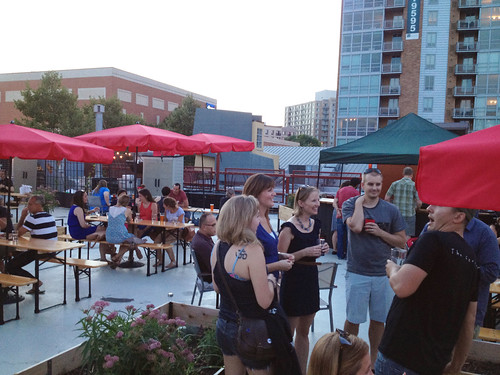
| Hanging out at Denizens. All photos by the author unless noted. |
Friday, March 6, 2015
expand route 29 to build a sidewalk? why not just build the sidewalk
![]() |
| One of four proposed interchanges along Route 29 in Montgomery County, with north on the right side. Image from the Maryland State Highway Administration. |
For decades, Maryland highway planners have been trying to turn Route 29 between New Hampshire Avenue in Montgomery County and I-70 in Howard County into a freeway. They recently unveiled new designs for a $128 million interchange at Route 29 and Fairland and Musgrove roads, just south of the Intercounty Connector. Today, both roads intersect Route 29, also known as Columbia Pike, at separate stoplights.
Under the state's proposal, Musgrove Road would become a dead end street on the west side of Route 29, while on-ramps and off-ramps would connect the east side of 29 to its northbound lanes. Fairland Road would go from four lanes to six and only have access to 29 going south.
If the project gets funding, construction could get underway in 2018.
Maryland has already built interchanges along Route 29 in Howard County and in Montgomery County at Cherry Hill Road, Briggs Chaney Road, and Route 198. In 2002, plans to build four more interchanges at Fairland and Musgrove roads, Stewart Lane, Tech Road, and Greencastle Road were put on hold and the focus shifted to the Intercounty Connector. In 2013, then-Governor Martin O'Malley revived the projects.
Monday, September 8, 2014
the definitive history of east county
![]() |
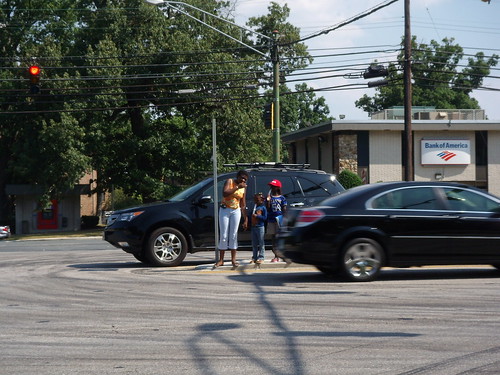
| A family tries to cross Columbia Pike in 2007. Photo by the author. |
I was trying to think of things to say about it, but the story manages to take things we've been talking about here for the past eight years and wraps it up into one overarching narrative and history of how East County got this way and what might happen next.
If you haven't read it yet, you you should do it now.
Tuesday, August 26, 2014
how did silver spring get its boundaries? and how would you define them?
| Silver Spring, as the Census Bureau sees it. Image from Wikipedia. |
Unlike northeastern states where every square inch of land sits inside a municipality, or western states where cities compete for territory to access natural resources or tax revenue, much of Maryland and Virginia are unincorporated. Part of the reason is that counties in these states can perform functions like zoning and schools, reducing the incentive for communities to become a town or city.
Silver Spring is one those places. As a result, most definitions of Silver Spring fall into two camps: one I call "Little Silver Spring," or areas near its historical center, or "Big Silver Spring," which comprises most of eastern Montgomery County. To find out which one is more dominant, local organization Silver Spring Inc. will have residents draw their own boundaries in an interactive event at Fenton Street Market this Saturday.
Monday, July 28, 2014
in white oak, the region's east-west divide becomes an urban-suburban one
![]() |
| The White Oak Shopping Center. All photos by the author unless noted. |
One of those places is White Oak in eastern Montgomery County, where the County Council will vote tomorrow on a plan to create a new town center. Local residents are eager to have more jobs and amenities close to home, but civic and environmental groups want to limit the amount of density in White Oak because it's several miles from a Metro station and roads are already congested.
But the kind of compact, dense development proposed for White Oak could allow residents to access jobs, shops, or other amenities by walking, biking, or simply driving a shorter distance than they would otherwise. It would generate less traffic than the alternative: more of the sprawling, car-oriented development that's currently allowed in White Oak, plus additional sprawl farther out.
Monday, June 30, 2014
residents, community leaders talk about white oak plan in a new video
The White Oak Science Gateway Master Plan… Now… It’s East County’s Time! from 'nFocus Videos on Vimeo.
Many residents support the plan, noting that East County lacks the same jobs and amenities that more affluent parts of the county take for granted. But there are some lingering concerns about traffic, the amount of development proposed, and whether the county will make good on a thirty-year-old promise to bring rapid transit to the area.
One of the plan's largest components is LifeSci Village a 300-acre complex of offices, research facilities, retail space, and housing on what's currently a concrete recycling plant. Montgomery County and developer Percontee are partnering to build the project, which is on Cherry Hill Road east of Route 29. This week, Percontee released a video to build support for the Science Gateway plan, featuring interviews with local residents, business and community leaders, and yours truly.
Many of the region's traffic problems come from an imbalance between jobs, which are mostly on the western side of the region, and affordable housing on the east side. This plan could go a long way to correcting that issue, and I'm eager to see it move forward.
Wednesday, May 28, 2014
single-family homes are the minority in Montgomery County
![]() |
| A single-family house in Silver Spring overlooking townhouses being built, with apartments in the background. Photo by the author. |
There are nearly 376,000 homes in Montgomery County according to the 2008-2012 American Community Survey. Less than half, or 48.5% are single-family detached homes. One out of three homes are apartments or condominiums, while another 18.2% are "single-family attached" homes such as twins and townhouses.
But different kinds of homes are clustered in different parts of the county. Single-family homes predominate on the more affluent west side and inside the Beltway. Townhouses are more common in newer neighborhoods far outside the Beltway, while apartments cluster along the Red Line and in farther-out areas.