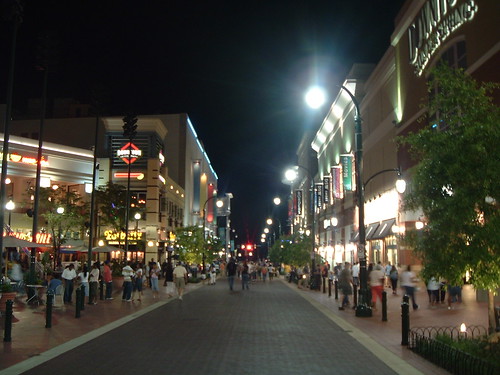
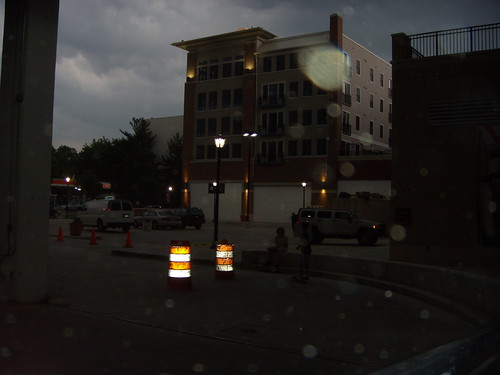
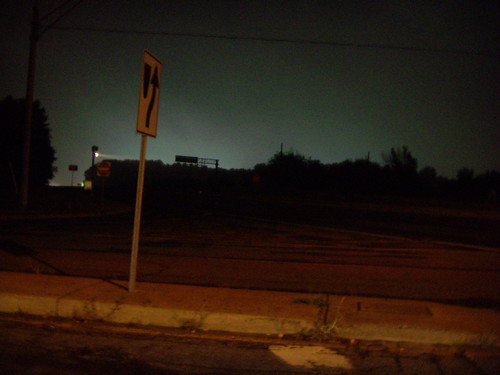
ABOVE: light pollution from the Montgomery Auto Park on Briggs Chaney Road at night.
From cornfields swaying in the breeze to condominiums in sprawling parking lots, Briggs Chaney Road has a little bit of everything. Less than six miles long, this twisty two-lane highway has wiggled its way into the consciousness of every East County resident driving out of town. It's even been immortalized in song by two different local bands, Aberdien and The Spotlight.
Yet behind the legend lies the reality of communities faced with change and decay. The densely populated Briggs Chaney neighborhood, centered on Briggs Chaney Road and Route 29, has become a symbol of everything that's wrong with East County: crime, disinvestment, and nasty traffic.
This week, Just Up The Pike takes a look at Briggs Chaney - what it is and what it will become:
MONDAY: What is Briggs Chaney Road? This slideshow explores what comprises the Briggs Chaney area - what works and what doesn't.
TUESDAY: Rocked by tragedy, a Briggs Chaney apartment complex opened their arms to the community - and the community answered. JUTP looks at the East County Community Day and what it means for the future of East County.
WEDNESDAY:JUTP checks out the new, high-end developments popping up in some of East County's poorest neighborhoods. Are these projects really improving the community? We'll find out.
THURSDAY: A local punk legend is stabbed outside of his Briggs Chaney condo. How can your own neighbors turn against you? JUTP sifts through the facts.
FRIDAY:JUTPinterviewsSean Ruppert, a local builder who took a chance on Briggs Chaney with some outlandish townhouses. While the market's biting, County policies might prevent him from returning to the area.
Part of a continuing series on Briggs Chaney Road - what it is and what it will become.
"anyhoo, i'm about a block away from my place coming home after work & really exhausted. out from the outdor pool area of my condo community pops up 5 enthusiastic (now i'm thinking all hopped up on goofballs!) young hs kids. i pay no mind until one of them comes up to me "hey whassup, hey hey hey". now i'm thinking this might turn into a random assualt & robbing. because they're all around me i can't pay attention to them all & one of them sucker punches me . . ." - John Stabb, lead singer of Government Issue
Sift through the Gazette's weekly Police Reports and you'll notice a lot incidents from Briggs Chaney. This one's only news because it's a person well-known within D.C.'s punk scene - but to the kids that jumped him, he's just some white guy.
"Seriously, never doubt the power of a group of clean-cut kids (not to play the stereotype card but this time they happened to be black teens) if you're walking alone somewhere," Stabb writes on a message board. "And i have my theory they actually live in this condo area so they can hit, rob, and run back to their homes."
so much more AFTER THE JUMP . . .
Park and Planning reports that the Fairland planning area - which comprises Calverton, Briggs Chaney and Burtonsville - has nearly a thousand Moderately Priced Dwelling Units, the overwhelming majority of which are in Briggs Chaney. The concentration of affordable housing - both subsidized and market-rate - in Briggs Chaney contributes to a distrust of perceived "outsiders." I'm not sure if the kids thought Stabb lived in the condo. This brings up a question of whether or not the kids would've jumped him (regardless of race) if they knew who he was.
There's also a lack of police presence. East County falls in MoCo's 3rd Police District, which covers the entire Route 29 corridor from Downtown Silver Spring to the Howard County line. Where are the cops? Downtown? In Long Branch? White Oak? They can't be everywhere at once, and kids know it and take advantage of it.
Briggs Chaney as it is exists today is a poorly-designed community where public and private space is ill-defined. It's easy to hide and easy to escape responsibility for maintaining the area around you. This enables crime by default.
And it's pretty easy to get lost, which creates more "outsiders" and offers "insiders" more opportunities to take advantage. While trying to find the East County Community Day last Saturday, a man pulled up in a car next to me and yelled "What the fuck is your hot ass doing out here?" Welcome to the neighborhood!
There are solutions, but they aren't simple and they aren't cheap. We have to rethink how Briggs Chaney is physically set up. We have to encourage the construction of more higher-end housing. And we need a greater police presence. Is the will there? Probably. But the money isn't.
Less than a year old, the InterCounty Connector Trail offers a new way to get across Montgomery County by bike. However, a circuitous route, a lack of connections to surrounding areas and sections with poor visibility all hurt its potential.
The ICC was originally planned to have a bike trail running parallel to it, but in 2004, the State Highway Administration got rid of it, claiming it would reduce the toll road's construction costs and environmental impacts. Instead, they gave the ICC Trail a more circuitous and indirect route, running parts of it along the highway and the rest along local roads like Columbia Pike and Briggs Chaney Road.
Not surprisingly, area bicyclists were unhappy with the decision. "Why do designers think cyclists should have to go the long way, but cars need a direct route?" asks the WashCycle blog.
Part of the trail runs parallel to Columbia Pike between Fairland Road and Briggs Chaney Road in East County. Like the Forest Glen pedestrian bridge that crosses the Beltway, it runs under a highway. The trail is also lightly used and has already been vandalized.
This is unfortunate, because the trail could tie neighborhoods on both sides of the ICC together and is a crucial part of a "commuter bikeway" along Columbia Pike first envisioned in master plans 15 years ago. But this part of the ICC Trail won't get any busier or safer without better foot and bike connections to get people to it.
Let's take a look at the trail:
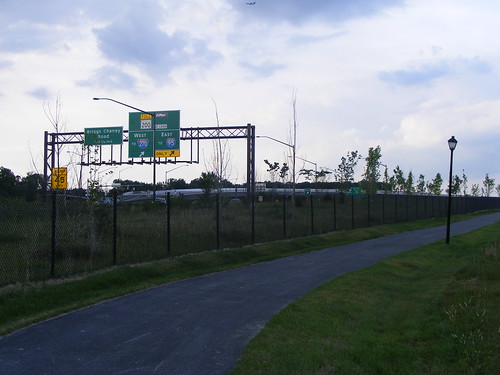
Here we are on the trail, just north of Fairland Road. That's the exit sign for the InterCounty Connector up ahead.
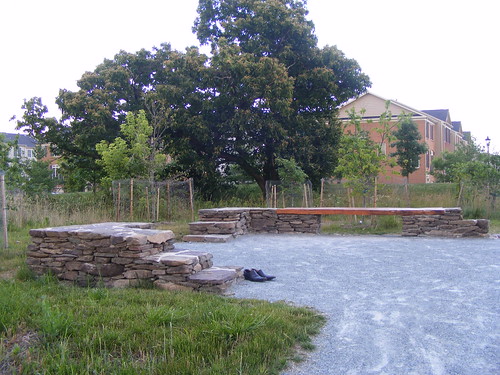
First we pass this small seating area. People do use it, judging from the abandoned pair of shoes. I enjoy the dry stacked stones and wooden bench, which give the trail a woodsy, rustic feel despite its surroundings.
Behind the seating area is the recently-built Fairland View subdivision. It's separated by a grass berm and has no connection to the trail, despite being yards away. (The view, of course, is of the InterCounty Connector.) I assume these nearby chalk drawings came from kids living there.
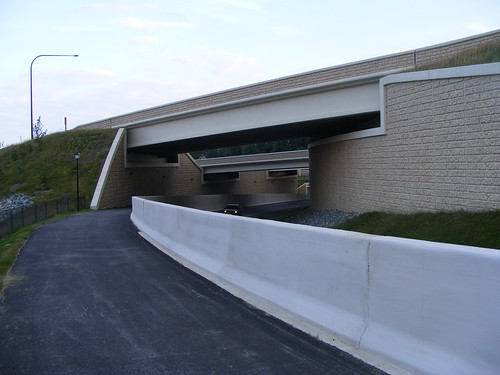
Now we're heading under the interchange between Columbia Pike and the ICC. This part of the trail is almost invisible from either road and the surrounding houses, and I passed a group of young men smoking right before I took this picture.
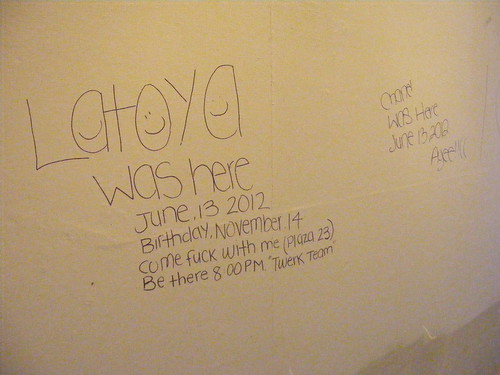
There is Sharpie graffiti in the tunnel, though it's not much worse than anything I saw or did myself in high school. The tunnel appears to have been repainted a few times since it opened; in fact, since I took this photo, the scribbles have already been painted over. It's good to see that the state is maintaining the trail, though I wonder how regularly they patrol it.
After the tunnel, we go under a couple of overpasses. The roar of traffic is pretty intense, and I noticed some broken glass on the path where lights have been knocked out.
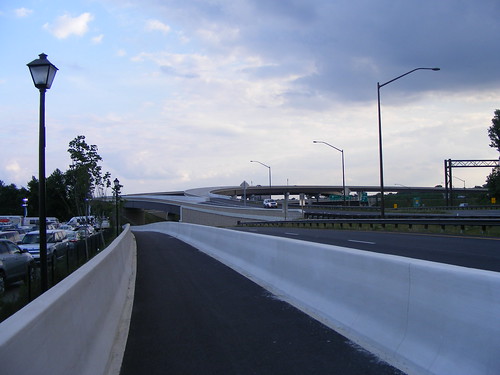
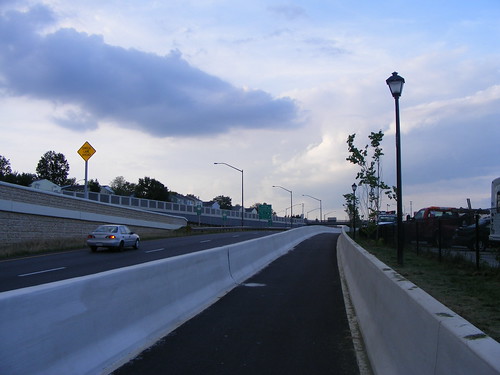
We're now between Columbia Pike on the left, and the Montgomery Auto Park on the right. Turn around and you get a great view of the interchange. There are maybe waist-high concrete walls on either side of the trail and a chain-link fence separating it from the Auto Park. The wall might keep bicyclists safe from car traffic, but I wonder if it's also there to protect the car dealerships from bicyclists.
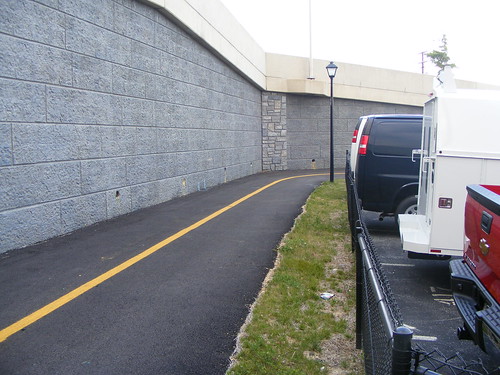
And then we hit a wall. This is the interchange of Columbia Pike and Briggs Chaney Road, which was completed about four years ago; the trail takes a hard right to get around it and then joins Briggs Chaney Road.
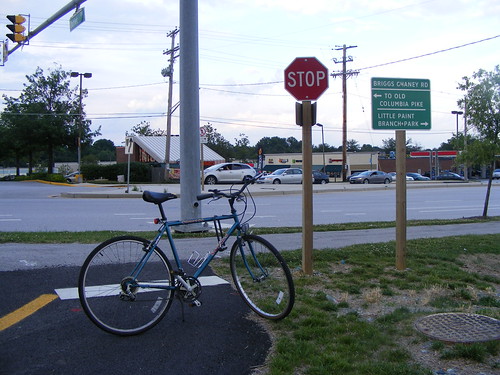
Across the street is the Briggs Chaney Plaza shopping center; there's a stoplight and intersection in front of us, but no pedestrian signal or even a crosswalk. From here, we can continue down Briggs Chaney, which has a nice, wide shared path for about a mile and a half before connecting to a portion of the trail that's actually on the ICC.
Residents of Tanglewood, a subdivision on the south side of the ICC, complained that a trail would invite "criminals" from the apartment complexes along Briggs Chaney Road. While I still think that accusation was unfair, residents' predictions that there would be vandalism on the trail turned out to be true.
But as WashCycle points out, the best way to make a safe trail is to make it busy. In the handful of times I've used this one-mile portion of the ICC Trail, I've seen maybe a dozen people there. The trail is new enough that some people haven't heard of it, but it's also obscured by a highway interchange and sound berms.
It would've been ideal if the State Highway Administration had laid out the trail first and then worked around it, rather than the other way around. The trail would be more direct, and possibly more visible, while having little or no effect on the ability of drivers to pass through.
Since that opportunity no longer exists, the best thing we can do is to improve foot and bike connections to nearby destinations like Briggs Chaney Plaza and neighborhoods like Castle Boulevard, which recently got new sidewalks and medians. The easier it is to walk or bike in the area, the more likely people are to use the ICC Trail, and the less destructive behavior will occur.
Check out this slideshow of my bike ride along the ICC Trail and other roads in East County.
Part of a continuing series on Briggs Chaney Road - what it is and what it will become.
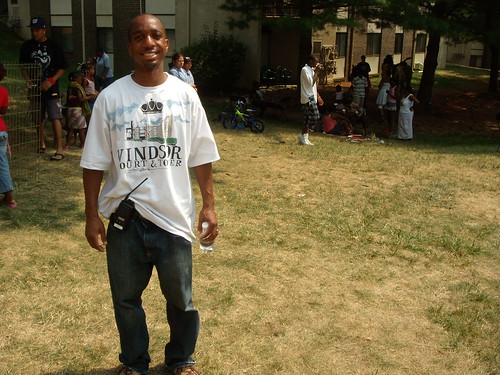
Windsor Court and Tower leasing manager Dexter Price was the organizer of last Saturday's East County Community Day, held at the Castle Boulevard apartment complex.
Check out this slideshow of the East County Community Day.
Still reeling from a June fire that killed four of its residents, a Briggs Chaney apartment complex played host to hundreds of local residents last Saturday for the East County Community Day, a fair held on the sprawling campus.
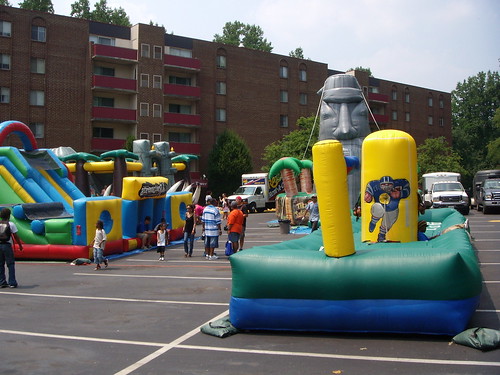
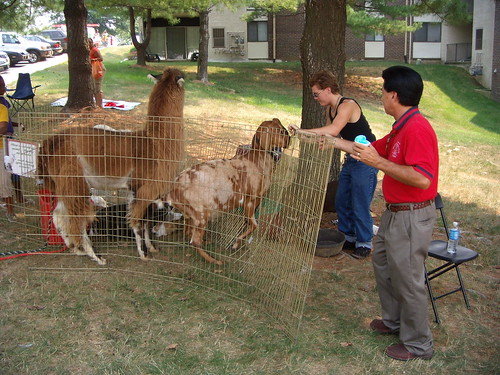
Attractions at the Windsor Court and Tower apartments on Castle Boulevard - one of the oldest complexes in the Briggs Chaney area ranged from a moon bounce and petting zoo to a "vendor tent" with representatives from businesses, County agencies, and local organizations. In the evening, there was a singing contest dubbed "Windsor Idol."
"I think this event'll be successful in making an impact - at least in these apartments - because it'll show that somebody cares," says Chris Briggs, staff member at the East County Regional Services Center and a Greencastle Lakes resident. Briggs and fellow staff member Chuck Crisostomo of Gaithersburg manned a table for the Regional Services Center, housed a few blocks away at Briggs Chaney Road and Robey Road.
so much more AFTER THE JUMP . . .
A hand-written sign advertises the event on Briggs Chaney Road.
One Windsor resident was glad to see activities for the kids, noting that most apartment complexes do little to accomodate their younger tenants. "I'm happy to see the turnout," says resident Kristin Chesson. "I think a lot of the parents are beginning to see children need a place on-site to be involved."
The event had been in planning for months, but was catalyzed by the tragic loss of the three Foncham sisters - Makenzie, Megan and Chanelle - and their mother, Elsie Nuka in a fire in late June. A memorial service for the family was held before the Community Day celebration.
"The tragedy touched a nerve in the community," says Dexter Price, leasing manager at Windsor Court and director of Community Day. "When this tragedy happened, I was impressed with the way the community came out."
Immediately after the fire, the Regional Services Center set up a well-publicized "Community Crisis Fund" to raise money for the family's funeral expenses and witnessed an "outpouring of support," according to Chuck Crisostomo, whose daughter Contessa writes for the Gazette. "Every two days, we'd see $3,000 more," says Crisostomo, "but we had donations as small as five dollars."
"I was surprised by looking at the return addresses on the envelopes," adds Crisostomo, noting that donations came from throughout the region.
Enough money was raised to send the mother's remains to her native Cameroon, where a funeral will be held this week, while one individual donated cemetery plots in Suitland for the three Foncham girls.
While not everyone who sent in money showed up at Community Day, Price was pleased with the event's effect on his complex. "I always wanted to do more with the people and this property gave me the opportunity," says Price, dressed in a white T-shirt with a drawing of the apartments on it. "A lot of times [apartment complexes] get pressured by the investors . . . and we get caught into just collecting rent."
Since joining the leasing staff, the twenty-six-year-old Price has become an active member in the apartment community, organizing a basketball league and a movie night. "I don't want to say 'activist' because that scares people, but that's what I am," notes Price.
The question remains, however, whether Windsor Court will install sprinkler systems, which could have prevented the fire from spreading. Built in 1974 as Villa Del Sol, the complex is exempt from County building codes requiring sprinklers. Many older apartments are reluctant to install them, suggests Crisostomo, because the cost would force them to raise rents, hurting tenants.
"Because we're so close to the P.G. County line, some [landlords] say they'll lose tenants to P.G.," says Crisostomo. "But school systems really make a difference."
But on Saturday, Windsor Court and Tower set those concerns aside to focus on making do with what they have. The Windsor leasing staff is looking forward to hosting next year's Community Day. "It's not about the apartments," says leasing agent Ebony Grayson. "We're not leasing today. It's about getting the community together."
Don't forget to vote in today's District 4 Special Election! To find your polling place, check out the Board of Elections website.
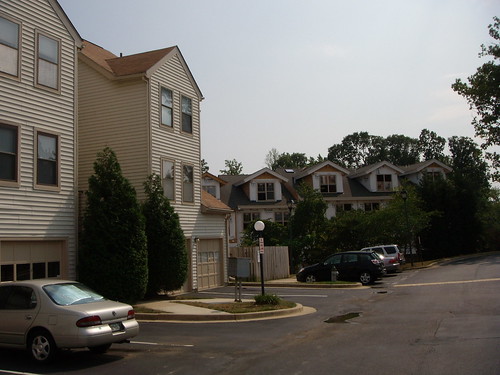
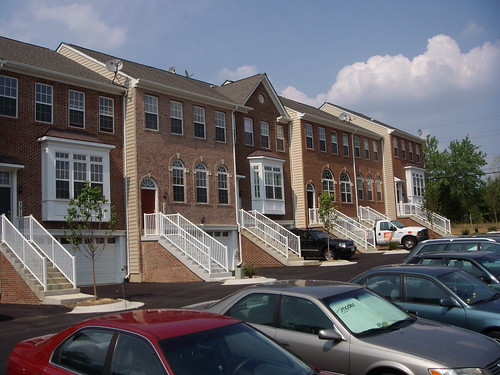
Condos and townhomes in Briggs Chaney.
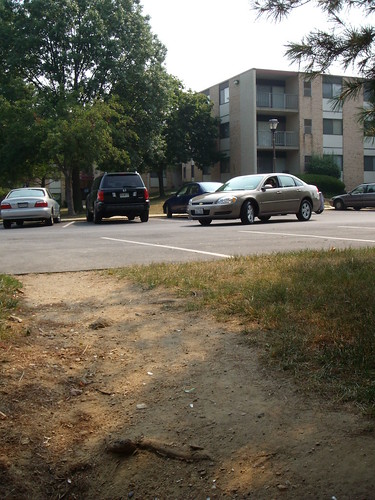
With clusters of self-contained apartment and townhome complexes, places like White Oak and Briggs Chaney have all of the problems of density with few of the benefits. They're compact enough that residents could (and often do) walk to amenities like schools, shopping and transit, but because they're divided into isolated complexes and built with few connecting streets, these neighborhoods have become decidedly car-oriented environments - and they've got the traffic congestion to show for it.
Not only that, but they discourage the formation of community. The yearly East County Community Day, hosted by the Windsor Court and Tower apartments, doesn't draw nearly as many people as it could - both from within Briggs Chaney and the greater area - because it's tucked away inside one apartment complex, out of sight and out of mind.
What would it take to make these communities into functioning, pedestrian-friendly urban places? Chris Bradford from the Austin Contrarian blog writes about Austin's "apartment city," a place that sounds strangely like Briggs Chaney, and says it's a waste that a dense neighborhood can't also be a paragon of good urbanism as well:
"It occurred to me that this vast stretch of apartment buildings was a tremendous missed opportunity. With just a little rearranging, these apartments could have been transformed into a pleasant urban neighborhood of 20 or 30 blocks.
The complexes contain literally scores of individual buildings. It would have been easy to arrange them in a grid fronting public streets with alleys in the back. The only significant architectural modification would have been closing in the breezeways/stairwells to create common entrances . . . I have to believe that lots of prospective tenants would have preferred an urban layout. They would have gotten pleasant, proper neighborhoods, with a store or two nearby -- the complexes are dense enough to support a couple of small retail uses were they not walled off from one another.
The only drawback -- and I acknowledge it could be a big one -- is safety. Those tall fences and gates provide a sense of security. Now, they don't make it difficult to get into the complex. In large complexes with hundreds of residents, the gates are constantly opening or closing. (I freely wandered in and out of one yesterday.) But the fences and gates do make it harder to get out, which deters criminals. Complexes like these of course experience assaults and car break-ins, but I'm sure they're safer than similar complexes that lack fences and gates.
Proper urban neighborhoods provide their own deterrents, though. A short block lined with dense walk-ups has lots of eyes and ears on the street. Good lighting is another deterrent. As is steady traffic."
The Briggs Chaney Road area doesn't get a lot of love from most East County residents. This motley mix of scraggly apartments and townhomes is often ignored by people now able to whiz through on Route 29. But this Saturday, you're invited to look at Briggs Chaney in a different light.
East County Community Day, which goes down August 4th at noon, will turn Windsor Court and Tower Apartments into a wonderland of activity for anyone willing to make the trip down Castle Boulevard. There'll be food and fun for the whole family - in addition to a brief service for the Nuka family, whose three children perished in a fire in the Windsor apartments last month.
Just Up The Pike will even have a table where you can learn a little more about what I'm all about. (I think: I have to talk to the person in charge there.) So come on by - if East County can't come together around hamburgers and hot dogs, I don't think there's any hope for us.
post title from "Briggs Chaney" by local band The Spotlight.
Tucked away within what wilderness remains in East County, are - what else? - new homes. A few weekends ago, I wandered into three developments now under construction Up The Pike. Here's another installment of Model House Reviews: Down Briggs Chaney edition.
Check out this slideshow of ParkView, Whitehall Square and Aspen Ridge.
And you can forget about walking to the park - sidewalks are absent, especially in the development itself. The real view is asphalt, lots and lots of asphalt, and it's ugly as sin.
AFTER THE JUMP: Colorado comes to East County, disappearing salesmen, and the ongoing fight to have "Silver Springs" banished.
I toured the Lafayette model, which sells in the $480's. The construction feels incredibly cheap: the stairs creak with every step; the sound of the air conditioner in the basement rumbles through the entire house, competing with the noise of traffic on Greencastle. A bowl of lemons placed on a kitchen counter said more about these houses' value than I ever could.
The sales associate was nowhere to be found - I finally discovered him in the basement, staring blankly at a computer screen, oblivious to my presence. For a few seconds, I stood there, wondering what I should do (and what he was looking at), but instead gave up and quietly slipped out, leaving my card on a table.
Whitehall Square
As is the trend in East County subdivision names, there is no "square" in Whitehall Square, located off of Stewart Lane in White Oak. Local juggernauts NVHomes and Ryan Homes have put together an all-star lineup of their best townhome models, the Carnegie and Astor. How do we know they're the best? Because they're the same homes offered in all of their other communities.
With models named for 20th-century Americansocialites, Whitehall Square demands an aura of grandeur. And yes, never before has the jumble of apartments in White Oak's center looked so beautiful as from atop the majestic hill on which Whitehall Square is perched. It's especially true when compared to the detritus that surrounds the rest of the site: multiple boarded-up houses, glimpses of barbed wire from the neighboring FDA campus, and an abandoned trailer from a Giant truck.
The Whitehall sales office was staffed by no less than three associates, outnumbering the two actual potential homebuyers there at the time. One of the sales associates offered me his spiel, citing the proximity to the FDA, the Metro, the wooded site, the affordable price - starting in the $440's, he says, adding, "It's not what you'd expect in Silver Springs."
"Silver Springs?" I ask.
"Silver Springs," he repeats.
"No. Silver Springs?" I repeat, incredulous.
"He means Silver Spring," Sales Associate #2 counters, rather annoyed.
Aspen Ridge
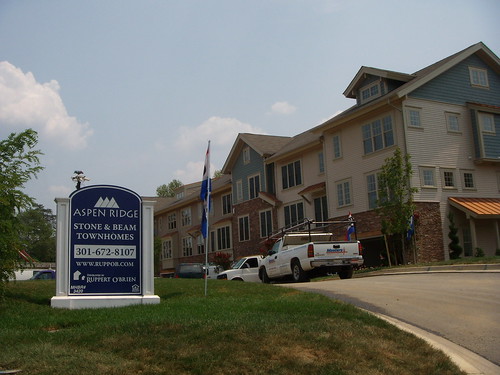
The hills on Dogwood Drive aren't good for skiing. But at the end of the road, two new developments by local builder Ruppert O'Brien advertise "Telluride-Inspired Townhomes." Whether or not the location off of Briggs Chaney Road reminds you of Colorado, it's clear from the start that Aspen Ridge and its sister community Albany Grove - the subject of one of JUTP's first posts, by the way - have a style all their own.
Much to my surprise, Sean Ruppert - the head of the company - greeted me inside the model house. The homes were, in fact, designed by a Colorado architecture firm, he explains. And sounding very like an HGTV host, Ruppert led me around, pointing out the open floorplan ("We try to be very 'cas'," he says) and the polished concrete countertops in the kitchen.
"Isn't it very 'mod'?" he asks. I nod in reply.
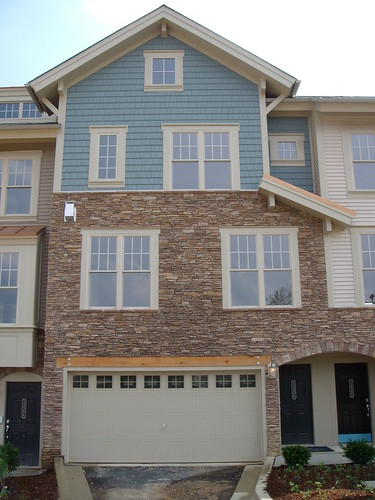
With stone-and-cedar-shake fronts, large windows and a splashy color palette of blues and reds, the Aspen Ridge townhomes are a breath of fresh air in East County, where most homes both new and old are traditional Colonials. But "townhomes as unique as you are," as the advertising suggests, comes at a price: the cheapest house is just under $500,000.
Come back on FRIDAY as Just Up The Pike sits down with developer Sean Ruppert to figure out just how Aspen Ridge came into being - and if he'll ever want to come our way again when it's finished.
A look at the Briggs Chaney Road area (focusing specifically on the road between Old Columbia Pike and the Montgomery County line), setting the stage for the "Down Briggs Chaney" series on Just Up The Pike.
Check out this photoset and come back later this week for more stories.
The Transportation Planning Board's draft proposal for a BRT network across the region, including seven lines serving East Montgomery County. Below: People boarding a bus in Briggs Chaney.
Today, the Transportation Planning Board released a map of a regional network of Bus Rapid Transit lines that they’d use to apply for funding from President Obama’s stimulus package (the very same that’s being used to repave New Hampshire Avenue in Colesville). While the system could be whittled down to fewer routes, it could become a reality by 2012 if the funding was available.
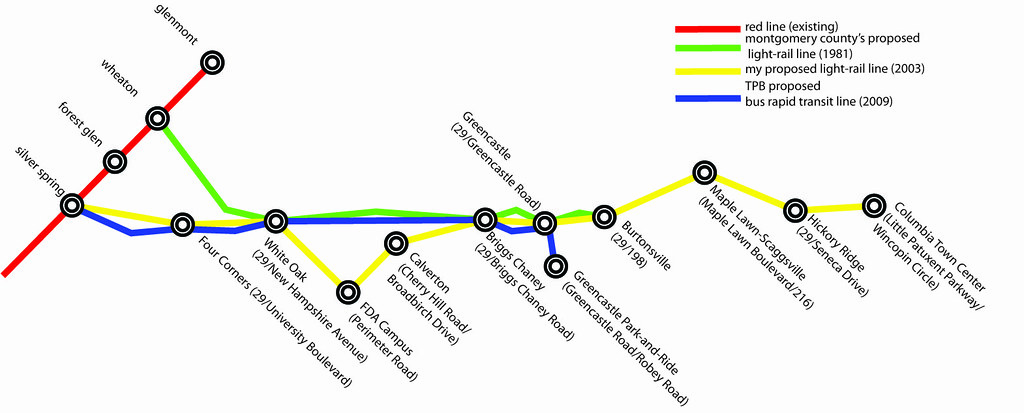
TPB’s proposal (see report and geographically accurate map) is very similar to Metro’s plan for priority bus corridors and includes no fewer than seven lines serving East County along Georgia Avenue, 16th Street, New Hampshire Avenue, University Boulevard and Veirs Mill Road, and an express line on the InterCounty Connector. It also includes a line along Route 29 between Silver Spring and Briggs Chaney, which might be the closest we ever come to the light rail line once planned along the corridor several decades ago.
Under the concept of “transit serviceability” – today’s Transit Oriented Development – thousands of apartments and townhomes were built in White Oak and Briggs Chaney in anticipation of the line, which had been a part of the master plan for eastern Montgomery County as late as 1981. That year, planners considered a rapid transit line between Wheaton and Burtonsville via Route 29, University Boulevard and an unbuilt “Route 29 Spur,” thus bypassing traffic going into Downtown Silver Spring. On Route 29, which is a limited-access freeway north of White Oak, the line would have been in the median, with “stops at major intersections, fringe parking lots, major employment centers, and other appropriate locations.”
With a price tag of $350 million ($1 billion in today’s dollars), the line’s projected low ridership made it a non-starter for the Planning Department. “Although projected peak period ridership was in the range considered appropriate for light-rail transit, projected patronage, on a day long basis could not justify the expenditure of capital and operating costs,” reads the 1981 plan. The Planning Department saw that light rail could actually be viable along Route 29 were it not for a lack of mid-day ridership. When the Fairland Master Plan was revised again in 1997, the concept of "transit serviceability" was removed altogether, taking away any provisions to expand transit even for the development that had already occurred, let alone what was to come.
As the project gains political momentum and development patterns along Route 29 slowly begin to justify additional transit services, any kind of rapid transit here seems more of a possibility. A Bus Rapid Transit line between Silver Spring and Burtonsville has been on the county's Move Montgomery plan for nearly a decade. On their scorecard for the District 4 County Council election, the Action Committee for Transit found that all but one of the eleven candidates expressed some interest in a 29 line.
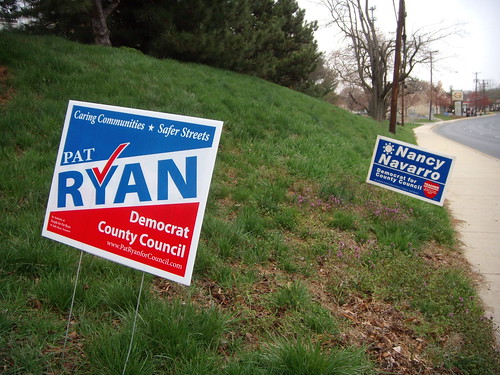
Responding to their candidate survey, Democrat Nancy Navarro notes that development on the east side has been and continues to be tied to public transit. "Without transit in District 4, there is no opportunity for transit-oriented development or smart growth," she writes.
Why rapid transit along Route 29? An existing pool of 200,000 daily rides is just the beginning AFTER THE JUMP . . .
A very quick diagram comparing past and present proposals for rapid transit along Route 29, including my own proposal from 2003.
1) By 1981, only a portion of the Briggs Chaney and White Oak areas targeted for dense development had been built out, and today, there are literally thousands of people living within a half-mile of the median of Route 29, where stations would have been located. The downside is that these neighborhoods were not designed to be pedestrian-friendly, meaning that few people are actually a half-mile walk from anything.
2) Shopping centers have been built at Burtonsville, Briggs Chaney, Cherry Hill Road and Tech Road, beginning to provide the mid-day trips the 29 Line needed to be economical. East County still isn’t nearly the shopping destination that Wheaton or Rockville Pike is, meaning that people running errands would still make up a small part of the potential ridership.
3) A small but growing job sector means that some people could have “reverse commutes” from the District, Downtown Silver Spring or other parts of Montgomery County. The arrival of 7,000 jobs at the FDA campus in White Oak and 3,000 jobs at the new Washington Adventist Hospital in Calverton suggest there’s a potential market for transit.
4) The industrial parks, garden apartments and shopping centers built during East County’s first wave of suburbanization in the 1960’s are all showing their age, meaning there are opportunities for infill development. Many of these projects, like the abandoned Francis Filbey Building at Route 29 and Tech Road, are adjacent to the highway, making them ideal candidates for TOD if a transit line were running in the median.
5) Route 29 has a large but underserved transit-riding population. The seven Z routes between Silver Spring, Ashton, Burtonsville and Laurel had a combined weekday ridership of 223,961 last July, according to WMATA, making it one of the highest-ridden lines in the entire Metrobus system.
Part FOUR of our "District 4 Head-to-Head Tour," which seeks to interview all eight candidates running in a special election to replace Councilmember Marilyn Praisner, who passed away in February. A primary will be held April 15, followed by a general election May 13.
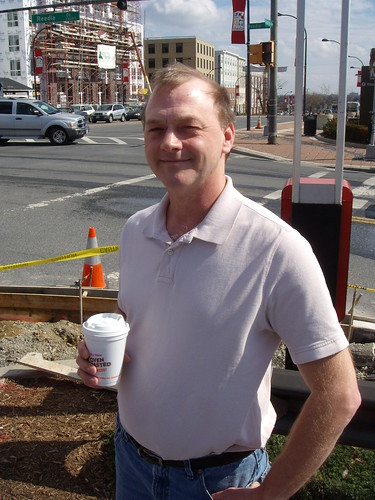
County Council candidate Thomas Hardman stands in Downtown Wheaton. Check out Hardman's campaign website and blog.
"If I seem a little disorganized and incoherent," explains Thomas Hardman while we're sitting down at Dunkin' Donuts in Wheaton, "it's because I don't have this [computer] screen in front of me serving as my short-term memory."
Ten years ago, the Aspen Hill resident was making a name for himself online, with a prolific posting streak on Usenet, an early bulletin board system, and a website that you could call an early blog. But today, he's stepping away from the keyboard and onto the campaign trail, running as a Republican for the open District 4 seat on the County Council.
"I'm finally realizing it's more important to do things in the real world than to write and write," Hardman says. "You actually have to go out into the streets, shake hands, talk to people in order to make changes. Writing is just grist for the mill."
Today, Hardman is dismayed by the County's inability to acknowledge the issues affecting many communities, including his own Aspen Hill. "I was going on and on about gangs in my neighborhood for eight years and the County pretended it didn't exist," he says. "Security here is a big issue, and there are huge gaping holes that people ignore here for political reasons."
so much more AFTER THE JUMP . . .
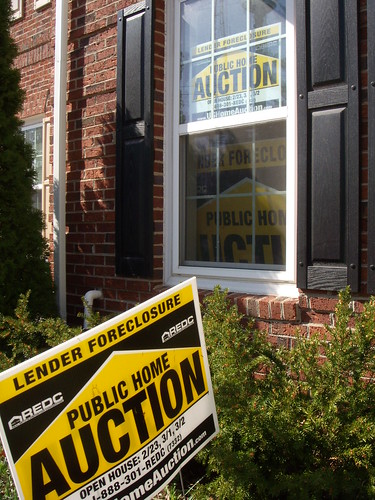
A new townhouse in Wheaton is up for foreclosure. A downturn in the economy has made foreclosures increasingly common throughout Montgomery County.
Overcrowding has changed the place his family moved to forty years ago when it was "pretty much the end of the world," Hardman says. He would see "people that would pave their yards, three to four families a house . . . most of those people were construction workers here to work on the [building] boom," he notes.
And the Department of Permitting Services, who is charged with making sure that homes are legally occupied and meet building codes, hasn't done a thorough job. "If you look at most of the fires in Aspen Hill, they were in homes with excess occupancy . . . if they had been inspected, these problems could have been prevented," he laments. "In some situations you may want to speed up the process for more egregious violations."
With the faltering economy, however, overcrowding isn't the only problem in his neighborhood anymore. "You drive through Aspen Hill now, especially on the main thoroughfares, and it's one For Sale sign after another," he says. "I read about a town in Ohio that has the highest foreclosure rate in the nation, and it's just melted down . . . I could see some of those problems happening here."
Meanwhile, the County budget keeps growing larger and larger, he laments. "I'm trying to think of the right organic metaphor," Hardman says. "You ever see those science fiction movies with the giant amoebas?"
However, raising taxes isn't an option. "We're also gonna have to cut a lot of services," he laments. "You have a lot of these agencies that try to be everything to everyone . . . focus on the core competencies and less money will slip through the cracks," Hardman adds. "The last thing we want to do is tax the middle class into insolvency."
Hardman fears that Montgomery County could be getting too big for its britches. "Stop inviting more growth," he insists. "If you look at living things, the size of an organism is designed for its environment. You're not gonna have an elephant where there isn't enough food for it to eat . . . things are scaled by design."
While the pace of growth may be too high, the quality of the growth isn't nearly high enough, creating a "disconnect" between "here's where people work and here's where people live," he says. "That's where mixed-use zoning comes in. I lived in the District for several years and what I liked the most about it was within two blocks you had a variety of stores."
The addition of high-end housing in Downtown Wheaton allows people to live, work and shop in the same place.
We're outside at the corner of Georgia Avenue and Reedie Drive now, voices fighting the traffic, commenting on the accelerating redevelopment of Downtown Wheaton. Hardman keeps returning to the idea of the 'arcology,' a kind of superstructure in science fiction where a large amount of people can live, work and play without ever leaving. Places like Wheaton could almost be considered arcologies, he says. "If you think of the arcology as the reinvention of the village, you've got places to live, places to shop, places to work and transit," he explains. "All the stuff is there, you just have to build boxes and put people in them."
Hardman says it's possible, but he's skeptical. "This is the city, but it wasn't designed to be . . . other than saying 'this is a commercial area,'" he says. "The roads just weren't designed for this kind of traffic and the transit system is at its breaking point."
"These places will be pretty nice 'cause they're near Metro and shopping," he continues, motioning to a block of apartments and offices rising across the street. "The issue is can the people who work there afford to live across the street . . . can people who live there work at the mall?"
While Hardman supports public transit - he would like to see the Metro augmented with a system of "circulator-type" buses in business districts and longer-distance express buses - he rarely uses it anymore. "It's an increasingly unpleasant experience not because of the character or the quality of the people but because there are so many of them," he says. "It's getting to be more like Japan where they hire people to push you through the door."
Nonetheless, he states that "rail of any kind is the most efficient form of transportation that we have," but further implementing it here wouldn't necessarily be that way. "If we move to an urban planning concept that resurrects the village and have rail connecting them. . . I don't know how well that would work for Montgomery County as it's configured now," he says.
"All of this that runs on oil . . . all of this here will have to be massively downscaled - and sooner rather than later, or we could wind up like squirrels who haven't stored enough nuts for the winter."
Boarding a bus at Briggs Chaney Road and Old Columbia Pike. Hardman feels that creating more mixed-income housing in Briggs Chaney could have a large effect on the surrounding area.
I was flattered when Hardman e-mailed me to say that he'd been so inspired by JUTP's series on Briggs Chaney Road last summer that he drove down it a few days before our interview. The portion west of Old Columbia Pike "looks like a pretty nice neighborhood, the kind of place people would want to stay the same, save for a little less traffic," he says, though the areas east of the Pike were another story.
For their candidate profile, the Gazette asked Hardman if he felt the Planning Board was to blame for low test scores at Paint Branch High School, which serves the square-mile amalgamation of low-rent apartments and townhouses at Briggs Chaney and 29. "Probably concentraing [low-income people] all in one district isn't going to make them happy," says Hardman. "You look at scattered-site housing . . . maybe they could convert some of those high-density areas into luxury condos and have a wider mix of incomes."
Hardman was very disappointed, though, to read that local punk legend and Government Issue lead singer John Stabb was assaulted outside of his Briggs Chaney condo last summer. Twenty-five years ago, he was a fan, he explains. "You probably shouldn't write this, but I was kind of one of the first Goths in town," says Hardman. "I was not really super involved in the hardcore [punk] scene, but I probably drank in the same bars as they did."
Today, however, his musical involvement consists of some very respectable noodling on the guitar, which he's featured on his campaign website. Hardman likes to play guitar on his front porch, adjacent to a bus stop, which earns him both cheers and jeers from passers-by. "Most of the neighbors were like 'hey, great job, keep it up,'" he says. "But the people on the bus were like 'cut that mess down,' so I don't go on the porch anymore."
UPDATE: We've revised this post to reflect the new name of the builder at Aspen Ridge, OPaL. You can check out their latest projects in Montgomery County and across the region at their website, www.opaldc.com.
Part of a continuing series on Briggs Chaney Road - what it is and what it will become.
Photos graciously provided by Sean Ruppert. To see more pictures of Aspen Ridge and Albany Grove, check out our "model house reviews" slideshow.
For local builder Sean Ruppert of OPaL, inspiration comes even after you've mentally hit a wall.
"Look at the condos next door," Ruppert says, pointing to a three-story-high blank wall visible from his office at Aspen Ridge, a new townhouse development going up off of Briggs Chaney Road. "They look really old and tired, but I just love the architecture. See how steep the roof is? It really reminded me of a ski chalet."
With the help of an architect from Boulder, Ruppert (at right) created a Colorado dreamscape in East County with his latest developments, Aspen Ridge and Albany Grove. With exteriors painted in rich blues and reds, stonework and shingles, these houses break the brick-Colonial mold. Inside, huge windows frame views of the trees and the surrounding apartments.
so much more AFTER THE JUMP . . .
Inside the Breckenridge, one of two models offered at Aspen Ridge and Albany Grove. Photo provided by Sean Ruppert.
"You take into account the positives," Ruppert says. "This is a great location. There's a lot going on, and you're still in Montgomery County." East County's improved dramatically over the past few years, he explains. The Aspen Ridge website even refers to Silver Spring as "Montgomery County's sweetheart city."
That attention to detail - both inside his houses and inside the community - has won over the neighbors. Sort of. "The condo association next door loves us," Ruppert notes, "and the people in the apartments just don't care."
"Townhomes as Unique as You Are . . . Don't Settle for Yet Another Colonial Townhome." - Aspen Ridge advertisement
OPaL's first project in Montgomery County - the more traditional Towns of Aston Manor a few streets over - was "something safe" that would sell. But at Aspen Ridge, "We just wanted to do something that would appeal to people who expect something different from their home," Ruppert says.
"My mother worked in real estate, and she always said what makes a good home for resale is what makes it unique," states Ruppert. "When you walk through our homes . . . you just feel good. You feel good about the space you're in. Most of our competitors build ordinary Colonial homes, and on the inside, they feel ordinary."
Most builders are familiar with their competition. Ruppert used to work for NV Homes, his biggest local competitor. He actually lives one of their houses - one he sold to himself sixteen years ago. And don't get him started on Whitehall Square, the latest NV Homes development a few miles away in White Oak.
"Whitehall? Of course. They build the same thing everywhere," Ruppert says, a giddy smile crossing his face. "That's the Carnegie and the Astor. You can get it in Tysons for one million, on the Eastern Shore for seven-seventy-five, and in Baltimore for three-fifty. I was the first to sell the Carnegie in 1996 for $233,900 at the Springfield Metro."
When Ruppert got tired of shilling Carnegies, he decided to start his own firm. Since 1999, OPaL's been building small projects across the region - from Northern Virginia to Baltimore - and he'd like it to stay that way.
"I think that it's completely and utterly insane with this NIMBY mentality. If we'd had that in the '60's and '70's, no one would be living here."
"I like the size that it is now," Ruppert says. "A few employees, a few key people. I'd like to do a few more projects in Northern Virginia."
Would that mean Aspen Ridge and Albany Grove will be OPaL's last projects in Montgomery County? The red tape is just too expensive, laments Ruppert. Problems with a sewer line caused a delay, he says, in addition to others imposed by Montgomery County, WSSC and the State Highway Administration, which will start construction on the InterCounty Connector nearby next year. And that time spent means money lost.
"I can't say I would actively ever look for another project in Montgomery County," says Ruppert. "Park and Planning has been a challenge at every stage . . . it's so expensive, and every time you turn around there's a fee that wasn't there before."
Ruppert blames the current "NIMBY mentality" in MoCo for his difficulty in getting houses built - despite the fact that his project's neighbors are happy with what he's doing. "They [the NIMBYs] preach Smart Growth? This is Smart Growth," he says. "It's close-in, it's near that transportation hub."
He's referring to the Briggs Chaney Park-and-Ride (at left), about a half-mile away. A visit to the station revealed a single bus stand boiling in the midday sun. One person was waiting for a bus and staring idly at the cars for sale in the Auto Park across the street.
"I understand there's more traffic congestion" in Northern Virginia, Ruppert laments, "but they're so much more business-friendly." A sales contract in Virginia or the District of Columbia, he points out, is only six pages long. In Montgomery County, it's an inch thick.
"It's such a shame because it's such a great market, and there's people who want our product," says Ruppert. "You should stay here on Sunday and see what people have been saying about the model. 'We've never seen something like this,' or 'Montgomery County deserves this.'"
Rendering of the Eco-Estate @ Briggs Chaney. Photo courtesy of Showcase Architects.
Before the economy disappeared (or perhaps because of it) there's been a lot of discussion of "green" building techniques, especially here in East County. Both the proposed White Oak Recreation Center and Burtonsville Town Square shopping center are gunning for some certification on the LEED rating system, which measures how environmentally sustainable a building is. For instance, Burtonsville Town Square will use geothermal heat pumps, which carry warm air from four hundred feet below ground to the surface, instead of using an electric or gas-powered furnace.
If you've driven down Briggs Chaney Road in Cloverly recently, you've probably seen the "Eco-Estate," a new home being designed and built by Showcase Architects as a laboratory for environmentally-friendly building techniques. It is also ugly, with the massing of a warehouse, the charm of a strip mall and failing even to do the faux-Colonial thing that every other McMansion in East County does in a cheap attempt at paying homage to this region's architectural heritage.
Model of the Eco-Estate @ Briggs Chaney. Photo courtesy of Showcase Architects.
But my beef with the Eco-Estate has less to do with its looks than the idea that building a super-sized house with a three-car garage on an acre-plus lot in an edge-suburban area miles from schools, workplaces and [most] shopping (it's a thirteen-minute walk to the Safeway in Cloverly, says Google Maps) is "green" because you used Energy Saver appliances. There are many notable environmentally-friendly features - the same heat pumps planned for Burtonsville Town Square, for instance - but one that could have saved the most energy was ignored completely.
We haven't talked enough about "green" planning - reducing energy use by making it easier to get around without a car, and reducing impacts on the natural environment by building in existing communities. The Downtown Silver Spring revitalization is a good example of this or, on a smaller scale, the twenty-year-old Wyndcrest development in Ashton. Neither of these projects could get a LEED rating, but they've been noted for their eco-friendliness by making it easy to walk to schools, shops and transit. In Wyndcrest, homes are sited on small lots, using up less land in a community still dominated by farms and forests.
The real "Eco-Estate" would be located closer-in, near Metro, maybe in one of the neighborhoods around Downtown Silver Spring or Wheaton where you won't need a three-car garage because the occupants won't need three cars. Or it could still be in Cloverly, but next to the town center, allowing a real village to form while not disturbing the semi-rural areas around it. The house would also be much smaller, reducing energy use solely because you have fewer rooms to heat.
If we're going to make this house an example of "green" design, it should show every single way that a family could reduce their impact on the planet. (It would also be nice if the architects actually put some architecture on this house as well, because as it currently stands, the most environmentally-friendly way to improve the Eco-Estate would be to put it out of its misery.)
The Gazette wonders who will fill the shoes of civic activist Stuart Rochester, who passed away last week. Judging by the number of times his name's appeared in that paper over the past several years, I doubt it's likely to be one person. Nor should it. As open-minded as those in Wednesday's article say Rochester was, an individual can only represent the wants and needs of a few in our increasingly diverse community.
There are a vast number of constituencies here - different ethnic and religious groups; blue-collar and white-collar; families, couples and singles; young and old; people who remember what Burtonsville was like forty years ago and those impatient to see it forty years from now. Never have they been fully represented by East County's civic structure. Aside from neighborhood and homeowners' associations, we've never had much organization on a larger level. And as devoted as the members of an HOA can be, they usually look out forthemselves and ignore the greater context.
Citizens Involved, an "umbrella civic group" whose Eileena York became a mouthpiece for Burtonsville's long hoped-for revitalization, fizzled out after barely two years of existence. We have the East County Citizens Advisory Board, which does an excellent job as transmitting our concerns to County Executive Ike Leggett, himself a Burtonsville resident. But they make recommendations, not actual policy. And with eighteen members, they've got enough people to form their own civic association but too many to lead one.
What I would like to see is a regional advocacy organization unbound by the parochialism of local homeowners' associations and seeking to be as inclusive as possible. It should cover a wide area - the entire Route 29 corridor from Burnt Mills to Burtonsville, for instance - and seek representatives from as many neighborhoods as possible. In Olney, where the county wants to redevelop the town center, the Planning Department has convened an Advisory Committee composed of delegates from homeowners' associations, civic groups, and business and social organizations as well. As a result, the discussion won't be one-sided because you have groups with many, many different interests at the table.
One group that definitely needs to be included in any East County civic group is the residents of apartment complexes. Rental communities are stereotyped as being "transient," something Stuart Rochester constantly railed against, but by not engaging the residents who are there for the long run, you can't rally for the kind of improvements that would make more people want to stay.
Windsor Court and Tower Apartments, located on Castle Boulevard in Briggs Chaney, has done a good job bringing their residents and those of surrounding complexes together with the East County Community Day, held each August for the past two years. Spurred by the deaths of three sisters in an apartment fire, the event is an outdoor fair held in a parking lot. Attractions include a barbeque, performances by local musicians, a petting zoo, and booths offering goods and services. There is no hidden agenda; leasing agents insist that they wouldn't be showing apartments during the fair.
Right now, Community Day is a small event, tucked in the back of an apartment complex on a residential street many people may never go down. But it's well supported by the nearby Regional Services Center and could grow if moved to a more visible location - say, in the parking lot of the Briggs Chaney Plaza shopping center, which after last month's shooting in broad daylight could use some good publicity. It's an opportunity to showcase local restaurants; to "re-brand" the Briggs Chaney area for people more familiar with its reputation for crime; and give renters a chance to assert themselves as part of the greater community.
I've been reflecting a lot on the passing of Stuart Rochester, and what his loss truly means for those who live in eastern Montgomery County. And I come to the same conclusion that I had before: we need more voices in the conversation. Not just because he worked so hard that no one could replicate his efforts, but because no one can truly speak for the majority. If there's a hole in East County, I'm looking forward to getting it filled - by many people, from many places, with many ideas.
You're reading Just Up The Pike's 702nd post. It's hard to keep count after nearly three years of writing about the east side, but I thank you for reading and putting up with me all this time!
The "Eco-Estate" (right) and a newish, traditional house on Briggs Chaney Road in Cloverly.
The other day, I drove by the "Eco-Estate," a new house under construction on Briggs Chaney Road in Cloverly. Showcase Architects, the local firm which designed and built the house, sought to make it environmentally-friendly. Earlier this year, I wrote that a big, boxy house on a big lot in the suburbs isn't particularly "green" - but a house that ignores its context is even worse.
What context? Historically, this part of East County - Fairland, Cloverly, Burtonsville, Sandy Spring, so on and so forth - were small, rural communities. Homes sat on large parcels of land, but that land was being farmed. And the houses built were modest - no two-story great rooms here; just a living room, a kitchen, a couple of bedrooms, a porch for sitting. The only "green" features were an efficient use of materials and windows on all sides for cross-ventilation because air-conditioning wasn't cheap. These older houses you might see on Briggs Chaney Road might look dowdy and run-down, but they represented an awareness of conservation and sustainability we're still trying to find today.
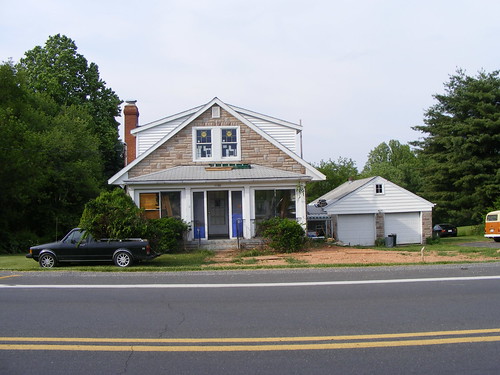
This cottage across the street is being rehabbed.
The "greenest" - and often cheapest - thing you can really do is take an old house and renovate it. Showcase Architects should be applauded for moving and eventually renovating the house that formerly occupied the site where the Eco-Estate is now. Across the street, another old farmhouse is being renovated. Built in 1937, it predates the Silver Theatre in Downtown Silver Spring, but as recently as last year there was a "For Sale" sign outside advertising a tear-down. By fixing the house up, we're preserving East County's history while providing a new, environmentally-friendly place for a family to live in.
Over the past four years, I've sought to examine East County's people, places and major issues in greater depth. Just Up The Pike Special Series are multi-part explorations of life on the east side.
percontee: giving new life to the county line They've been building in suburban Washington for over fifty years. But can Percontee get their ambitious new proposals for Calverton and Hyattsville off the ground?
three brief posts on the silver spring library After years of waiting, Downtown Silver Spring finally gets a new library. Or, at least, final plans for a new library. the press conference | part ONE | part TWO | part THREE
the videomakers: a JUTP exclusive interview Walter Gottlieb's made a career out of documentary filmmaking, but the Silver Spring resident's trying his hand at fictional storytelling - with a decidedly local twist. part ONE | part TWO | part THREE | part FOUR
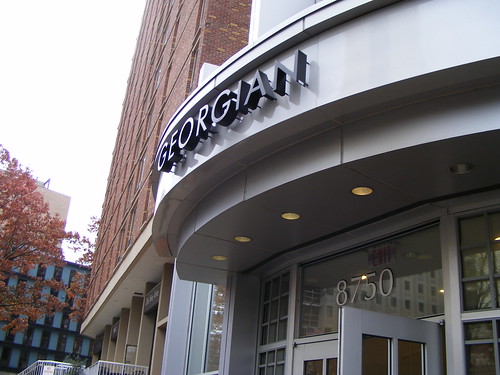
they used to call it georgian towers (part ONE | part TWO | part THREE) Looking back at growing up in an now-gentrified apartment building in Downtown Silver Spring.
district 4 "head-to-head tour" 2009 Meet the District 4 County Council candidates in these exclusive, one-on-one interviews, which will be posted as they're completed.
the purple line diaries (part ONE | part TWO | part THREE) My attempts (of varying success) to get from College Park to Twinbrook and back during rush hour - and to get my roommate to ride the bus.
burtonsville town center charrette (part ONE | part TWO | part THREE | part FOUR | part FIVE) The community comes together to discuss Burtonsville's present - and creates a plan that'll determine its future.
creating a legacy: lisa null A four-part series exploring the life and career of Silver Spring folk artist Lisa Null.
district 4 "head-to-head tour" 2008 Meet the candidates and learn about the County Council special election in these exclusive, one-on-one interviews.
hip hyattsville (part ONE | part TWO | part THREE | part FOUR) JUTP visits Arts District Hyattsville, one of several new developments aiming to reposition the Prince George's County town as a new, urban center.
turf town meeting (part ONE | part TWO) Residents and experts meet to discuss the future of "the Turf" in Downtown Silver Spring.
rockville mayoral election (part ONE | part TWO | part THREE) An unlikely trip through the bowels of Rockville Town Square with 2007 mayoral candidates Drew Powell and Susan Hoffmann.
county government "head-to-head tour" 2007 Just Up The Pike heads to Rockville to sit down with our County Councilmembers and County Executive Ike Leggett and talk about whatever's bothering East County.
 ABOVE: light pollution from the Montgomery Auto Park on Briggs Chaney Road at night.