While we're deciding whether a developer should own a new town square in Wheaton, we should remember that the danger of public spaces in private hands is that they can cease to be public spaces entirely, especially when fears about crime or safety arise.
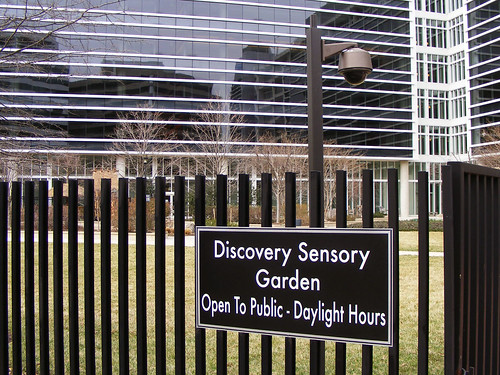
In the agreement (PDF), Discovery would keep the garden open seven days a week from 7am to 10pm during Daylight Savings Time and from 7am to dusk the rest of the year. They also agreed to create an "enclosure" to the Sensory Garden that would "minimize the visual presence of the fence" while "[reducing] the screening effect of the landscaping" in order to "[increase] the public sense that they were welcome and safe in the garden."
Yet for most of the past decade, the garden has been inaccessible, surrounded by a tall iron fence whose gates were open intermittently. Both the garden and a public plaza Discovery provided at the corner of Georgia and Wayne avenues have been aggressively patrolled by security, which is unusual compared to most "pocket parks" in downtown Silver Spring.
After a gunman entered Discovery Communications' offices and took hostages last September, the company shut the garden completely. It reopened "during daylight hours on weekends only" in November, but a month later, Discovery announced that independently-conducted security assessment recommended they build an eight-foot-tall fence around a playground within the garden.
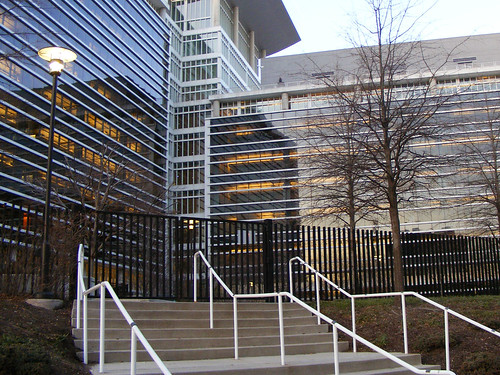
Four weeks ago, the Planning Board approved the taller fence, which would require reducing the garden's area by 1,400 square feet. To compensate, Discovery offered to "provide an artistic, interactive design" for the fence that would "engage the public."
Though Discovery's actions completely violate their agreement to provide public space, county planners have been unusually lenient, calling security a "sensitive issue" for the company. Police say that the gunman, James Lee, was carrying a bomb that could have injured several people nearby.
Last year's hostage situation was a tragedy, and it's understandable that Discovery wants to keep their employees safe. That does not, however, allow Discovery to turn their offices into a fortress. They're located in a busy urban area, with thousands of people walking through or around their complex each day. To say that most of them are not a security threat would be an understatement. In fact, having so many "eyes on the street" makes Discovery's complex safer.
To bring Discovery to Silver Spring, Montgomery County cleared four city blocks and abandoned several streets to assemble a parcel of land big enough to build a corporate headquarters. The public space they agreed to provide already belonged to the public. Would the county let Discovery close a street for security purposes? Of course not. And they shouldn't give up the Sensory Garden, either.
In the agreement (PDF), Discovery would keep the garden open seven days a week from 7am to 10pm during Daylight Savings Time and from 7am to dusk the rest of the year. They also agreed to create an "enclosure" to the Sensory Garden that would "minimize the visual presence of the fence" while "[reducing] the screening effect of the landscaping" in order to "[increase] the public sense that they were welcome and safe in the garden."
Yet for most of the past decade, the garden has been inaccessible, surrounded by a tall iron fence whose gates were open intermittently. Both the garden and a public plaza Discovery provided at the corner of Georgia and Wayne avenues have been aggressively patrolled by security, which is unusual compared to most "pocket parks" in downtown Silver Spring.
After a gunman entered Discovery Communications' offices and took hostages last September, the company shut the garden completely. It reopened "during daylight hours on weekends only" in November, but a month later, Discovery announced that independently-conducted security assessment recommended they build an eight-foot-tall fence around a playground within the garden.
Four weeks ago, the Planning Board approved the taller fence, which would require reducing the garden's area by 1,400 square feet. To compensate, Discovery offered to "provide an artistic, interactive design" for the fence that would "engage the public."
Though Discovery's actions completely violate their agreement to provide public space, county planners have been unusually lenient, calling security a "sensitive issue" for the company. Police say that the gunman, James Lee, was carrying a bomb that could have injured several people nearby.
Last year's hostage situation was a tragedy, and it's understandable that Discovery wants to keep their employees safe. That does not, however, allow Discovery to turn their offices into a fortress. They're located in a busy urban area, with thousands of people walking through or around their complex each day. To say that most of them are not a security threat would be an understatement. In fact, having so many "eyes on the street" makes Discovery's complex safer.
To bring Discovery to Silver Spring, Montgomery County cleared four city blocks and abandoned several streets to assemble a parcel of land big enough to build a corporate headquarters. The public space they agreed to provide already belonged to the public. Would the county let Discovery close a street for security purposes? Of course not. And they shouldn't give up the Sensory Garden, either.