Monday, April 9, 2012

third proposal emerges for downtown wheaton redevelopment

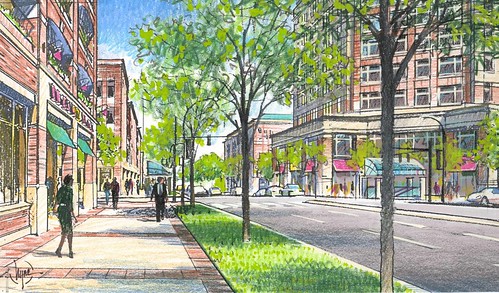
office-render
Conceptual rendering of offices along Georgia Avenue from a 2004 design charrette.

Last Thursday, I wrote about the dueling proposals for the redevelopment of downtown Wheaton. For two years, County Executive Ike Leggett has been in talks with developer B.F. Saul to build a new town square on Lot 13 and a platform over the Metro to accommodate several office buildings and a hotel. Meanwhile, the County Council proposes a smaller plan, with just one or two office buildings and a new town square on Lot 13.

Wheaton Patch wrote on Friday that a third proposal emerged. This plan would basically carry out the County Council's proposal while providing an additional $1.7 million in funding to study building a platform in 2017 and 2018. The County Council will vote on one of the three proposals tomorrow.

Meanwhile, Leggett's office wasn't happy with my post. Over at GGW, my post received two angry comments from Jonathan Fink and Chelsea Johnson, both of whom are members of the Wheaton Redevelopment Advisory Committee, which endorsed County Executive Ike Leggett's proposal. I also received an e-mail from Donna Bigler, assistant director to the county's Office of Public Information, demanding that I make corrections. It's printed at the end of this post.

I stand by my research for this post, including included two phone interviews, several e-mails, reading the County Council's staff report that's available online, and many articles from the Gazette and Wheaton Patch. I admit that I did not reach out to anyone in the County Executive's office about their proposal, foolishly assuming that any information I needed would be available online. It wasn't. Neither the WRAC homepage, the county's page on Wheaton redevelopment, or B.F. Saul's page have any recent information about the current proposal.

It seems that if Leggett wants to make his side of the story, he needs to make his story readily available to the public.

Anyway, I've previously stated my misgivings about the size of Leggett's proposal, but my bigger issue is his timing. The Metro station, located at the intersection of Georgia Avenue and Veirs Mill Road, is potentially the most valuable property in downtown Wheaton and a logical place to put a lot of development. At the same time, you have to spend nearly $40 million to make it buildable. Why do it now, when we're still coming out of a recession and when Wheaton has not yet established itself as a high-value location for office development?

We should start with other publicly-owned properties in downtown Wheaton, like Lot 13 and other parking lots, if only because they're already on solid ground. Building there would draw people to the area and turn Wheaton into a more desirable place to live and do business. Then, we could come back to the Metro station in several years and make a killing.

Of course, Ike Leggett won't be County Executive in several years, so he won't be able to take credit for whatever happens then. Elected officials are often averse to thinking beyond the next election, but that's the only way you can make a large, complicated redevelopment project happen.

The following is the e-mail I received from Donna Bigler:

Upon review of the article in GGW, Montgomery County Department of General Services and other Executive branch staff offer the following comments and clarifications:

The article states that $42M would only cover the cost of the platform.

This is inaccurate. The $42M covers the cost of the platform, the relocation or interim bus operations, the construction of a new public town square on Lot 13, new bus bays that comport with future RTV facility needs, lease costs associated with the relocation of the Regional Services Center as well as other miscellaneous expenses like staff resources and public art.

The article states the County Council’s alternate proposal would cost $55M -- $2.5M for the town square and $5.6M for an underground garage.

This is grossly underestimated. While the town square construction is estimated to cost $2.5M, the underground garage would exceed $19M. The Lot 13 is a Parking Lot District facility and the PLD is required to be made whole on their property. In other words, the new underground garage would need to replace all of the existing surface parking spaces. The PLD would require 205 (an entire level) to replace the surface spaces. Add the future development on Lot 13 and the garage would need to be at least three levels at 205 spaces per level. Executive staff estimates the cost to be approximately $31,000 per space or $19M for 615 spaces (3 levels). Further, a new office building on Lot 13 to be constructed by Montgomery County would exceed $46M by nearly $30M. Other published estimates grossly misjudge the public costs of constructing an office building on Lot 13.

The article notes that 1,600 workers would come to downtown Wheaton’s 415,000 square feet of County office buildings.

This is inaccurate. The Council’s PHED Committee proposal only suggests funding for one office building – an either/or scenario. As such, the required space would only amount to 150,000 square feet for a new building -- not 415,000. If the building were to be a new MNCPPC headquarters, they have 400 employees. If it were an office building for DEP and DPS, they have 100 and 200 employees respectively.

The article states that the County is positioned to subsidize rents for a GSA tenant.

This is inaccurate. BF Saul and the County Executive’s staff have not entered into any agreement to subsidize rents for a GSA tenant nor is the County Executive staff considering any such arrangement. That said, it has been a long practice in Montgomery County to incentive economic development initiatives by subsidizing rents, i.e. Silver Spring and NOAA. It is important to note however, that those incentives are County Council actions and not those of the Executive.

The article states that the County has not performed a cost benefit analysis as part of the Executive proposal.

This is inaccurate. In fact, there have been several iterations of fiscal impacts and analysis completed throughout the public process. The fiscal impact was provided to the County Council and it was evident that the impacts are positive over the long term. Further, the fiscal impact simply evaluated the Executive CIP proposal’s effect and did not include the greater positive benefits from development that is generated as a result of fostering a new market.

Regarding the Urban Land Institute recommendation:

The 2009 ULI recommendation was made before the Safeway/Patriot high-rise, mixed-use project became a reality and before County resources were considered to build a platform over the Metro site. The ULI recommendation, in fact, differs from a 2008 International Downtown Association study, which recommended that development on the Metro site and Parking Lot 13 be major element of Phase I redevelopment. (We wrote about their findings, namely their proposal to move the Wheaton library downtown -ed.)

That study recognized the need and importance of such County support. “Panelists believe that the CBD could support more {Office development}, though perhaps not on the scale of Bethesda or Silver Spring. Because the CBD is an untested market for Class A commercial office space, the County will have to play a key role in attracting commercial office development to the CBD. It may need to be a pioneer by locating a significant department in Wheaton’s CBD, either as a tenant in a private sector development or as a county facility that could anchor additional private sector development.”

Thursday, April 5, 2012

county council to vote on dueling development proposals in wheaton (updated)

Next Tuesday, the Montgomery County Council will choose a development proposal that it hopes will jump-start revitalization in downtown Wheaton.

Two competing proposals have emerged from County Executive Ike Leggett and the council for several publicly-owned properties in the area, both of which include significant office space. Leggett's proposal is larger and enjoys community support, but it may not make economic sense. The council's proposal is smaller, but takes a more deliberate approach to redevelopment.

While residents are impatient to see change in Wheaton, rushing into a redevelopment scheme that could harm existing businesses without quickly creating new value in is not in the community's best interest.

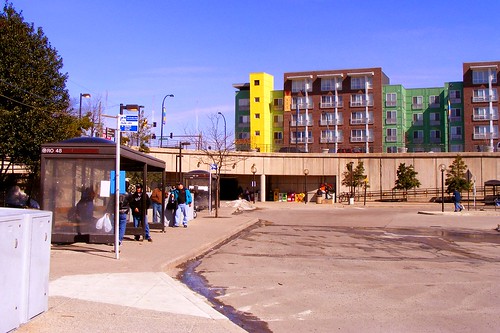
MetroPointe & Wheaton Station
The Metro station bus turnaround today, with the recently-built MetroPointe apartments in the background.

In 2010, Leggett made an agreement with developer B.F. Saul to redevelop several county-owned parcels in the center of downtown Wheaton. On Parking Lot 13, located at the corner of Reedie Drive and Grandview Avenue, B.F. Saul would build a six-story, 250-unit apartment building with ground-floor retail and a new town square in a setup comparable to Bethesda Row.

The developer would also build a platform over the Wheaton Metro station's bus turnaround as the base for a hotel and three 14-story office buildings. With approximately 900,000 square feet, nine times the existing amount of Class A office space in downtown Wheaton, these buildings would bring about 3,600 workers to Wheaton's downtown every day.

Those offices would house the county's Department of Environmental Protection (DEP) and the Department of Permitting Services (DPS), both currently located in Rockville, along with the Park and Planning Commission, currently in Silver Spring.

The county would also like to find a federal government tenant, though the rent cap on government offices will require them to subsidize rent, as they already do for the National Oceanic and Atmospheric Administration's headquarters in downtown Silver Spring.

Leggett wants to set aside $42 million for the project, which would only cover the cost of building the platform. It's unclear how much it would cost to build the rest or whether the county or B.F. Saul would pay for it. Nonetheless, the proposal has been endorsed by the Wheaton Urban District Advisory Committee and Mid-County Citizens Advisory Board, another developer working in Wheaton, and the Gazette.

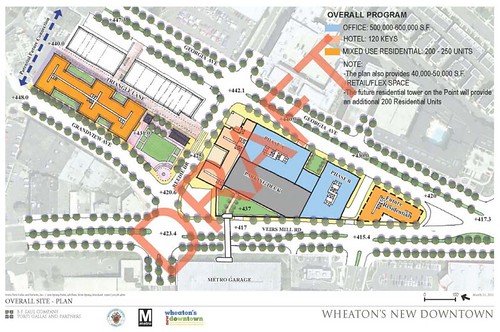
Draft plan for downtown Wheaton, Winter 2011
A draft of B.F. Saul's plan for downtown Wheaton.

Concerned about the size and cost of Leggett's proposal, the County Council's Planning, Housing and Economic Development Committee offered a counterproposal last month. In their proposal, estimated to cost $55 million, B.F. Saul the county would build a new town square on Lot 13 with an underground parking garage, at a cost of $2.5 million and $5.6 million, respectively, along with a building for DEP and DPS for $46 million.

There's also room for the Park and Planning Commission if another $46 million is found to build another building. Both buildings would contain 415,000 square feet of office space and hold about 1,600 workers.

"It is misleading to say that $42 million will revitalize Wheaton," says Councilmember George Leventhal, who sits on the committee. (Full disclosure: I used to work for Leventhal.) "The only thing that $42 million buys now is a concrete hat over the bus bay, and if you want to relocate county agencies, the cost will go above $100 million."

Though local blogger Wheaton Calling accuses the council of "throwing a wrench" into the redevelopment process with their counterproposal, the benefits of Leggett's proposal remain unclear. The county's Department of Economic Development usually does a cost-benefit analysis of major public investments, like the $4 million big-box retailer Costco received to open a store in Wheaton Plaza, but they haven't done one for this project.

"The 'end' is not to build a platform, to execute a General Development Agreement, or to attract a federal tenant," writes Jacob Sesker, economic analyst for the County Council, in a report for the PHED committee. "Rather, the desired end is to introduce land uses (to wit, office space) . . . that downtown Wheaton currently lacks and which the market will not provide."

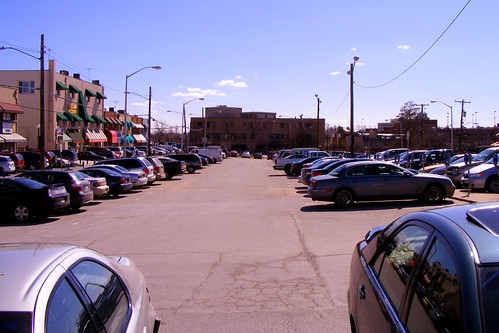
Wheaton Lot 13
Lot 13 today.

In a phone call with JUTP, Sesker points out that in large-scale redevelopment projects, the best way to start is with the least challenging or expensive parts, like Lot 13. Those improvements will add value to the rest of the development, which makes the expensive parts more profitable to build later on, meaning B.F. Saul will require fewer subsidies.

The platform also has no direct benefit to the community by itself. "Unlike a school or a train, a platform does not teach any child to read and does not take anyone to work." Without those benefits, Sesker says, "if it is not generating revenue, then it probably is not a good investment."

"The County Council is the steward of public money," adds Leventhal. "If we're going to spend that money, it's reasonable to ask what this will do for taxpayers. We have to be very cautious about our decision, and we need much better analysis than what we've gotten."

Some still say offices just don't make sense in Wheaton. In 2009, a group of real estate and design experts commissioned by the Urban Land Institute to offer recommendations for redevelopment concluded that there is "no inherent reason" for offices to locate there:

The panel heard from a number of stakeholders that there is a desire for more office space in the CBD, in order to bring in greater daytime foot traffic . . . Wheaton is not well-positioned to attract development of, or users for, new large-scale office space. There are simply too many other office centers within the region that possess greater strengths, particularly in the near-term, where so much new office space has recently been built.

Instead, the panel suggests building apartments and townhomes to draw young professionals who are being priced out of Silver Spring, a handful of chain stores and restaurants outside of Wheaton Plaza to "anchor" the downtown, and a small music venue taking advantage of its proximity to the renowned Chuck Levin's Washington Music Center.

On Lot 13, they proposed a town square and a smaller "2-3 story building" with shops and apartments. Like Sesker, they recommend waiting to build over the bus turnaround, as that site is the "most valuable" in downtown Wheaton and has "the potential for the greatest density." This vision, particularly the focus on music and entertainment, fits in with earlier proposals for Wheaton that were well-received by the community.

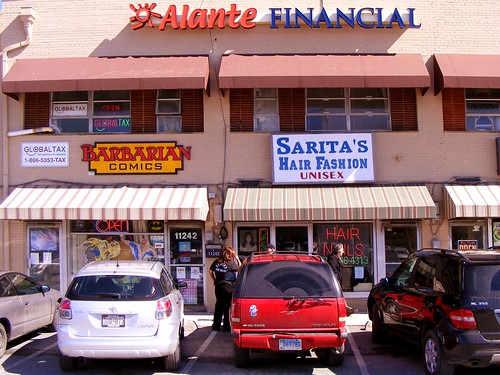
Alante Financial
Local businesses in downtown Wheaton today.

No matter what the county does, they should heed the ULI panel's warning on any development in Wheaton: "Wheaton's strengths, such as its eclectic retail mix, are also quite fragile, and could be irreparably harmed by any redevelopment projects that are ill-conceived or rushed. Thus, the panel recommends a gradual approach to redevelopment," they write. "An attempt to force a desired result . . . would not only fail, but would also end up undermining the unique identity that Wheaton already possesses."

We've been waiting for a new Wheaton for twenty years, so it's understandable some are impatient. But rushing into any project without a thorough understanding of its potential costs and benefits could destroy what people already like about the old Wheaton while limiting its future potential.

Tuesday, April 3, 2012

and now, for a brief message from our sponsor

Looking Back Towards Ellsworth
Inspiration.

Today's my birthday, so I hope you'll indulge me in talking a little about myself and my life outside the blog.

Two years ago, I moved to Philadelphia to attend planning school. And next month, I plan to come back to the D.C. area to become an urban designer – for lack of a better term, someone who's responsible for designing the spaces between the buildings. Why do I want to be an urban designer? Because of Ellsworth Drive in downtown Silver Spring and the mark it left on me.

A great public space is the backbone of a community, a place where people can come to hang out, to gather, to celebrate and protest. And though I've visited and learned about great public spaces all over the world, I keep returning to Ellsworth.

I'm always blown away by how diverse the crowds are. I've brought my friends from out of town here and tell them about what's takes place on Ellsworth during a normal day: men playing soccer, appearances from Hare Krishnas, even political protests. Ellsworth isn't perfect. The architecture could be better, and micromanagement of the space by both Peterson and the County makes it hard for it to reach its full potential. But this street has become a model for suburban communities around the country. More importantly, it's become the heart of Silver Spring and East County.

I'd like to spend my career creating more places like Ellsworth Drive, in cities, towns and suburbs throughout North America and maybe even the world. But first, I've got to start looking for work. That's why I'm reaching out to the readers of this blog.

Rendering of a new neighborhood over the railyards behind Penn Station in Baltimore.

Site plan for the redevelopment of Roosevelt Mall in Philadelphia.

I've got a passion for placemaking, an educational background in architecture and city planning, and work experience in local government and public outreach. I know how to craft spaces, but also how to craft the story around it and present it to the public. If you or someone you know is looking for someone with those qualities in your organization, I'd love to talk to you. I can be reached by email at reeddbk at gmail dot com.

I write about what I love, and I hope I can turn it into a profession. And hey, it worked once before.

Left: hand sketch, Space 15 Twenty in Los Angeles. Right: Model, proposal for a community green in Alexandria, Virginia.

I invite you to visit my LinkedIn and take a look at my resume and portfolio, which includes work from college and graduate school, along with a couple of freelance projects I've done. As always, thanks for reading. I'll let you know how my search turns out, and I look forward to moving back to the D.C. area in a few months to begin a new chapter of my life.

Sunday, April 1, 2012

egyptian pyramids mysteriously appear in burtonsville

pyramids of burtonsville
It's not the Wegmans he promised, but developer Chris Jones found the destination he was looking for to draw customers to his Burtonsville Town Square shopping center, located at the intersection of Route 198 and Old Columbia Pike.

"Burtonsville has always been known for its history," says Jones, head of the Bethesda-based BMC Property Group. "Now that history includes artifacts from 2540 BC."

Residents say the newly-rechristened Great Pyramid of Burtonsville, along with its smaller counterparts the Pyramid of Paint Branch High School Panthers and Pyramid of the InterCounty Connector, appeared behind the two-year-old shopping center Thursday morning. The ancient burial monuments, originally dedicated to Egyptian pharoahs and meant to resemble the shape of the sun's rays, have quickly become a tourist attraction, drawing confused visitors from as far away as Alexandria, Virginia.

"We've always wanted to see the pyramids," says Jim Jebow of Maple Lawn. "Now we can do it without worrying about civil war breaking out. Or having to eat unfamiliar food."

Street vendors offering rugs and camel rides have already begun to appear along Route 198, while shoppers complain that all of the special parking spaces for hybrid cars that won Burtonsville Town Square an environmental award are constantly filled.

Not everybody's excited, though. "I vaguely remember learning about the pyramids in sixth-grade history," says Burtonsville resident Sandra Spring. "But I was kinda hoping we'd get something fun in Burtonsville, like a bowling alley."

Across the street at Burtonsville Crossing, which lost a Giant and several of their tenants to Burtonsville Town Square, the remaining shopkeepers are fuming.

"I heard our landlord totally had a plan to bring the Great Pyramid of Giza to our shopping center, but once again we got screwed over," says Mac Iato, manager of the Starbucks. "I mean, we've got a drive-thru and that weekly car show in the empty parking lot, but there's no competing with one of the Seven Wonders of the World."

Jones estimates that 10 million people will visit the pyramids this year. However, he won't say how they got to Burtonsville.

"Let's just say that my nephews made me watch the movie Despicable Me," he says, "and I got inspired."

Still from the movie Despicable Me.