Monday, February 27, 2012

liquor laws, lacking silver spring nightlife helped kill piratz tavern


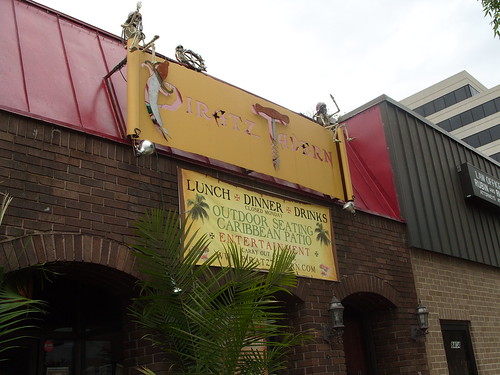
Front of Piratz Tavern
Piratz Tavern in downtown Silver Spring. Photo by davethegame on Flickr.

Last weekend, pirate-themed bar Piratz Tavern received a makeover from the TV show Bar Rescue and re-opened as a more conventional hangout dubbed Corporate Bar & Grill. While host Jon Taffer and many customers say it failed because of bad food and poor service, there are other factors that sunk this ship.

For starters, Montgomery County makes it hard to open a bar. Every place that serves alcohol in the county has to buy it from the Department of Liquor Control, whose markups and bureaucratic delays result in higher prices for booze than in surrounding areas. The county also requires that food make up half of all sales at establishments selling alcohol. And until a few years ago, there was a limit on how many liquor licenses a single owner could hold.

These restrictions make it difficult and expensive to run a bar, which encourages owners to locate in areas where there's already a bar scene with a guaranteed customer base. Hence, there are lots of bars in Bethesda and relatively few elsewhere. Yelp counts 25 bars in downtown Bethesda and just 9 bars in downtown Silver Spring, including Babe's Sports Bar, which closed earlier this month. And both pale in comparison to Clarendon, which with 44 bars has the highest number of any neighborhood outside the District.

This hurts bars in other parts of Montgomery County, who lose customers just by not being where all of the other bars are. It's especially hard for bars like Piratz Tavern. Though I've enjoyed myself thoroughly each time I went there, I can safely assume that not everyone wants to go to a bar and drink grog and sing sea shanties.

Piratz was a niche business, like a Korean restaurant or a record store, reliant on a small portion of the general public for their customer base. Niche businesses need a lot of people coming to the area to ensure that enough of them want what you're selling. That requires a high population density, like in the Akibahara "geek ghetto" in Tokyo, or a concentration of businesses serving a niche population, like Annandale, whose 900 businesses catering to Koreans make it a destination for Greater Washington's Korean community.

When you have a lot of people coming to your area, niche businesses can thrive. But in Silver Spring, where the bar scene and thus the pool of potential customers is very small, anything too unusual will get squeezed out.
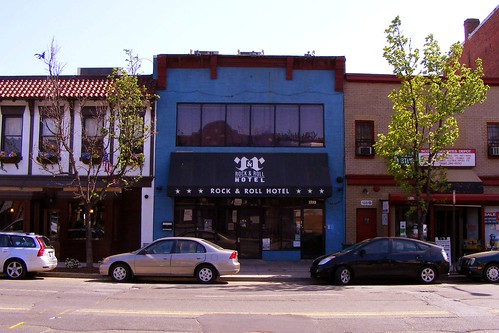


Rock & Roll Hotel
Bars along H Street NE.

Successful nightlife districts offer visitors lots of choices for dinner, drinks, and entertainment options. That's why Joe Englert purposely opened several unique venues at once along H Street NE in the District. He provided lots of reasons for lots of different kinds of people to come there, drumming up a substantial bar scene in a short period of time and helping to revitalize the neighborhood, which in turn produced more bars and restaurants.

Silver Spring could do the same if Montgomery County made it easier to open a bar here. Making the area a bigger nightlife destination could draw business to existing bars while encouraging new bars to open. It could also provide enough customers for niche bars like Piratz Tavern. Not only that, but it could also make the area safer, getting people on the streets at night when the sidewalks are normally empty.

Piratz Tavern didn't just fail because it was a pirate-themed bar. It failed because there aren't enough bars, pirate-themed or otherwise, to create a critical mass of bargoers in Silver Spring. Unless things change, the new Corporate Bar & Grill will struggle as well.

Monday, February 20, 2012

being progressive means allowing progress sometimes

Storefronts & People, Carroll Avenue, Takoma Park


Takoma Park has long been known for their civic activism, dating back to the freeway fighters that stopped I-95 and I-270 from cutting through the area forty years ago. But that culture could prevent their community from allowing good changes to happen.

Writing in Utne Reader, the same publication that once called Montgomery County the "Most Enlightened Suburb," Alex Steffen notes that Takoma Park's progressive politics prevent it from being truly progressive (emphasis mine):

One of the most unfortunate side effects of the urban activism of the ’60s and ’70s is the belief that development is wrong and that fighting it makes you an environmentalist. We know that dense cities are both environmentally better and dramatically more equitable places. Walkable neighborhoods are better than the suburbs for people with a wide range of incomes, and what happens in cities that don't grow is that they gentrify and poor people are pushed out. Trying to fight change makes you less sustainable and more unfair.

Sometimes, standing in front of bulldozers is the right thing to do. It's likely that Takoma Park wouldn't have become a sought-after place to live if it were carved up by highways. And sometimes it's harmful, like the efforts of some residents to block a housing development adjacent to the Takoma Metro station back in 2007.

Well-designed urban infill development in places like Old Town Takoma can get people out of their cars and bring customers to the area's struggling local businesses, which presumably are progressive ideals. Not allowing development to happen effectively enables all of the things progressives say they don't want, like more driving, more gentrification, more suburban sprawl and more destruction of farmland.

Not all progress is bad. It's the mark of a true progressive when they can tell the difference.

Friday, February 17, 2012

the pseudo-economic argument for gay marriage

It's hard to believe that almost a year ago, Maryland failed to legalize gay marriage, in part due to a few legislators who changed their minds at the last minute. But I'm excited to see that today, we can make it right as the House of Delegates resumes deliberation on same-sex marriage.

There are a lot of reasons why this is a good idea, but the most compelling one to me is that legalizing gay marriage makes our community, in this case the state of Maryland, a stronger place. We live in a world where not everyone looks like us, acts like us, or thinks like us. Some people respond by trying to ignore those differences at best and by using some legal or religious standing to inhibit them. Not surprisingly, this doesn't work, and like Sisyphus, social conservatives will repeatedly try to push that boulder marked "Traditional Values" up a hill, only to watch it roll back each time.

As I've written before, the people and places that recognize and embrace our differences are the ones that will succeed in the future. In 2004, Seattle's alternative weekly The Stranger dubbed these places, which are often liberal, educated, but most importantly diverse, the "Urban Archipelago." And it's in the archipelago where the economy seems to be doing okay, if not exactly thriving.

These places are valued for their tolerance of each other's differences. A few days ago, the New York Times wrote about affluent, foreign-born parents putting their kids in that city's public schools because they wanted them to be exposed to the world:

“When they go to public school, they’re in a whole new world, a whole world of different people and different values, which is what the world is like,” said Lyn Bollen, who grew up in Birmingham, England, and attended — and taught at — state-run schools. “Shielding them from that is doing them a disservice.”

I don't know if there's an actual correlation between gay marriage and economic prosperity. But we do know what intolerant places look like. Just look at poor Anoka, Minnesota, where Michelle Bachmann began her campaign of folksy, home-spun paranoia and bigotry while on the local school board. Her efforts created such a toxic environment for young people both gay and straight that they're struggling with a rash of suicides. Adam and Steve may be the downfall of the traditional family, but it seems inviting them into your community might produce healthy, well-adjusted kids.

Maryland could be that place, drawing the best and the brightest from across the United States and the world with the promise that no matter who you are, you are welcome here if you have something to contribute.

My mother is a pastor, and she brought me up to believe that God had a plan for each of us. I believe He has a plan for me. It happens to include me sleeping with men, but I get the feeling it's not the most important part. But as long as we focus on who Marylanders go to bed with, we prevent them from giving something greater to our state. In the end, it's not just gays who lose out. We all do.

Monday, February 13, 2012

JUTP compy in the shop/more awesome timelapse footage of silver spring

I assumed something was wrong with the official JUTP MacBook when it was taking ten minutes to start up, and a visit to the Apple Store on Saturday revealed that it's on its last legs. The blog will have to go on hold for a couple of days while I get my computer fixed. Keep your fingers crossed and we'll be back soon.

In the meantime, Tolu Omokehinde, Blair High senior/protege of amazing photographer Chip Py, just posted another amazing timelapse video of Silver Spring, this one from the rooftop of his school. Check it out! And if you liked that, you'll also like this video of Ellsworth Drive shot by Omokehinde and his classmate Nick Grossman.

Cloudscapes - Montgomery Blair High - HD Time Lapse from Tolu Omokehinde on Vimeo.