Monday, April 18, 2022

east county could get a new grocery store and senior housing, and some neighbors fear the worst

Montgomery County envisions a new town center along Route 29 in White Oak, and after a decade, plans are finally moving forward. But at one local church, there's a disagreement about whether "love thy neighbor" extends to a proposed development next door. 

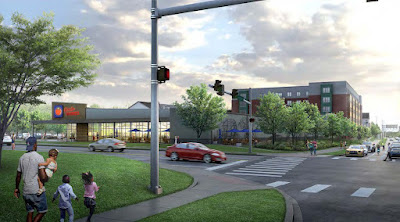
A rendering of the proposed grocery store and senior apartments, with East Randolph Road on the right. All images from the Planning Board report.

This Thursday, the Planning Board will hold a public hearing on and review Conley Square, a proposal to build a small grocery store and 234 homes, including affordable senior apartments, townhomes, and stacked townhomes at the intersection of Old Columbia Pike and East Randolph Road. Today the vacant 11-acre property is zoned for single-family homes on half-acre lots, so the board will recommend whether to rezone the nearly 11-acre property to allow mixed-use development ahead of a hearing at the Board of Appeals on May 2.

If built, Conley Square would be one of the first new developments along Flash, a bus rapid transit line between downtown Silver Spring and Burtonsville that opened in 2020. It’s next to the Tech Road station and a few other projects moving forward, including a shopping center with an Amazon Fresh grocery store and 390 apartments and stacked townhomes.

People are mad

Over the past month, members at the Southern Asian Seventh-Day Adventist Church - which sits next door to the proposed development and would share an entrance with it - have sent form letters to the Planning Board opposing it.

The letters claim that a new grocery store and homes will “will bring in undesirable people into the peaceful surrounding,” adding, “Some of the concerns are drugs, prostitution, vandalism, theft, and crimes.” Some letters implied that, as many members are of East Indian descent, the development would lead to anti-Asian violence.

Wednesday, January 12, 2022

downtown silver spring as a "black space"

This article is part one of a two-part series exploring Silver Spring, Maryland’s historical and contemporary role as a black space.

There are a lot of conversations going on right now about the future of downtown Silver Spring. Here’s one we should be having: Silver Spring is one of the region’s most significant Black business districts.

I love summertime in #silverspring because we get so many awesome street musicians—no schedule, no county program—and they can draw a crowd with a cover of "she will be loved." #dtss #busking #maroon5 #igdc

This winter, Montgomery County planners are working on recommendations for the Silver Spring Downtown Plan, which will guide the business district’s growth and evolution over the next twenty years. And a few months ago, the Montgomery County Council voted to move forward with the Silver Spring business improvement district, which would create a private non-profit to handle marketing and promotions for the downtown area.

While both of these efforts have discussed the role of small businesses in downtown, there hasn’t been a huge focus on specifically Black-owned or oriented businesses. A recent study found that of downtown’s 100+ “minority-serving” businesses, the majority of them focus on Black, Black African, and Caribbean patrons.

What does that look like in practice? In Silver Spring you’ll find a coworking space for the African diaspora and a hub of Black interior designers. On the weekends you’ll find Ethiopian, Jamaican, and Ivorian festivals, as well as the region’s only Black Pride event. And in the evenings you’ll see lines outside Black-owned clubs and bars like Society Lounge, Republic Garden, and Kaldi’s Social House, immortalized in a Tostitos commercial.

Silver Spring’s Ethiopian restaurant scene is well-known, but it’s Senegalese, Caribbean, and Southern barbecue restaurants are getting attention too. Not only were there several Black Lives Matter protests throughout Silver Spring last summer, but two designers painted a Black Lives Matter mural outside their downtown clothing store.

Tuesday, December 7, 2021

who’s speaking out against montgomery county’s plan to thrive?

Montgomery County council members are currently reviewing Thrive 2050, a “plan for other plans” that will guide zoning and policy decisions in the coming years. It updates the county’s General Plan, first written in 1964, and tackles some of the big issues of our time: climate change, segregated neighborhoods and schools, skyrocketing home prices, and a sluggish economy.

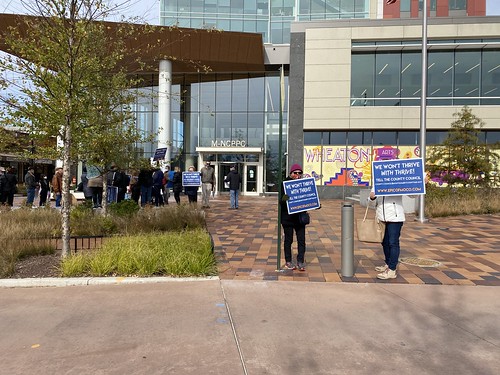
thrive protesters at the planning department
Protesters opposing the Thrive 2050 plan in November 2021. Photo by the author.

Council members may finally pass Thrive, even as a group of residents tries to stall or block it, arguing that there hasn’t been enough community input. It appears, however, that opponents want more say for themselves — not the increasingly diverse residents who need to be heard the most.

Of Thrive’s recommendations, one that’s gotten the most attention is allowing more affordable duplexes, townhomes, and apartments in areas where you can only build a single-family house.

Wednesday, October 13, 2021

pit bull bans are a housing issue

It’s Pit Bull Awareness Month, which is a time to celebrate this misunderstood (but very common) dog breed and help get them adopted. One barrier to finding these dogs loving homes are breed-specific laws and housing restrictions, which were intended to protect people from unsafe dogs but have long failed to do so.

Aruba (left) and Drizzy (right), two pit bulls who found loving homes. Photos by the author.

Meet my dog Drizzy. My partner and I adopted him last summer. Like many dogs, he can usually be found going for long walks or destroying squeaky balls. We’ve enjoyed him so much that last summer, we fostered another dog named Aruba. She’s an eight-month-old puppy who was found as a stray.

Both Drizzy and Aruba are pit bulls. Drizzy came from a rescue in Virginia, and we own a home in Montgomery County, so there was no issue when we wanted to adopt him. It wasn’t so easy for Aruba. She came from the shelter in Prince George’s County, which has banned pit bulls since 1997. Anyone caught with a dog suspected of being a pit bull can get fined up to $1,000 or even go to jail.

Instead, dogs like her usually end up at other shelters or with groups like Vindicated Pit Bull Rescue, which saved Aruba. In turn, they have to find a potential adopter outside of the county. But that family can’t live in an apartment complex or a homeowner’s association, because they often ban them too. Despite being a puppy with no record of harming anyone, she was treated like a danger because of how she looked.

Tuesday, August 31, 2021

residents of a rich MoCo neighborhood provide a helpful list of places where cheaper homes can go

Second Avenue in Woodside
A view of Woodside with downtown Silver Spring in the background. Image by the author.

Montgomery County has a chronic housing shortage, particularly for low- and middle-income people. In Silver Spring’s Woodside Park neighborhood, nearly 200 residents signed a letter listing other places where those homes can go. It’s part of an ongoing campaign to keep affluent neighborhoods from opening up to new homes and new people.

The price of homes in Montgomery County are rising steadily

Home prices in Montgomery County increased 14% last year, and for the first time the median home price topped $500,000. For a single-family home, it’s nearly $800,000. This isn’t unique - jurisdictions across the Washington region and around the nation are struggling with rising home prices. What all of these places have in common is a chronic shortage of new home construction, particularly for lower-priced homes. Montgomery County needs to build over 80,000 homes in the coming decades to fill the gap. In 2020, it permitted just 1500.

It’s easy to lose track of all the things county leaders are doing to address high housing costs: tax incentives, rent stabilization,lifting a ban on new homes near crowded schools, letting people build accessory apartments. Now, they’re targeting what might be the biggest obstacle: in most of Montgomery County’s residential land, you can only build one house per lot due to single-family zoning.

Monday, February 22, 2021

MoCo wants to create more affordable homes in wealthy neighborhoods. but when?

Montgomery County has a housing shortage, particularly for lower-priced homes. The median home price is now $500,000, 14% more than last year. Inside the Beltway and near the Red Line, prices can be significantly higher as people compete for a limited supply of houses.

Montgomery County wants to make it easier to build “missing middle” homes, like this triplex in Silver Spring. All photos by the author.

That’s happening in part because of single-family zoning, which was created in the early 20th century to keep Black people out of white and affluent neighborhoods by making townhomes and apartments illegal. This policy — along with racial covenants and redlining — still contributes to segregation today, but it also makes housing more expensive and inaccessible for everyone. That’s why places from Minneapolis to Sacramento are opening up their single-family zones.

In December, County Councilmember Will Jawando introduced a bill, ZTA 20-07, that would allow duplexes, townhomes, and small apartment buildings on “R-60” lots within one mile of Red Line stations. If passed, the bill would change planning permissions for about 24,000 lots where today you can only build one house and an accessory apartment.

“We must have an all hands on deck approach that includes multiple solutions” to address the housing shortage, he wrote in a letter to the County Council.

Montgomery County has a goal to build 41,000 homes by 2030 to meet the shortage. The Planning Department is already working on its own plans to create more “missing middle” homes, including one focused on downtown Silver Spring that could involve zoning changes and Thrive 2050, which looks at the entire county and will not involve any zoning changes. Both of these efforts will play out over the next several months, with many opportunities for public input.

Hurry up, or wait

So now there’s a debate: pass Jawando’s bill and allow more homes today, or take our time and potentially allow more homes in the near future?

Friday, February 5, 2021

this black history month, think about the power you wield

When little kids learn about Martin Luther King, Jr., they usually hear a version of this story: when Dr. King was a child, a white friend says they can’t play together anymore because his parents won’t let him play with a Black child. It’s the inciting incident in Dr. King’s story, what inspires him to fight for justice.

Students organized this Black Lives Matter protest in Bethesda last summer. Photo by the author.

King came from a relatively comfortable family. He grew up in a large Victorian house originally built for a white family. Both of his parents went to college, as did he and both of his siblings. His sister was a professor. None of those things could protect him from the whims of a white person defining where, when, how, or even if they would engage with him.

Decades after the Civil Rights movement, segregation and discrimination persist because that power imbalance still exists. This Black History Month, if you’re planning to do a day of service or support a Black-owned business, I encourage you to take it a step further and examine the power structures in your community.

Thursday, December 17, 2020

two bills could bring rent control and “missing middle” homes to montgomery county

If you’ve tried to find a home in Montgomery County recently, you know things are rough. The county has a housing shortage, with 23,000 homes needed in the next 10 years. The median home price in the county is a half-million dollars, 14% more than last year. Rents are rising more slowly, but some tenants still received 33% rent increases this year. An estimated 20,000 households are behind on rent due to pandemic-related financial hardship, and could get evicted.

Montgomery County could legalize "missing middle" homes, like this triplex and duplex in Silver Spring, within one mile of Metro stations. All images by the author.

This year, county leaders have hustled to find solutions: capping rent increases during COVID-19, tax incentives to build homes at Metro stations, and getting rid of the housing moratorium, which blocked new homes near crowded schools. Last week, County Councilmember Will Jawando introduced two bills dubbed “More Housing for More People” that could go even further.

Monday, December 7, 2020

MoCo is working on a plan to tackle racial equity, public health, and climate change

The Montgomery County we know today may exist because of a little-known document written over 50 years ago. As county planners work on a replacement, they’re tackling some big issues, like racial equity, public health, and a slow economy.

A glimpse of our possible future? Image by Montgomery County Planning Department.

When most people think of Montgomery County, they might think of a prosperous, affluent bedroom suburb. It is one of the nation's richest counties and the largest employment center in Maryland. But household incomes have been flat for 30 years, and home prices jumped 14% just this year. Schools and neighborhoods are segregated by class and race, and Black and Latinx residents are more likely to be unemployed or pay more of their income for housing. Meanwhile, nearly two-thirds of adults were overweight or obese.

Over the past year, Montgomery County planners have been trying to find solutions, and put them together in Thrive 2050, an ambitious document for how the county should grow and change over the next thirty years. Thrive wouldn't actually change laws or policies: Planning Board chairman Casey Anderson called it a “plan for other plans," helping leaders make laws or policies in the future. The plan's big themes include racial justice, affordable homes, and more transportation options.

"A plan for other plans"

This isn't the first big plan Montgomery County has made. In the 1960s, the Planning Department produced “On Wedges and Corridors”, when people were leaving cities for the suburbs. Back then, the county doubled in population every 10 years, growing as fast as cities like Los Angeles and Houston. At the time, new suburban developments were messy and disorganized, lacking schools, roads, or parks.

Wednesday, September 16, 2020

flash, maryland’s first bus rapid transit line, is almost finished

Maryland’s first Bus Rapid Transit line will open in Montgomery County later this year. Let’s take a look at one of the stations under construction.

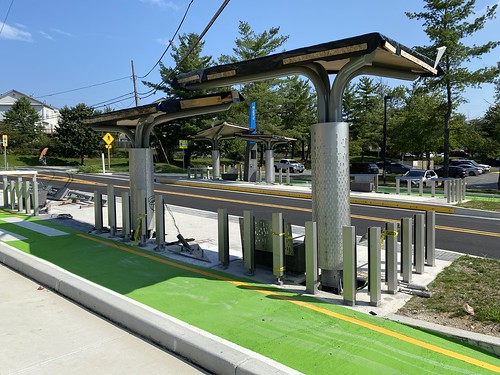
Rear of April Lane Flash BRT platform
The April Lane station on Flash, Maryland's first bus rapid transit line. Click here for a slideshow. All photos by the author.

Under construction since 2018, Flash BRT is an 14-mile line that will run along Route 29 (Colesville Road and Columbia Pike) from the Silver Spring Metro station to Burtonsville, making 11 stops along the way.

It’s the first of three lines Montgomery County is working on - the other two are on Veirs Mill Road between Wheaton and Rockville, and along Route 355 between Bethesda and Clarksburg. Route 29 is one of the busiest bus corridors in the region, and Flash buses will come every 7.5 minutes during rush hour and run from 5am to midnight.

One of the stations will be April Lane, located on Lockwood Drive in White Oak where buses will briefly detour to serve a large cluster of apartment complexes. When I stopped by in August, the station (or stations, since there are platforms on both sides of the street) was almost finished, save for a few signs that hadn’t been installed and some construction debris.

Monday, September 14, 2020

ellsworth drive is one of silver spring's most successful public spaces. should it stay in private hands?

Despite its name, Ellsworth Drive has become one of the region’s most successful pedestrian retail streets. As plans for a facelift move forward, community members are worried that what makes this place special and enticing could be lost.

Ellsworth Drive last summer. Montgomery County owns the street, but leases it to a developer who runs and maintains it. Photo by the author.

Twenty years ago, this street was a back alley, lined with loading docks and parking lots. Today, Ellsworth is arguably the most important street in Silver Spring, if not Montgomery County. On a Friday night in the summer, Ellsworth is the place to see and be seen for a big swath of suburban Maryland.

Little kids play in the fountain. Teen boys skateboard and try to one-up each other, weaving around couples on dates. There are usually a handful of buskers, some with amps, alongside panhandlers. Proselytizers march with sandwich boards past Hare Krishnas waving tambourines. At the corner of Ellsworth Drive and Fenton Street, a man pushes a cart selling roasted nuts, who was recruited here from New York by former MoCo planning official Rollin Stanley.

Ellsworth also hosts a number of major events, from the Montgomery County Thanksgiving Parade, to the annual Silver Spring Jazz Festival and Blues Festival, the Zombie Walk, a weekly farmers’ market, and this summer, several Black Lives Matter protests. No surprise that the big-D Downtown Silver Spring complex (not to be confused with the wider downtown Silver Spring area) that lines Ellsworth Drive was first marketed as a “good old fashioned sensory overload.”

And until March, it was completely car-free, making Ellsworth one of the few exceptions to a long history of failed pedestrian malls. Developer Peterson Companies, which manages the street, wants to keep it that way, and has big renovation plans in mind. In order to make them happen, This fall, the Montgomery County Council will decide whether to give Peterson more control over Ellsworth Drive.

soon, you'll be able to drink in montgomery county parks

Starting Thursday, you might be able to legally enjoy a drink in a Montgomery County park. A new directive from Montgomery Parks will allow alcohol, including beer, wine, and spirits, in a designated area in nine county parks. It’s a trial, and would only take effect through next May.

A juicebox in Sligo Avenue Park, which is not one of the parks where you'll be able to drink harder things. Photo by the author.

The proposed rules are part of “Picnic in the Park,” a new effort by Montgomery Parks to promote its parks and support local restaurants. Visitors to nine parks in Silver Spring, Takoma Park, Bethesda, North Bethesda, Wheaton, and Germantown can order takeout from a nearby restaurant and have it delivered to the park.

Under the new directive, people would now be able to enjoy a drink in designated areas within one of the nine parks. The county began allowing restaurants to sell alcohol to-go when everything shut down in March due to Covid-19, but has kept the rule in place even as restaurants were allowed to have indoor dining. Of course, you’ll have to be 21 to drink in the park, and people are encouraged to drink responsibly.

Thursday, July 2, 2020

14 years!

As longtime readers know, I started this blog 14 years ago last Friday, June 26, at the age of 18. I was passionate about this place, but it was a lonely effort. Most of my friends had other things to worry about, and they were tired of me ranting in class or at parties or at shows about the Purple Line.

I wish 18-year-old me could see how much things have changed!

BLM protest at Walter Johnson High School
A socially-distanced protest at Walter Johnson High School in Bethesda, organized by two recent graduates. Photo by the author.
This spring, I've had the chance to meet a number of young people in Montgomery County who are leading the fight for equity and justice in our community, from the MCPS school boundary analysis to over two dozen Black Lives Matter protests that have happened here since May. They live in all parts of the county. They come from a variety of different backgrounds. What unites them is their energy, their persistence, and their willingness to say what needs to be said.

Zoe Tishaev, a graduate of Clarksburg High School, organized a two-hour discussion on exclusionary zoning in Montgomery County called A Legacy of Segregation, where I spoke along with Jane Lyons from the Coalition for Smarter Growth and Planning Board member Partap Verma. You can watch it here:


Last weekend, I had the honor of speaking at a BLM protest at Walter Johnson High School in Bethesda organized by Matt Garfinkel and Nat Tilahun, two MCPS grads who understood the power of making yourself heard right here at home.

These are just two examples, but I'm constantly inspired by the hard work of our student activists - and challenged to push harder for what's right. As grown-ups (am I a grown-up yet?) we would do well to listen to them.

Anyway, here's the text of my speech on Saturday. Here's to 14 years of Just Up The Pike, and here's to 14 more years:


Tuesday, June 9, 2020

thomas hardman (1958-2020)

Thomas outside Dunkin' Donuts in 2008.
Photo by the author.
Thomas Hardman, a longtime Aspen Hill resident, computer programmer, occasional political candidate, and moderator of several local Facebook pages, was found dead in his Gaithersburg apartment over the weekend. An autopsy reports that he had a heart attack. He was 62.


Thomas's friend, civic activist Cary Lamari, reported the news on Facebook last night. Lamari says he asked people if anyone had heard from him since he hadn't posted in several weeks, and filed a missing persons report. Montgomery County police conducted a distress call and found Thomas Sunday night. He was not married, and did not have any children.

From Cary's Facebook page:
Thomas was liked by many people on Facebook and in the Aspen Hill Community, He attended Robert Perry High school and has been a staple in County political discussion for many years. You could always find Thomas at meeting in the Aspen Hill Civic Association meetings and he had a wonderful historical memory of past events and developments in our Community...Thomas was a good and Moral person and will be missed.
Thomas was a big part of the JUTP community as well. Back in the early days of the blog, Thomas was a frequent commenter and a longtime friend of the blog, eagerly offering his thoughts over coffee at Dunkin' Donuts (and it was always Dunkin' Donuts).

From 1980s punk rock to obscure science fiction to Linux to the arcana of Montgomery County, Thomas always had a good anecdote to share and an eagerness to find solutions. According to his personal website, he received a patent in 2008 for an "invention in the field of computing and dataprocessing."


Friday, June 5, 2020

montgomery county could loosen up single-family zoning in silver spring, sort of

Downtown Silver Spring is one of the region’s youngest and most diverse neighborhoods, but rising home prices could make that a thing of the past. To address that, Montgomery County will look at ways to loosen up single-family zoning in the area.

fourplexes on nolte avenue
Fourplexes in Silver Spring. Montgomery County could allow more of this to be built. Image by the author.
After a public hearing Thursday, the Planning Board voted 4-0 to expand the boundaries of the Silver Spring Downtown Plan, a 20-year vision for the area that will cover everything from parks to streets to zoning. It'll allow planners to legalize “missing middle” homes, like duplexes, townhomes, and small apartment buildings, in areas where only single-family homes are allowed now.

"We have unrest in this country because we have people who are excluded from opportunities," said commissioner Partap Verma. "I grew up in missing middle housing, and if it wasn't for the opportunities that my immigrant parents had then, I wouldn't be here before you."

Downtown is back, but a victim of its own success

Montgomery County currently defines downtown Silver Spring as an area bounded by 16th, Spring, Cedar, and Fenton streets, and Eastern Avenue. After decades of decline and disinvestment, downtown has bounced back in a big way, attracting new residents and businesses. It’s become a hub for the region’s Ethiopian community, as well as a destination for beer lovers. Silver Spring is also one of the few places in the United States where black and white boys do equally well as adults.

Silver Spring has historically been an affordable area, but we have a regional housing shortage, and there's a growing demand for close-in neighborhoods with transit. Thousands of new apartments, including apartments set aside for low-income households, have been built in recent years, but it's not enough. In the 20910 zip code, which contains downtown and surrounding areas, home values are now higher than they were before the Great Recession.


Tuesday, June 2, 2020

across maryland and virginia, suburban protesters speak out against police brutality

All over the United States, people have taken to the streets to protest police brutality against Black people after George Floyd was killed in Minneapolis last week. Many of these demonstrations have taken place in center cities, including here in downtown DC. Yet suburban communities in Maryland and Virginia have stepped up as well.

Protesters kneel while blocking Germantown Road at a protest on Sunday. Photo by Rachel Taylor.
Protests started in the DC area on Friday, after two days of rioting in Minneapolis following George Floyd’s death on May 27 (One officer has been charged with third-degree murder and manslaughter in connection with Floyd's death). Since then, there have been demonstrations around the White House every afternoon. The first suburban protest may have been Saturday evening in Manassas, a community in Prince William County with a large Latinx population, a long history of harassing immigrants, and a history of protest.

Demonstrators blocked Sudley Road, a state highway lined with big-box stores and shopping centers. Tweets from the protest show a line of people in a standoff with police, peacefully holding posters. As in cities around the nation, police responded with violence. Twitter user Tony posted photos of police tear-gassing and shooting rubber bullets at the crowd.


Friday, May 29, 2020

this questionnaire shows MoCo school board candidates' commitment to equity

As we speak, voters in Montgomery County are receiving ballots for the June 2 primary, which includes a crowded and often nasty race for school board. To help voters learn about the candidates, a group of progressive organizations put together an "Equity Questionnaire" on major issues affecting students.
Click to see the entire questionnaire.
Montgomery County Public Schools is the largest school system in Maryland, and its Board of Education is responsible for 165,000 students and a nearly $3 billion budget. It's a very diverse system and a fast-growing one, which raises questions about how MCPS should best use its resources.

While this year's school board race has largely revolved around a sometimes-controversial look at school boundaries, there are other big questions, like whether MCPS should do more for LGBTQ students or place police officers in schools.

There are also a lot of candidates in the primary, from which the top two vote-getters will advance to the general election in November. Thirteen people are running for the at-large seat, which is vacant.
Incumbent board member Shebra Evans has two challengers in District 4, which covers Silver Spring and Wheaton, while fellow incumbent Rebecca Smondrowski has a challenger in District 2, which covers Gaithersburg and North Potomac. (Since there are only two candidates running in District 2, it won't appear on your primary ballot.)

To help voters understand the issues, over a dozen progressive organizations in the county teamed up to make the "Equity Questionnaire," which asks candidates about everything from school boundaries to teacher hiring. Those organizations, which include SURJ (Standing Up for Racial Justice), Impact Silver Spring, the LGBTQ Democrats of Montgomery County, Jews United for Justice, and One Montgomery, aren't making any endorsements but share a commitment to social justice. There's a chart showing the candidates' answers to 12 yes/no questions, followed by more in-depth answers on specific topics.

This questionnaire only reflects the candidates' answers, which don't always line up with answers they gave to other organizations or public statements they've made. If you're really interested in digging into this race, you can also check out the League of Women Voters' voter guide, which includes all of the Montgomery County school board candidates.

Friday, May 8, 2020

battles over school boundaries divide candidates for montgomery county school board

Most years, school board races in Montgomery County can be pretty quiet. This spring, a study about school boundaries in this affluent yet diverse county have made the Board of Education election an explosive debate about race and class in public schools. It may be the most important race on the ballot.

Students outside Paint Branch High School in 2013. All photos by the author.

Montgomery County Public Schools (MCPS) comprise a very diverse school system: 72% of MCPS students are non-white, and the system has more students on free or reduced lunch than DC Public Schools has students. It is also growing rapidly. Although it is already the largest school system in Maryland and serves over 165,000 students, more than 2,000 additional students have enrolled each year for the last several years.

The Montgomery County Board of Education oversees MCPS and its nearly $3 billion budget. Eight of its board members are elected in something like a jungle primary: anyone from any political party can run, and the top two vote-getters in the June 2 primary will go to the general election in November. There are three seats up for grabs, one at-large seat and two district seats, which everyone votes for regardless of where they live. Meanwhile, middle and high school students nominate and elect a student as the ninth member, which they’ll vote for on May 20.

We’re talking about school boundaries

School board members in Montgomery County are considered part-time, and receive a very small salary to make decisions from the converted auditorium of what was the county’s black high school in the 1950s. But they have a lot of power. In 2018, student board member Ananya Tadikonda proposed that the school board look at school boundaries, which in some areas haven’t changed in 30 years. The school board hired a consultant, and their research  — which began last fall — affirmed things that many parents or students already knew or assumed:


Wednesday, May 6, 2020

guest post: a silver spring's trip through (an article about) greenwich forest

Andrew Lindemann Malone is one of the OG Silver Spring bloggers. He grew up here, and as early as 2003 was writing about the then-early stages of downtown's revitalization. Today, he still lives here and offers this live reading of the Washington Post real estate section, known for its over-the-top profiles of the area's bougiest neighborhoods:

Screenshot from the Washington Post I tweeted the other week -ed.
For wanna-be urbanists such as myself, the recent Post real estate section article about Greenwich Forest, a neighborhood in Bethesda, is structured like a horror movie: You read through it and everything sounds creepy in a normal Bethesda way, but a shocking twist at the end upends your assumptions about the narrative. So to make fun of the article properly, I am going to quote the end part first.


Friday, April 17, 2020

so, what am I up to right now? a summary

Almost every day, my partner and I go for a long walk in Sligo Creek Park, which is three blocks from our new house. It's a nice routine during a time when we can't do most normal things. I especially enjoy walking on Sligo Creek Parkway itself, which is one of several streets Montgomery County has closed to car traffic during the Covid-19 pandemic to give people space to exercise.

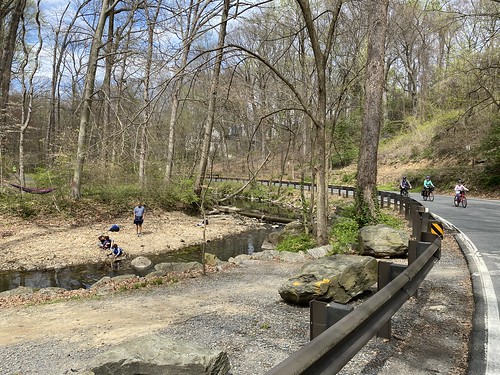
bikes and family in the sand
Enjoying Sligo Creek Park while the parkway is closed to traffic. All photos by the author.
Of course, while we're supposed to be keeping our distance from people, we run into a lot of friends and neighbors. Last week, a longtime reader asked me, "Why haven't you been writing? I haven't seen anything from you in a while." So, I figured it was worth sharing a few things I've been up to: