Showing posts sorted by date for query down briggs chaney. Sort by relevance Show all posts

Friday, March 6, 2015

expand route 29 to build a sidewalk? why not just build the sidewalk

Maryland highway planners say four new interchanges on Route 29 in eastern Montgomery County will cut congestion, improve pedestrian and bicycle safety, and make it easier to build bus rapid transit. But the designs they've proposed would actually make all three of those things worse.

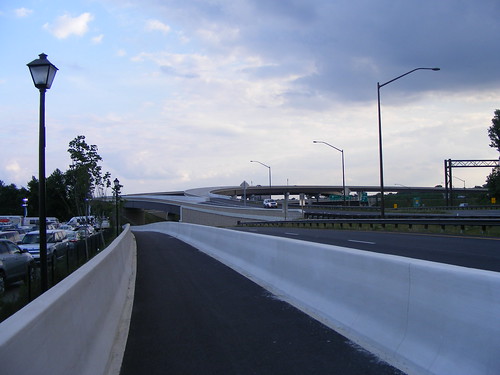
One of four proposed interchanges along Route 29 in Montgomery County, with north on the right side. Image from the Maryland State Highway Administration.

For decades, Maryland highway planners have been trying to turn Route 29 between New Hampshire Avenue in Montgomery County and I-70 in Howard County into a freeway. They recently unveiled new designs for a $128 million interchange at Route 29 and Fairland and Musgrove roads, just south of the Intercounty Connector. Today, both roads intersect Route 29, also known as Columbia Pike, at separate stoplights.

Under the state's proposal, Musgrove Road would become a dead end street on the west side of Route 29, while on-ramps and off-ramps would connect the east side of 29 to its northbound lanes. Fairland Road would go from four lanes to six and only have access to 29 going south.

If the project gets funding, construction could get underway in 2018.

Maryland has already built interchanges along Route 29 in Howard County and in Montgomery County at Cherry Hill Road, Briggs Chaney Road, and Route 198. In 2002, plans to build four more interchanges at Fairland and Musgrove roads, Stewart Lane, Tech Road, and Greencastle Road were put on hold and the focus shifted to the Intercounty Connector. In 2013, then-Governor Martin O'Malley revived the projects.

Tuesday, July 2, 2013

integrated schools will keep MCPS competitive

Last in a series on segregation and academic equity in MCPS. Check out part ONE | part TWO | part THREE

Over the past week, we've looked at how demographic changes and flight are making Montgomery County Public Schools a segregated system. Today, let's talk about ways to fix it.

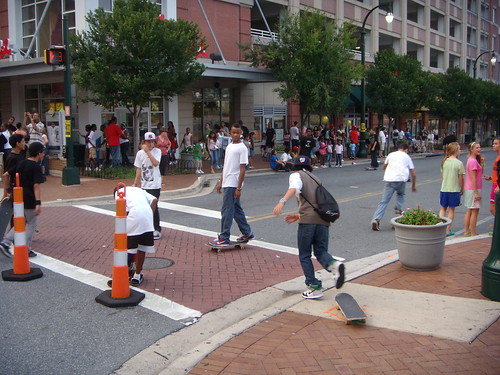
Kid Falls Off Board, Everyone Laughs
Montgomery County's schools should look Montgomery County's residents. Photo by the author.

I started working on this series last year, when my brother began looking at Northeast Consortium high schools to attend this fall. I'm a proud product of MCPS and Blake High School, but it's clear to me that both the school system and the county need to change if they want to remain competitive regionally, nationally and globally.

The de facto segregation of MCPS has been an issue for decades. But school and county officials have often ignored it or responded with weak or ineffective solutions. We can't keep isolating our low-income and minority students in the system's worst-ranked schools. And we must ensure that middle- and upper-middle class families see every school, not just a privileged handful of campuses, as a valid choice for their children.

Tuesday, March 12, 2013

where do young adults live in montgomery county?

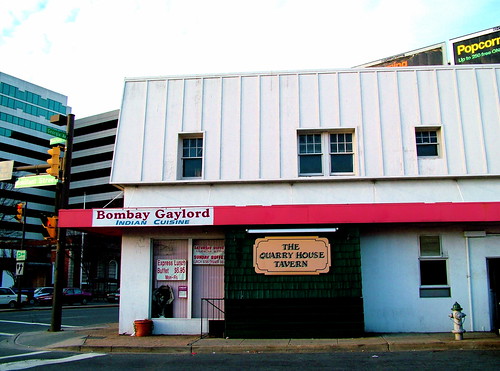
Bombay & Quarry House
Young people in MoCo choose to be near jobs, hangouts and transit. Photo by katmere on Flickr.
Montgomery County community leaders want to draw more Millennials, members of the generation born between 1982 and 2000, hoping that they'll stick around when they're older. As they explore ways to attract twenty- and thirtysomethings, from new transit projects to more nightlife, it's worth looking at where they live in Montgomery County today.

According to the 2010 Census, Montgomery County has about 186,000 residents between the ages of 20 and 34, making up about 19% of the county's population. In a recent Washington Post article about the county's Night Time Economy Initiative, reporter Bill Turque notes that young adults make up a lower share of Montgomery County's population than other places in Greater Washington.

Why is that? Trends show that Millennials want an urban lifestyle, but are often stymied by limited funds and a dearth of affordable housing. As a predominantly suburban, affluent county, Montgomery doesn't seem like the kind of place where young adults would want to live.

However, if you look at individual neighborhoods, you'll find substantial concentrations of Millennials, suggesting a way forward for Montgomery County as it seeks to draw more of them.

Millennials flock to areas near transit, jobs, affordable housing

all the young dudes ranked
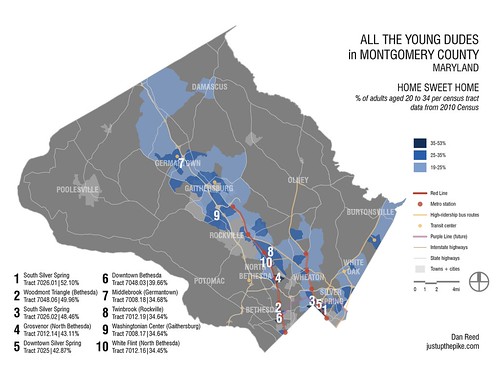
Where Millennials live in Montgomery County. Click on the image for a bigger version, or click here to see it without the rankings.

Here's a map of Census tracts where the percentage of 20-to-34 year old residents is higher than the county's 19% average in the 2010 Census. The county's largest concentrations of Millennials are along the Red Line in places like White Flint, downtown Bethesda and downtown Silver Spring, where young adults are a slim majority. Notably, these are also the places where walking, biking and taking transit to work are most common.

Young adults also seem to gravitate towards shopping and entertainment districts like the Washingtonian Center in Gaithersburg. Even though it's not near a Metro station or major bus route, Washingtonian Center is a pretty walkable area where one can shop or grab dinner without a car.

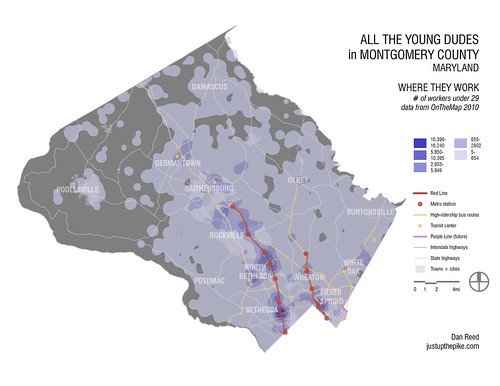
We can also conclude that many Millennials are trying to live as close as possible to their jobs. Here's a map of where people under 29 work in Montgomery County:

where they work-01
Where Millennials work in Montgomery County.

Compare it to the first map and you can see that clusters of young people coincide with the county's biggest job centers, White Flint, Bethesda and Silver Spring. Yet there are also large concentrations of Millennials in places with fewer jobs, like Briggs Chaney in East County and Germantown in the Upcounty.

Not surprisingly, these communities are also more affordable. According to the 2006-2011 American Community Survey, the median monthly rent is $1565 in Census tract 7048.06 in Bethesda's Woodmont Triangle, compared to $1344 in Census tract 7008.18 in the Middlebrook section of Germantown.

Both of these neighborhoods have some of the county's largest concentrations of Millennials, suggesting that there may be more to it than affordability. If we take a closer look at different segments of the county's young adults, we can get a better understanding of why they live where they do.

Educated and single Millennials move closer in

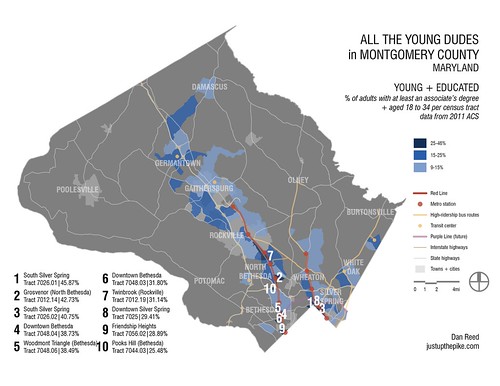
Here's a map of 18-to-34-year olds with at least an associate's degree:

young and educated ranked-01
Where college-educated Millennials live in Montgomery County. Click on the image for a bigger version, or click here to see it without the rankings.

The general distribution of young people is the same, but there's a slight shift towards the Downcounty. College-educated people tend to have higher incomes, which might explain why there are more of them in expensive areas like Bethesda and Friendship Heights.

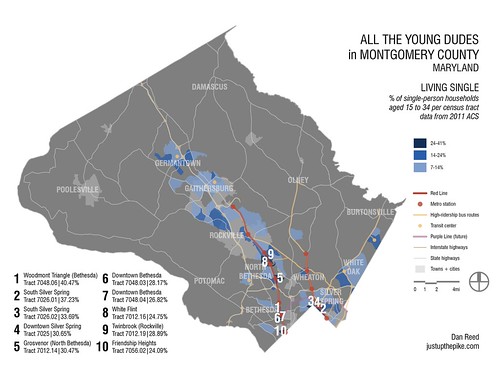
living single ranked-01
Where single Millennials live in Montgomery County. Click on the image for a bigger version, or click here to see it without the rankings.

However, the county's single Millennials have decidedly chosen to live closer in, settling in and around downtown Silver Spring, downtown Bethesda, Friendship Heights and White Flint. These neighborhoods have almost everything that a young single person would want: they're close to Metro, major employers and the District, they contain a fair number of bars and restaurants, and they have a variety of housing options. Silver Spring in particular has a number of group houses.

Millennials with families move further out

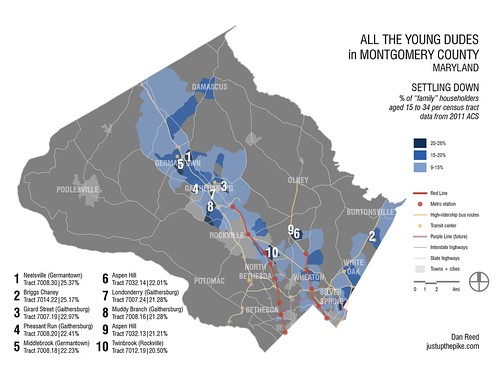
settling down ranked-01
Where young families live in Montgomery County. Click on the image for a bigger version, or click here to see it without the rankings.

While singles are flocking to closer-in neighborhoods, Montgomery's young families, defined here as households led by individuals under 34 and related by marriage, blood or adoption, are moving further out. All ten of the county's largest concentrations of young families are well outside the Beltway, particularly in Gaithersburg and Germantown. Just one is near a Metro station, Twinbrook.

This fits the long-held stereotype that once you get married and have kids, you move to the suburbs in search of larger, more affordable housing. Not only is it cheaper to rent in the Upcounty, it's cheaper to buy: the median home value in Middlebrook is just $294,000, compared to $516,800 in the Woodmont Triangle.

Yet families who choose to move farther out will pay considerably more for transportation than they would elsewhere. That might explain why young families appear to have settled in neighborhoods like Fallsgrove in Rockville, which were designed to encourage walking and biking, near shopping areas like Washingtonian Center or employment areas like the Shady Grove Life Sciences Center.

Meanwhile, young families still make up one-tenth of all households in downtown Bethesda and downtown Silver Spring, suggesting that some are interested in an urban lifestyle. This isn't a new trend: I grew up in an high-rise apartment building in downtown Silver Spring in the 1990's, and there were plenty of kids around. Of course, my mother chose to live there because it was "affordable and quiet," which I'm not sure characterizes the area today.

What does this mean?

These maps have implications not just for Montgomery County, but the whole region. They show that the District and Arlington aren't the only places that can attract Millennials, so long as they can be near neighborhoods near transit, shopping and jobs. While many young families are choosing to live further out, they're still seeking a semi-urban experience.

They also show that one of Montgomery's greatest strengths remains its diversity of neighborhoods, allowing it to attract both singles and families. However, two distinct challenges lie ahead. One is to preserve a supply of affordably-priced housing in the county's urban areas, both established places like Bethesda or emerging ones like White Flint. The other is to create more walkable neighborhoods and improve access to jobs, shopping and transit in the Upcounty and East County, where young families continue to settle.

Of course, Millennials aren't the only ones who want an urban or semi-urban lifestyle. But if Montgomery County wants to attract a new generation of residents, it needs to start listening to young adults. Without us, the county doesn't have much of a future.

Crossposted from the Friends of White Flint.

Friday, June 29, 2012

lack of connections, visibility hurt ICC trail

Looking Back at ICC Interchange


Less than a year old, the InterCounty Connector Trail offers a new way to get across Montgomery County by bike. However, a circuitous route, a lack of connections to surrounding areas and sections with poor visibility all hurt its potential.

The ICC was originally planned to have a bike trail running parallel to it, but in 2004, the State Highway Administration got rid of it, claiming it would reduce the toll road's construction costs and environmental impacts. Instead, they gave the ICC Trail a more circuitous and indirect route, running parts of it along the highway and the rest along local roads like Columbia Pike and Briggs Chaney Road.

Not surprisingly, area bicyclists were unhappy with the decision. "Why do designers think cyclists should have to go the long way, but cars need a direct route?" asks the WashCycle blog.

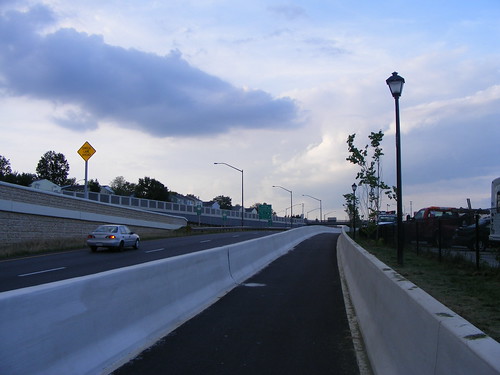
Part of the trail runs parallel to Columbia Pike between Fairland Road and Briggs Chaney Road in East County. Like the Forest Glen pedestrian bridge that crosses the Beltway, it runs under a highway. The trail is also lightly used and has already been vandalized.

This is unfortunate, because the trail could tie neighborhoods on both sides of the ICC together and is a crucial part of a "commuter bikeway" along Columbia Pike first envisioned in master plans 15 years ago. But this part of the ICC Trail won't get any busier or safer without better foot and bike connections to get people to it.

Let's take a look at the trail:

More Bike Trail


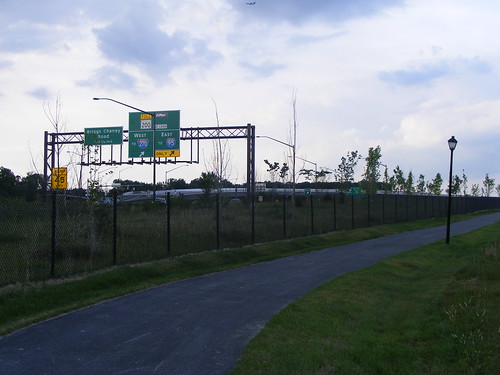
Here we are on the trail, just north of Fairland Road. That's the exit sign for the InterCounty Connector up ahead.

Little Seating Area


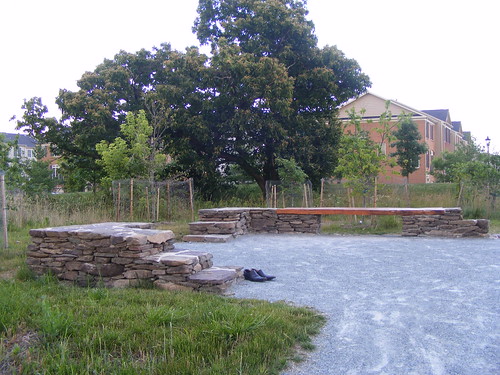
First we pass this small seating area. People do use it, judging from the abandoned pair of shoes. I enjoy the dry stacked stones and wooden bench, which give the trail a woodsy, rustic feel despite its surroundings. Behind the seating area is the recently-built Fairland View subdivision. It's separated by a grass berm and has no connection to the trail, despite being yards away. (The view, of course, is of the InterCounty Connector.) I assume these nearby chalk drawings came from kids living there.

Into the Tunnel


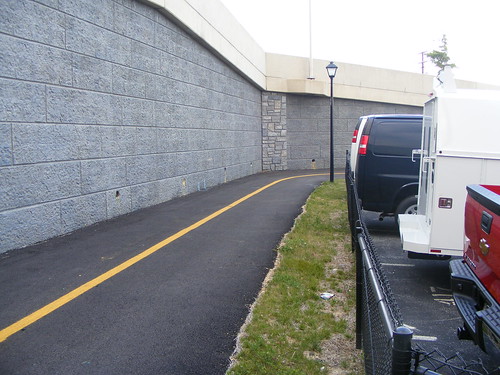
Now we're heading under the interchange between Columbia Pike and the ICC. This part of the trail is almost invisible from either road and the surrounding houses, and I passed a group of young men smoking right before I took this picture.

Sharpie Graffiti


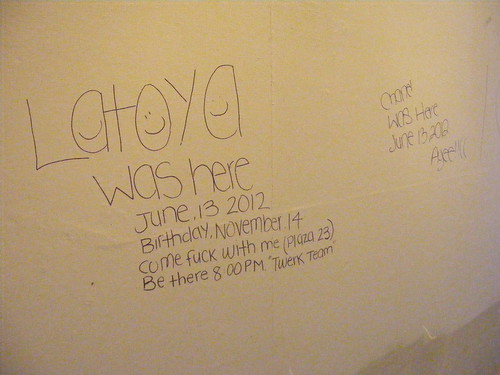
There is Sharpie graffiti in the tunnel, though it's not much worse than anything I saw or did myself in high school. The tunnel appears to have been repainted a few times since it opened; in fact, since I took this photo, the scribbles have already been painted over. It's good to see that the state is maintaining the trail, though I wonder how regularly they patrol it.

Trail Just North of the ICC


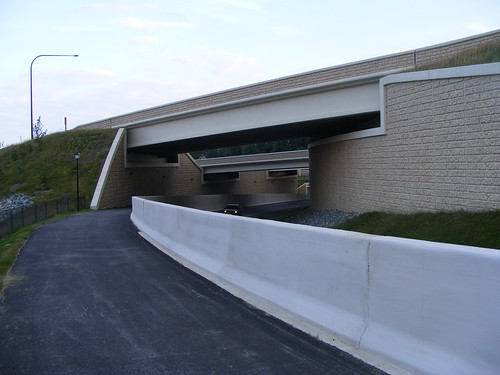
After the tunnel, we go under a couple of overpasses. The roar of traffic is pretty intense, and I noticed some broken glass on the path where lights have been knocked out.

Heading Towards Briggs Chaney Road


We're now between Columbia Pike on the left, and the Montgomery Auto Park on the right. Turn around and you get a great view of the interchange. There are maybe waist-high concrete walls on either side of the trail and a chain-link fence separating it from the Auto Park. The wall might keep bicyclists safe from car traffic, but I wonder if it's also there to protect the car dealerships from bicyclists.
Around the Auto Park


And then we hit a wall. This is the interchange of Columbia Pike and Briggs Chaney Road, which was completed about four years ago; the trail takes a hard right to get around it and then joins Briggs Chaney Road.


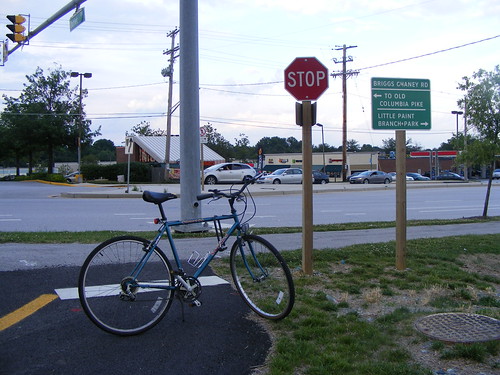
Trail Ends at Briggs Chaney Road


Across the street is the Briggs Chaney Plaza shopping center; there's a stoplight and intersection in front of us, but no pedestrian signal or even a crosswalk. From here, we can continue down Briggs Chaney, which has a nice, wide shared path for about a mile and a half before connecting to a portion of the trail that's actually on the ICC.

Residents of Tanglewood, a subdivision on the south side of the ICC, complained that a trail would invite "criminals" from the apartment complexes along Briggs Chaney Road. While I still think that accusation was unfair, residents' predictions that there would be vandalism on the trail turned out to be true.

But as WashCycle points out, the best way to make a safe trail is to make it busy. In the handful of times I've used this one-mile portion of the ICC Trail, I've seen maybe a dozen people there. The trail is new enough that some people haven't heard of it, but it's also obscured by a highway interchange and sound berms.
It would've been ideal if the State Highway Administration had laid out the trail first and then worked around it, rather than the other way around. The trail would be more direct, and possibly more visible, while having little or no effect on the ability of drivers to pass through.
Since that opportunity no longer exists, the best thing we can do is to improve foot and bike connections to nearby destinations like Briggs Chaney Plaza and neighborhoods like Castle Boulevard, which recently got new sidewalks and medians. The easier it is to walk or bike in the area, the more likely people are to use the ICC Trail, and the less destructive behavior will occur.

Check out this slideshow of my bike ride along the ICC Trail and other roads in East County.

Monday, June 11, 2012

roy rogers could ride again in burtonsville (updated)

UPDATE: Here's the Planning Department staff report for the proposed Roy Rogers, which would be located next to Capital One Bank.

Where can you find Roy Rogers chicken? One day, you might find it in Burtonsville.

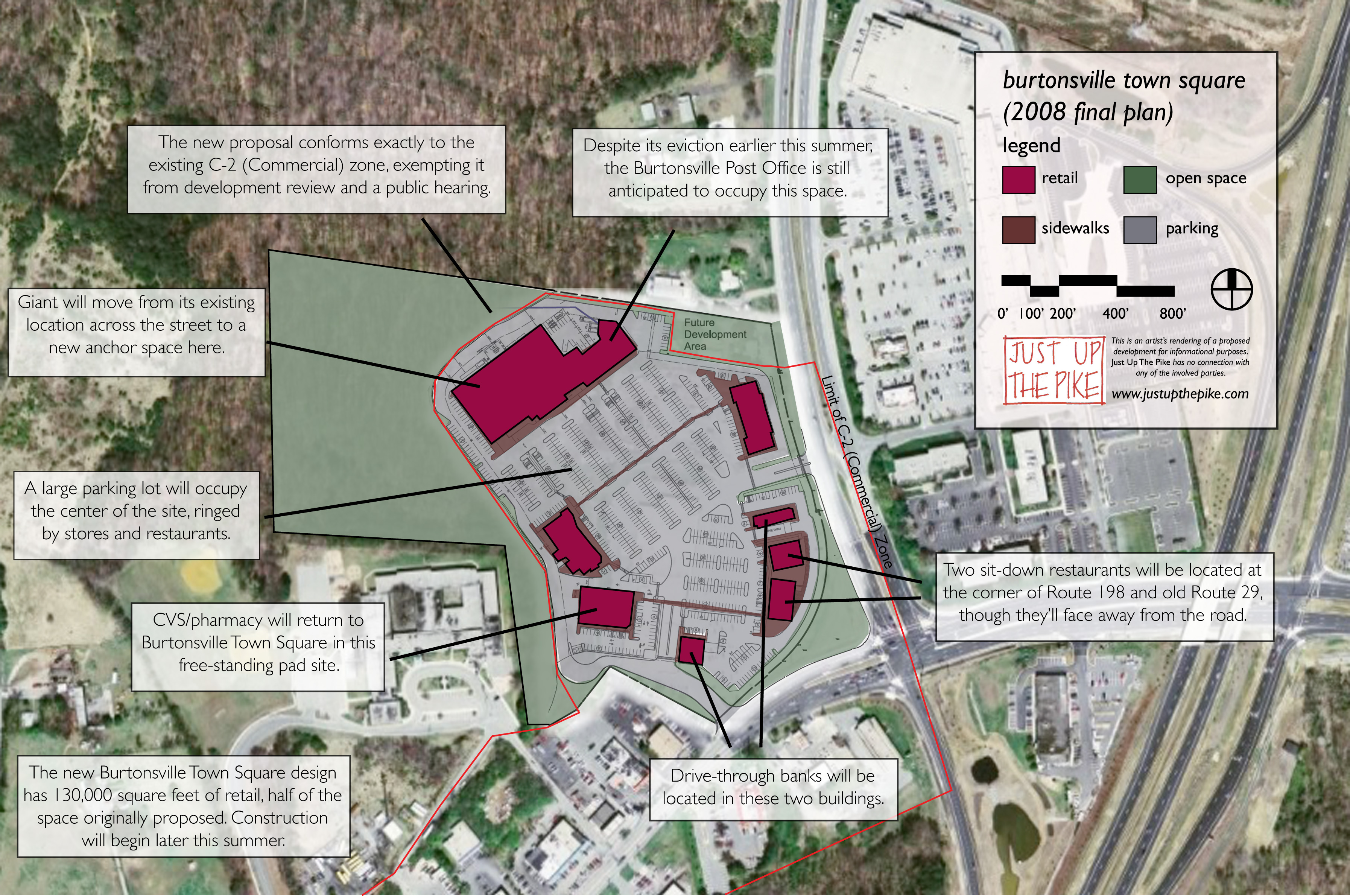
Next week, the Planning Board will review an application by Frederick-based hospitality company Plamondon Enterprises, Inc. to allow a drive-through restaurant at the Burtonsville Town Square shopping center on Route 198. Plamondon Enterprises, run by brothers Jim and Peter Plamondon, Jr, own the trademark and franchise system for Roy Rogers.

The Plamondon brothers' father, Peter Plamondon, Sr., helped develop the Roy Rogers concept while head of restaurants at Marriott in the 1960's. From one branch in Falls Church, the chain grew steadily throughout the 1970's and 80's, amassing 648 locations in the Mid-Atlantic and 200 in Greater Washington alone. Hardee's bought Roy Rogers in 1990 and converted some locations to their brand. They sold off the rest to Boston Market, Wendy's and McDonald's.

A few locations hung on before the Plamondon brothers bought the brand in 2002 and resumed adding new branches. Though the chain is much smaller than it used to be, there are currently 45 locations throughout the Mid-Atlantic and Northeast, 18 of which are operated by Plamondon. However, hungry East County residents must travel all the way to Gaithersburg, where the nearest Roy Rogers is located.

I've said before that Burtonsville's future is tied to its well-regarded restaurants, like Cuba de Ayer, Old Hickory Grille, and Soretti's. Roy Rogers may be a fast-food joint, but it enjoys a substantial following here in the D.C. area. Fast-food expert Sherry Daye Scott told the Washington Post in 2005 that chains with a regional following, like In-N-Out Burger in California, are often the most successful. And that bodes well for Burtonsville.

Lake George 144
A Roy Rogers in Lake George, New York. Photo by axelsrose on Flickr.

This isn't a done deal, however. Burtonsville Town Square was originally approved with sit-down restaurants only, which is why Plamondon Enterprises will have to ask the Planning Board for a special exception. Though if they don't receive one, they could also build a restaurant without a drive-through like the Chick-Fil-A on Tech Road.

A Roy Rogers in Burtonsville may not have the same impact as some of the other improvements proposed for Burtonsville's ailing village center, but it's good news nonetheless. I try not to eat a lot of fast food, but I look forward to having Roy's burgers and fried chicken in my backyard once again.

Post-script: Growing up in downtown Silver Spring, I would beg my mother to take me to the Roy Rogers at Georgia Avenue and Blair Road, which is now a KFC. I also remember ones at New Hampshire Avenue and Lockwood Drive in White Oak and at Briggs Chaney Plaza, which are now both McDonald's. Who remembers any other Roy Rogers locations?

Thursday, September 8, 2011

councilmember andrews seeks curfew alternatives (and a look at one)

Ellsworth Drive Is Alive (I Saw No Emo Kids)A police substation on Ellsworth Drive is just one of the alternatives to a curfew we have. Councilmember Phil Andrews (D-Rockville), so far the strongest opponent of Montgomery County Executive Leggett's proposed teen curfew, has a sharp, insightful op-ed in the Gazette today:
Police officers have many tools to maintain order, including laws against harassment, public drunkenness, disturbing the peace and disorderly conduct. In communities where crime is a problem, such as downtown Silver Spring, the county has added police officers. The County Council recently approved 28 additional officers for the Third Police District, including 12 more for downtown Silver Spring. The county also should pursue federal grants to fund surveillance cameras in problem areas, as County Police Chief Tom Manger proposes, and continue to deploy the Police Community Action Team to bolster police presence where needed . . . The council should reject Leggett’s proposal for a permanent youth curfew — a proposal which falsely signals that crime and youth in the County are out of control, when crime is actually down and the overwhelming majority of youth are law-abiding.
I don't know why people aren't more outraged that Police Chief Thomas Manger and County Executive Leggett has worked so hard to change the perception of Montgomery teens from overachieving honor students to remorseless criminals. Or that the provost of Montgomery College, who presumably works with young people every day, would compare youth crime in MoCo to the Great Fire of Rome. So that's why we have Councilmember Andrews, always the voice of reason, telling the rabble-rousers to calm down. He's totally right in saying that the county has many alternatives, and many more effective alternatives, to a curfew. Lt. Carter of the police department's Silver Spring district, gave me a list of eleven crime-fighting tools, ranging from gang prevention programs to a greater police presence. The most intriguing idea he offered was opening a police substation on Ellsworth Drive. Currently, the Third District police station, which covers downtown Silver Spring and most of East County, is on Sligo Avenue, six long blocks away. In a few years, the station will move to White Oak, several miles away. A police substation on Ellsworth would put police officers in the heart of the action, allowing them to see what's going on firsthand and respond as quickly as possible. It would also allow the public to have regular, positive interactions with police officers, building a relationship. Go to Ellsworth today and you can already see security guards hired by the Peterson Companies (the folks who brought you the Downtown Silver Spring complex) reaching out to customers, answering questions and palling around with teenagers. A police substation would give visitors another place to ask questions and seek help in case of an emergency. As a result, people will begin to trust and respect these authority figures. Not to say there won't still be problems (see this video of a Peterson security guard arguing with a kid who then threatens the guard) but this would be a step in the right direction. Besides staffing, all a police substation needs is space, and very little at that. One former substation was a 400-square-foot, single-wide trailer in the parking lot at Briggs Chaney Plaza. The Downtown Silver Spring complex alone has three vacancies, not including the soon-to-be-closed Borders, totaling 12,000 square feet. But space is expensive. The average rent for retail space in Silver Spring is $26/square foot. Yet if Leggett is truly serious about reducing crime, he should be willing to find the funds to open a police substation on Ellsworth. Or perhaps Peterson can provide a space for a discounted fee. They, along with the Greater Silver Spring Chamber of Commerce, have come out in support of the curfew. It's in their company's best interest to create a safe, vibrant environment on Ellsworth Drive. Surely, reducing the rent of a small storefront on Ellsworth would be worth the investment. Like Councilmember Andrews said, there are lots of good kids in Montgomery County. Rather than vilifying them, we should be trying to work with them to make this county a stronger place. Having a greater police presence in downtown Silver Spring is the first step to creating a constructive relationship with this constituency, rather than antagonizing them with a curfew.

Thursday, March 31, 2011

come out and fix burtonsville tonight with county planners (updated)

Eileena York At Table 6
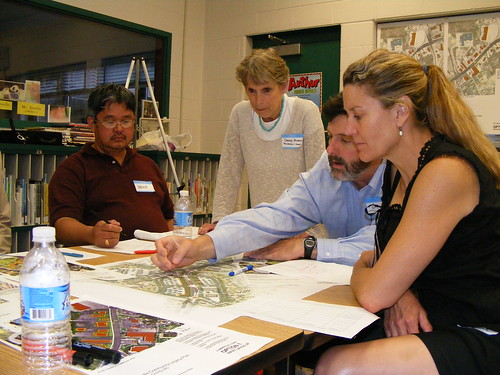
Burtonsville residents and county planners at a community charrette in 2008.

Tonight, county planners are hosting a charrette, or community design workshop, about the future of Burtonsville. It'll be at 7pm at the East County Regional Service Center, located at 3300 Briggs Chaney Road.

As you may know, the Planning Department is developing a plan for the Burtonsville Commercial Crossroads, defined as the area around the intersection of Route 29 and Route 198. Businesses in the neighborhood have been struggling since the Burtonsville Bypass opened in 2006, while the new Burtonsville Town Square shopping center has brought new life resulted in a game of musical chairs as stores formerly located across the street move in.

It's hard to be optimistic about Burtonsville, especially after a charrette three years ago in which shopkeepers complained about sidewalks and residents protested against "undesirables" moving in. Even planning director Rollin Stanley, who usually has something good to say about a place, has trouble talking up Burtonsville when he comes for a visit on the Planning Department's own TV show, Montgomery Plans:

Plans Around Town - Burtonsville - MP 27 from M-NCPPC on Vimeo.


At the now largely-abandoned Burtonsville Crossing shopping center, he tries to talk up the remaining stores. "You've got assets here," he says. "You've got a Hair Cuttery. Everybody needs their hair cut. And two beer and wine stores, a little more than normal." Driving (not walking) down Route 198 (did he at least have a coffee at Soretti's?), he laments, "For the most part, what you see will be here a long time."

Finally, the host asks if Burtonsville Town Square is "similar" to "other Town Squares" in Montgomery County. The answer to that is kind of obvious:

2010 06 07 - 8008 - Burtonsville - Burtonsville Shopping Center
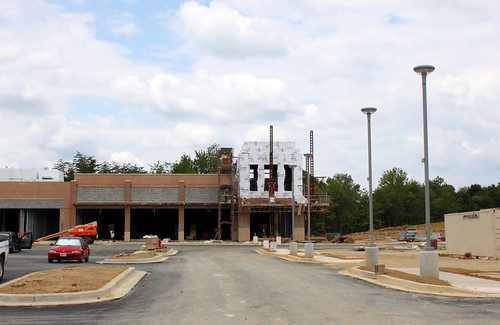
Burtonsville Town Square under construction. Photo by thisisbossi on Flickr.

Rockville Town Square, Saturday Evening
Rockville Town Square in 2007.

(Note the presence of an actual town square.)

It looks like Burtonsville residents are beginning to see the difference. Results from a meeting planners had with the East County Citizens Advisory Board last month (PDF!) seem promising. In that meeting, members of the board - which is composed of seventeen East County residents appointed by the County Council - suggest a number of improvements to Burtonsville. They include better landscaping along Route 198, creating a "mixed use zone" that would allow housing and offices in addition to existing shops, having "more entertainment venues" in the area, and improving pedestrian and transit access. That sounds like a place people might actually want to visit, which is more than you can say about Burtonsville now.

Going to graduate school three hours away will keep me from attending (is social media an appropriate substitute for participating in person?), but I hope those who support a better Burtonsville and not just the status quo will come out and say their piece. Unlike the 2008 charrette, which was focused on minor improvements, the Planning Department appears to be interested in more substantial changes.

Don't screw this up, y'all. If East County wants nice things like Rockville and Bethesda, it has to know what to ask for and how to ask for them. Now's your chance.

Friday, February 11, 2011

the densest neighborhoods in montgomery county

Falkland Chase (7)
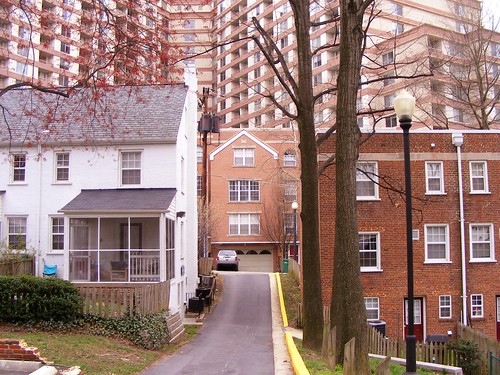
Apartments in downtown Silver Spring: Falkland Chase (foreground) and Lenox Park (background).

"Density" is one of those words that gets tossed around a lot with little care for what it actually means, kind of like "scale" or "quality of life." However, the word only refers to a number representing the proportion between an amount of something (like people) in a given space, and that number is meaningless without any context.

What does density look like? Or, more specifically, what does a dense neighborhood in Montgomery County look like? The 2010 Census results are slowly trickling out, but I looked at the 2009 American Community Survey for MoCo to see where the county's ten densest census tracts were. While census tracts don't always conform to accepted neighborhood boundaries, they can show us where people in MoCo are concentrated.

When I reached out to commenters earlier this week, many of them suggested that the county's densest places were all in downtowns, like Wheaton, Bethesda or Silver Spring. Much to my surprise, they're far more diverse than that. Some are in urban centers like downtown Silver Spring, while others are farther out, miles from a Metro station. Some are several decades old, while others are still being finished today. Not all of them have tall buildings, and not all of them look like the traditional idea of an "urban" place.

This creates a number of challenges, namely what we do with the thousands of (often low-income) people who live in dense neighborhoods far from jobs, shopping or other amenities they need. If you look at a list of the ten fastest-growing places in Montgomery County (which we'll talk about next week), you'll see that most of them are well outside the Beltway. This isn't a good thing. In fact, it only means that many of Montgomery County's current problems - traffic, the jobs/housing divide, and so on - will only get worse.

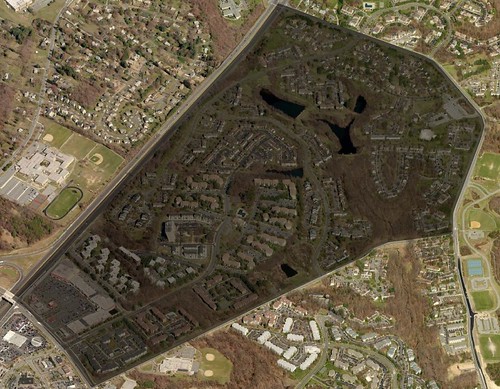
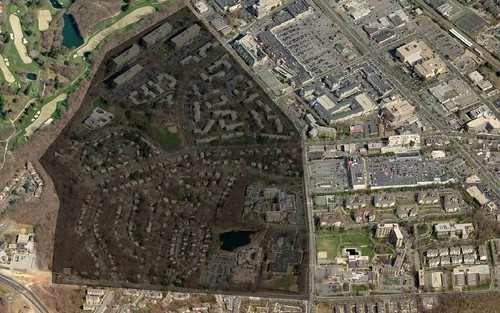
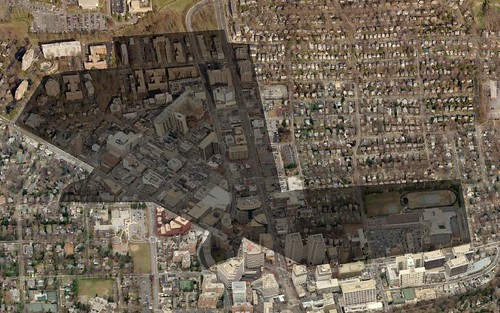
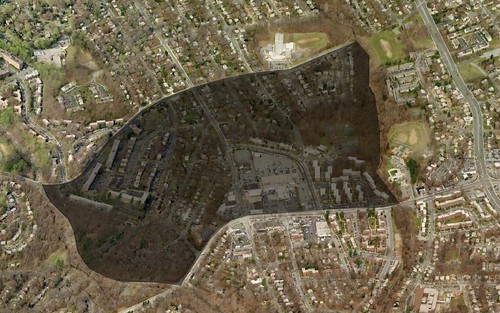
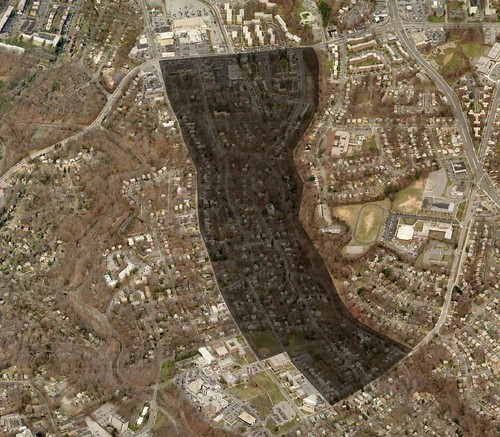
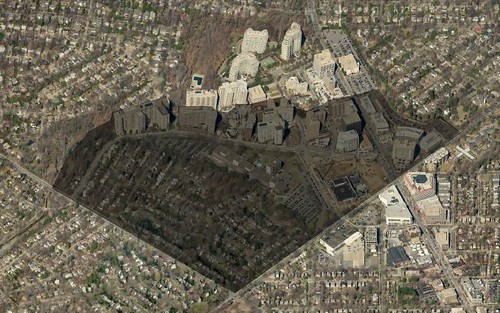
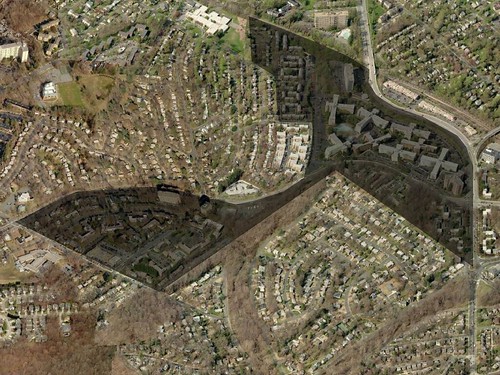
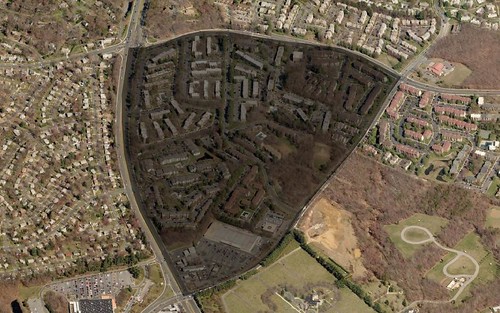
Anyway. Here are the ten densest census tracts in Montgomery County, all to scale and taken from Bing Maps. Scroll down to see them in a nifty slideshow:

10) Clifton Park, Silver Spring

Census Tract 7020
Land Area: 0.38 square miles
2000 Population: 5,275
2000 Density: 13,808.90 people/sq.mi.
2009 Population: 4,927
2009 Density: 12,897.91 people/sq.mi.
Population Change: -7.06%
Nearest Metro: Takoma (2.2 miles)
Place in 2000: #7

9) Briggs Chaney/Greencastle, Silver Spring

Census Tract 7014-16
Land Area: 0.54 square miles
2000 Population: 6,819
2000 Density: 12,698.32 people/sq.mi.
2009 Population: 7,191
2009 Density: 13,391.06 people/sq.mi.
Population Change: 5.17%
Nearest Metro: Glenmont (6.4 miles)
Place in 2000: #11

8) Rollins Park, Rockville

Census Tract 7009-05
Land Area: 0.30 square miles
2000 Population: 3,944
2000 Density: 13,016.50 people/sq.mi.
2009 Population: 4,223
2009 Density: 13,937.29 people/sq.mi.
Population Change: 6.61%
Nearest Metro: Twinbrook (.5 miles)
Place in 2000: #9

7) Woodmont Triangle, Bethesda

Census Tract 7048-01
Land Area: 0.28 square miles
2000 Population: 3,417
2000 Density: 12,160.14 people/sq.mi.
2009 Population: 4,012
2009 Density: 14,277.58 people/sq.mi.
Population Change: 14.83%
Nearest Metro: Bethesda (.1 miles)
Place in 2000: #13

6) Long Branch, Silver Spring

Census Tract 7023-01
Land Area: 0.24 square miles
2000 Population: 3,783
2000 Density: 15,632.23 people/sq.mi.
2009 Population: 4,115
2009 Density: 17,004.13 people/sq.mi.
Population Change: 8.07%
Nearest Metro: Silver Spring (1.8 miles)
Place in 2000: #5

5) Long Branch, Takoma Park

Census Tract 7019
Land Area: 0.17 square miles
2000 Population: 3,218
2000 Density: 18,494.25 people/sq.mi.
2009 Population: 3,350
2009 Density: 19,252.87 people/sq.mi.
Population Change: 3.94%
Nearest Metro: Silver Spring (1.8 miles)
Place in 2000: #4

4) Village of Friendship Heights (part)

Census Tract 7056-02
Land Area: 0.21 square miles
2000 Population: 3,234
2000 Density: 15,548.08 people/sq.mi.
2009 Population: 4,197
2009 Density: 20,177.88 people/sq.mi.
Population Change: 22.94%
Nearest Metro: Friendship Heights (.1 miles)
Place in 2000: #6

3) Summit Hills/Rock Creek Gardens, Silver Spring

Census Tract 7026-02
Land Area: 0.20 square miles
2000 Population: 4,558
2000 Density: 22,904.52 people/sq.mi.
2009 Population: 4,640
2009 Density: 23,316.58 people/sq.mi.
Population Change: 1.77%
Nearest Metro: Silver Spring (.5 miles)
Place in 2000: #3

2) North Gate, Aspen Hill

Census Tract 7032-13
Land Area: 0.22 square miles
2000 Population: 5,463
2000 Density: 24,719.46 people/sq.mi.
2009 Population: 5,634
2009 Density: 25,493.21 people/sq.mi.
Population Change: 3.04%
Nearest Metro: Glenmont (2 miles)
Place in 2000: #2

1) Falklands/The Blairs, Silver Spring

Census Tract 7026-01
Land Area: 0.13 square miles
2000 Population: 4,242
2000 Density: 32,630.77 people/sq.mi.
2009 Population: 4,016
2009 Density: 30,892.77 people/sq.mi.
Population Change: -5.63%
Nearest Metro: Silver Spring (.1 miles)
Place in 2000: #1

Check out this slideshow of the ten densest census tracts in Montgomery County. Click on the "show info" link to find out more about each one.

Thursday, June 17, 2010

the great peruvian taste test: my favorites

The JUTP Facebook page isn't maintained as well as it should be (though I encourage y'all to "like" us!), so it took me two weeks to notice this plea from Sardi's Pollo a la Brasa to "TRY OUR CHICKENNN."

Oh, Sardi's. If only I hadn't given away all my big JUTP buttons (from the ill-fated JUTP store) to small children in Briggs Chaney. Then, I could have worn them when I came to your restaurant - one on each side - and proudly told the cashier, "I HAVE TRIED YOUR CHICKENNN, AND IT IS SO GOODDD."

I basically abandoned our Great Peruvian Taste Test two months ago, stopping short of reviewing the #1 reader-selected favorite pollo a la brasa, El Pollo Rico.

There are a few reasons why this happened. For one, you can't get plantanos at El Pollo Rico, which are my favorite Peruvian chicken side dish. Second, I started dating a vegetarian, one who lives in Virginia and can cook really well, eliminating most opportunities I'd have had to eat heavily-flavored meat.

But the real reason is that we've all already eaten at El Pollo Rico, and those who are really into pollo a la brasa have long since dismissed it for the next great chicken. I know I have. My favorite Peruvian places never made the top five, but I figured you'd rather hear about them than anything else.

So let's bring an end to the Great Peruvian Taste Test:

Sardi's Pollo a la Brasa
Multiple locations; we tried the one at 10433 Baltimore Avenue, Beltsville.

I first learned about Sardi's in college, when a friend ordered food and I was stunned to find the delivery man brought not pizza or Chinese but delicious rotisserie chicken. Located on Route 1 in a former Pizza Hut, Sardi's is particularly convenient to those living Up The Pike who don't feel like going into Downtown Anywhere. Unlike many of its hole-in-the-wall counterparts, Sardi's has a nice, big, clean dining room. But don't let the non-Wheaton location and cleanliness fool you: This shit is good.

Meat and Flavor. Juicy, strong chicken. The meat falls right off the bone. The skin is nice as well, for those of you who do that. Right up there with Inka's in terms of taste.

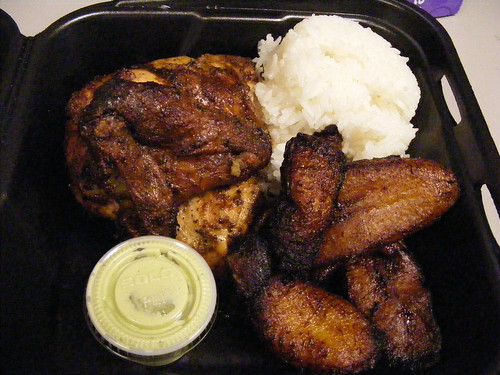
Sides. A huge variety of sides - and they're generous with them, too. The plantanos don't cost extra and are always golden and just a little crispy. Meanwhile, the white rice is soft and fluffy. Together, they support the chicken well.

Sauces. The standard yellow sauce and green sauce. But you won't really need either of them.

Chicken, Carbon in Rockville
Carbón Peruvian Chicken & Grill (above)
100 Gibbs Street, Rockville

You might worry that a pollo a la brasa joint in Rockville Town Square might dilute the quality of its food to please diners who'd otherwise take their business next door to Five Guys or Jerry's Subs and Pizza. But Carbón's doesn't compromise, mixing trendy décor - a menu with prices in whole dollars, posters from an obscure Andean potato ad campaign on the walls - with solid food.

Meat and Flavor. While not as cuminy as other places, the birds are far more consistent in quality here. Soft, juicy, and meaty. I'm convinced their chickens are bigger.

Sides. Plantains cost extra, unfortunately, but no complaints about the taste. I always run out of rice before I finish, though.

Sauces. There's the traditional green and yellow sauces, along with another greenish-yellow sauce that I'm told is "extra mild." (This is Rockville, after all.) It's not bad, however.

Chicken on the Run
4933 Saint Elmo Avenue, Bethesda

This is the place that started it all for me four summers ago while doing a miserable internship a block away. If it weren't for Chicken on the Run, I would've quit much sooner. It's a hole-in-the-wall - you might be able to get ten people in here sitting down - but perhaps the only dining establishment (save for mom-and-pop M&N's Pizza) worth your money in downtown Bethesda.

Meat and Flavor. Friend of JUTP Chip Py always jokes that the best Peruvian places are the ones where the chickens have years of old grease and dirt baked into them. It's probably applicable here. This pollo is dark and sumptuous - certainly not for beginners.

Sides. Plantains aren't extra, and they're good. They have a nice lunch special here that's definitely worth taking advantage of.

Sauces. Yellow sauce and green sauce. Perhaps this as a judging category was not a good idea.

And there you have it: the best Peruvian chicken in suburban Maryland. I hope you enjoyed this journey as much as I have, particularly right around lunchtime. If you're smart, you haven't eaten yet - and, hopefully, you're close to one of the eateries on the map below. Happy eating!


View the great peruvian taste test in a larger map

Monday, May 24, 2010

what's up the pike: put a strap on your head?


- Sk8ter Mom (see her profile in last week's Gazette if you missed it) posts this video of an argument between a skateboarder and security guards on Ellsworth Drive. (Warning: there's some strong language.) It's a little unclear what's happening here: who provoked whom, and why the security guards are literally following this kid down the street. What do you think?

- The City Paper's Tim Carman gets an exclusive tour of the kitchen at Hollywood East Cafe, which just reopened at Westfield Wheaton Wheaton Plaza earlier this year. "Out in Hollywood East’s cavernous dining room, I suspect few customers understand how much work [head chef Kenny] Lei and his team put into the plates that crowd those rolling steam carts," writes Carman, who favorably compares the restaurant to trendier dim-sum places that have popped up in D.C.

- Good Eatin' visits Mrs. K's Toll House on Colesville Road. "Mrs. K’s will never be hip or trendy, like say the new 8407, but it remains one of the nicest restaurants in this neck of the MoCo," he writes.

- Freelance writer and blogger/Briggs Chaney resident/friend of JUTP Whitney Teal laments the lack of coffee shops in East County, especially the ones that aren't welcoming to laptop-campers like herself. (Hey, at least she isn't breast-feeding or staging a protest in favor of breast-feeding there.) It's all on her new blog, The Washington Media Project, about "Newspapers, magazines, books, television, radio, blogs, social media (and staffers) in the Washington, D.C. area."

Monday, May 17, 2010

new chick-fil-a owner jumping into community life

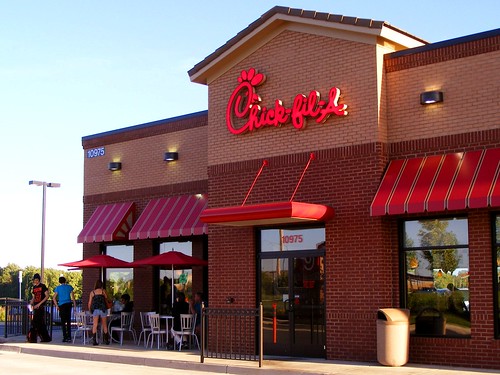
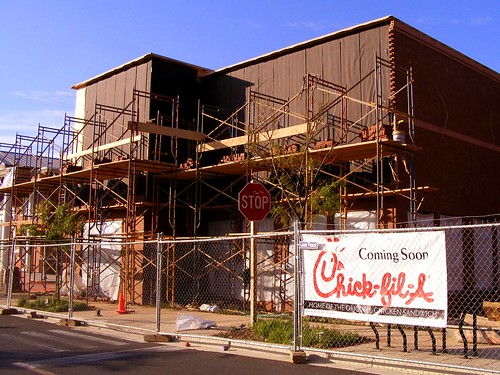
A new Chick-Fil-A will open on Tech Road on July 15, bringing the Southern-fried fast-food joint with a cult following to East County. The other week, I sat down with Erik Amick, the store's new owner and operator whose family just moved here six weeks ago. While he came to open a restaurant, Amick's looking forward to getting involved in the community as well.

Chick-Fil-A On Tech Road
A new Chick-Fil-A will open on Tech Road in Calverton July 15.

"I've always had a desire, wherever I am, to make an impact on the people around me," says Amick over banh mi, the Vietnamese stuffed sandwich, at Saigonese Restaurant in Wheaton. Born in Michigan, he grew up in Florida, where he attended Palm Beach Atlantic University.

In 1998, fresh out of school and newly married, Amick and his wife traveled across the world, doing a mix of missionary and relief work. The couple spent time in Indonesia, Turkey, and even worked with Malian immigrants in Paris before settling in Atlanta, where they joined the church who sponsored their travels.

While there, he grew attracted to the mission of Chick-Fil-A - founded by fervent Baptist S. Truett Cathy and well-known for its policy to close on Sundays - and began a grueling, fourteen-month interview process to be selected as a store owner and operator.

The company culture "is caring, generous, giving and positive," Amick writes in a later e-mail. "One where people seek to serve each other rather than outdo each other." He quotes the company's corporate purpose: "To glorify God by being a faithful steward of all that is entrusted to us. To have a positive influence on all who come in contact with Chick-fil-A."

"My goal is to fulfill this purpose in Silver Spring," says Amick. "I can have a positive impact on not only my employees, but the people who live nearby."

When he was finally selected to open a store, Amick asked to be placed "anywhere in the Southeast," though he looked forward to following a brother-in-law who'd recently moved to the D.C. area. His new Chick-Fil-A will be one of the chain's first freestanding store without a drive-through. The chain's branch in downtown Silver Spring also lacks one, but it's located inside a larger building in an area with considerable pedestrian traffic.

Chick-Fil-A, Johns Hopkins Road, Fulton
The new store will be larger than this Chick-Fil-A on Johns Hopkins Road in Howard County, but it'll also have outdoor dining space.

"To not have a drive-through is a challenge for us," says Amick. They plan to make up for it by having a larger-than-usual dining room, with 160 seats. By comparison, the recently-built Chick-Fil-A at Route 29 and Johns Hopkins Road in Howard County has only 100 seats. The new store will also have a "substantial patio," joining other restaurants in that shopping center with outdoor seating.

Like many newcomers to East County, Amick's discovered that it's hard to describe exactly where anything is when everything has a Silver Spring address. For example, the corporate office originally called his store Chick-Fil-A at West Tech Village Center. He made a Facebook page for it, but when no one joined, he wondered if the store's name should include Silver Spring, though that would create confusion with the current Chick-Fil-A Silver Spring located on Ellsworth Drive downtown.

"Where would you say it is?" he asks me.

I live a five-minute drive from the new store, I explain. The census says I live in Calverton, though I have a neighbor who would answer "Briggs Chaney" and another, "Burtonsville." Our post office is called "Colesville," but the Super Fresh nearby advertises itself as being in "White Oak." Generally, I say I live in Silver Spring "at 29 and Cherry Hill Road," and if that doesn't clear it up, I add, "by the Target."

Given all of this, Amick later names the Facebook page "Chick-Fil-A at Tech Rd. Silver Spring," which seems clear enough.

Since moving to Cloverly in March with his wife and three young children, Amick's been reaching out to the community, visiting local churches and exploring Silver Spring and the surrounding area.

"I'm grateful to be in a place" with so much diversity, says Amick, whose listed interests on Facebook include "Traveling" and "Cote D'Ivoire." "I'd rather be in another culture than my own," he continues. "Being around people who are different than me and learning about them . . . that energizes me."

Not only that, but his family's received a warm welcome. "We went to downtown Silver Spring and brought our [eighteen-month-old] with us to eat dinner," Amick explains, "and were really amazed by how friendly people were, coming up to us on the street and talking to us."

"Atlanta's known for Southern hospitality," he says. "I felt like 'Wow, people are more friendly here than they are in Atlanta."

Monday, April 19, 2010

east county's fast-food boom

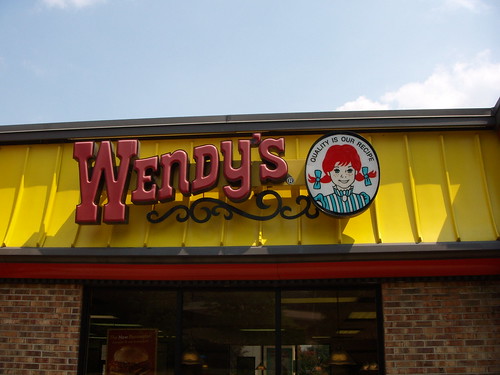
Wendy's
Sure, all those Downtown Silver Spring folks get to brag about their speakeasies and honey-lavender roasted chicken, but we've got our own culinary renaissance happening Up The Pike. If you've been down Randolph Road in Colesville lately, you know we're getting another Wendy's.

That's right, y'all: it's the same spicy chicken fillet and frozen dairy dessert you've come to enjoy in Wheaton, Briggs Chaney, Aspen Hill and Calverton, now just ten minutes away from all of those places. With those kind of eating options, it's only a little disappointing that despite a change in liquor laws, an ongoing lack of investment in our local economy (other than things that can bring profits back to corporate headquarters in Dublin, Ohio), continue to render East County a fine-dining wasteland.

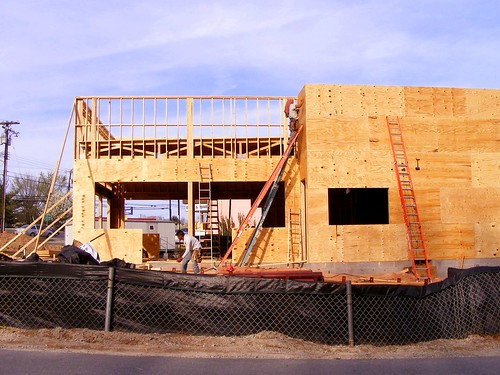
While the urban planner in me is cautiously excited about the provision of on-street parking, sidewalks, and outdoor dining at the Colesville Wendy's, it's frustrating that this new branch will look much like the other four within spitting distance of my house. Of course, this means that a restaurant that broke ground last month could have the fry-o-lators up and running by May Day, if not sooner.

This was the Colesville Wendy's on April 2:

Colesville Wendy's Under Construction


And here we are again on April 8:

Wendy's In Colesville, April 2010


And finally last Thursday, April 15:

Wendy's In Colesville


Now, don't get me started on the new Chick-Fil-A on Tech Road, which I guess is in the planting stage. (One big rainstorm and it will rise from the ground like a breaded phoenix.)

Westech Chick-Fil-A, April 2010


I love me some Chick-Fil-A (as I do Wendy's) and y'all know that I will be camping outside before opening day for a year's supply of chicken sandwiches. But it would be nice to see a little more variety where I live - food variety, which hopefully everyone can agree with. And of course, one could argue whether this Chick-Fil-A really represents a step down from the chain steakhouse we were supposed to get in that space.

But really, any new food that comes to East County, be it gourmet or gross, coupled with my increasingly sedentary lifestyle (the product of no longer living, walking - but not rioting - in College Park) will only continue to make me fat. So everything basically works out in the end.

Thursday, January 14, 2010

we need higher fares, not service cuts for ride on

Catching A Bus, Wayne at Dixon
Thirty-one Ride On bus routes, including thirteen routes serving East County neighborhoods from Takoma Park to Olney, could see reduced service or be eliminated altogether under cuts proposed by Montgomery County Executive Ike Leggett. The changes would close the county's $70 million budget gap by $2 million, but it would also eliminate a million of the thirty million annual trips taken each year using Ride On.

The full list of cuts (PDF!) include five Ride On routes in East County which would be cut completely. Four routes would stop running on weekends, including two Metrobus lines operated by Ride On, the L8 (Connecticut Avenue Line) and Z2 (Colesville-Ashton Line). Two routes, the 7 (Wheaton-Kensington) and 22 (Silver Spring-Hillandale) would lose some weekday service. Routes 15 & 17 (Silver Spring-Langley Park) and 34 (Aspen Hill-Friendship Heights) would run less often in the evenings.

At Rebuilding Place in the Urban Space, planning consultant Richard Layman points out that the $2 million saved by reducing Ride On service could be made up by increasing fares by ten cents. It's easy to say that this would be unfair to working people - after all, that's exactly what they say about tolls on the InterCounty Connector. But if you don't want to pay to drive on the ICC, you can take another road. Transit users who don't or can't drive have no other alternative.

Going to the West Coast revealed to me just how cheap bus fares are in this area. Like Metrobus, Ride-On costs $1.35 to ride, or $1.25 with a SmarTrip card. In San Francisco and Portland, it's $2.00. In Seattle, a variable fare structure means you could pay up to $2.75 to ride the bus at rush hour. Like most public transit systems, none of these cities' buses pay for themselves, but they make it clear that people willingly accept higher fares. If a small increase in bus fares means keeping the service we've got, then by all means it should be implemented.

Bus Stop, Good Hope Road
A bus stop on Good Hope Road for Route 39, which would not be cut.

On the other hand, why should we continue paying for routes with anemically low ridership? The five routes being eliminated are either redundant or serve areas where there are few people. Route 3 (Silver Spring-Takoma) loops around Downtown Silver Spring, blocks from any major attractions. Not surprisingly, it carries just eight people each hour.

Route 33 (Glenmont-Bethesda) avoids major roads like University and Connecticut in favor of a slow, winding trip down neighborhood streets. Route 21 (Silver Spring-Briggs Chaney) was created in 2006 to make up for Metrobus routes that were either cut or changed, but the indirect route that resulted attracts few riders.

Route 31 (Wheaton-Glenmont) wraps around Wheaton Regional Park. Route 53 (Shady Grove-Glenmont) ambles through parks and farmland outside of Olney. Kathy Jentz, editor of Washington Gardener magazine, has written about the importance of bringing transit to nature, but farms and parks aren't good at drumming up riders.

Rather than saving $2 million by cutting underperforming lines, we should redirect the money toward creating more efficient service. And if that's not enough to put buses in places where people can and will use them, we should increase bus fares as well. Paying more to ride the bus can be a financial hardship - but if people can't get to work, how do we expect them to cough up any money at all?

Monday, September 28, 2009

rain still does not threaten burtonsville day celebration

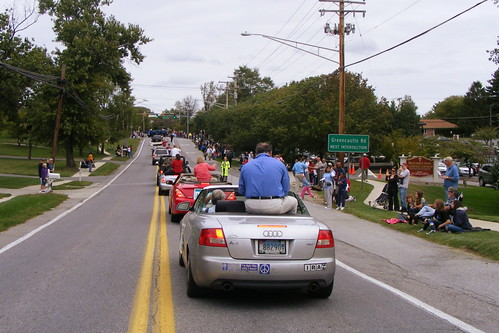
Burtonsville Day is the one time a year Burtonsville looks like the "small town" it purports to be the rest of the time. For all the people who come out each year for the parade up Old Columbia Pike and festival at the Praisner Center, I wonder how many don't even know what it is. My own parents, who've lived here for ten years, had no idea what Burtonsville Day was until I was in it this year. What I didn't know last July when I took my current job that my duties would include driving the official George Leventhal parade float SUV (at left) as the Councilmember and his son rode on top.

The Parade at Old Columbia and Greencastle
Nancy Navarro and the Zipcar
LEFT: County Councilmembers on parade down Old Columbia Pike, from left to right: Phil Andrews, Nancy Navarro, Nancy Floreen and Marc Elrich. (I am driving George Leventhal's car while taking this photo.) RIGHT: District 4 Councilmember Nancy Navarro rode in a rented Zipcar.

Tents at Praisner Center
Going to more and more events in Downtown Silver Spring has spoiled me, I think, because it seemed like there wasn't enough activity at Burtonsville Day. I'm convinced that it was smaller than last year's Burtonsville Days - which included a movie Friday night and a fashion show Saturday afternoon - but I can't really tell.

East County Regional Services Center

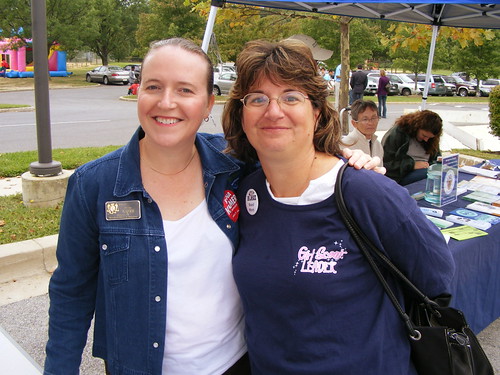
Anne Kaiser and Alison Praisner Klumpp
The East County Regional Services Center booth - staffed by assistant director Chuck Crisostomo, director Joy Nurmi, and advisory board member Benoy Thomas (at left) - was a stopping point for local luminaries, among them state Del. Anne Kaiser and Alison Praisner Klumpp, who was eating a hot dog when I asked her for a photo but quickly hid it (at right). Joy and Chuck insisted that this year's Burtonsville Day was far, far bigger than last year's, which was threatened by rain. Of course, it rained like hell this year, too. So I don't really know, but I'll defer to the optimists, I guess.

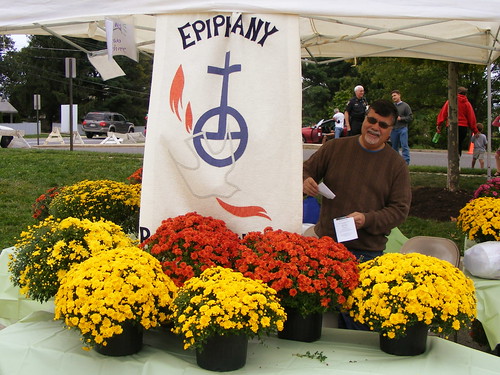
Epiphany Lutheran Plant Stand
I used to joke that East County was the "Bible Belt" of MoCo, and for good reason. (Just look at this Google map in which I searched for "church" in Burtonsville.) One out of every six booths (there were thirty-six in total) at Burtonsville Day were for one of the area's many houses of worship. The majority of them were seeking to fill pews, but Epiphany Lutheran Church on Old Columbia Pike was selling flowers.

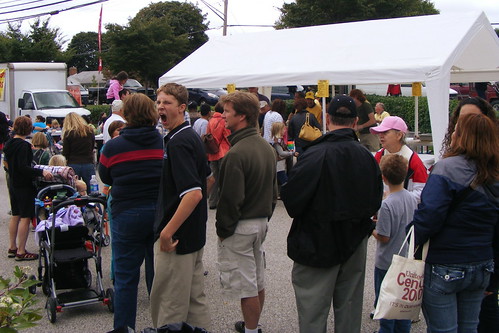
Kid Yawning In Food Line
Of course, the biggest attraction is always the food, provided by the Burtonsville Lions. You can smell it all the way up and down Old Columbia Pike, filling the nasal gap between where you stop smelling Old Hickory Grille at 198 and where you start smelling Marina's Pollo a la Brasa at Briggs Chaney Road. This kid definitely wanted a couple more hours of sleep, but hopefully a hamburger will wake him up.

If I took any photos you haven't already seen, they'll probably be in this nifty slideshow.