Showing posts sorted by relevance for query guest blog. Sort by date Show all posts

Monday, July 20, 2009

guest blog: sligo creek golf course hearing recap

The Planning Board's hearing on what to do with the Sligo Creek Golf Course was pretty intense for those who dared to brave the three-hour affair last Thursday evening (which was also covered by your favorite Silver Spring bloggers.) North Woodside resident Woody Brosnan offers his perspective of what happened. If you've got something you'd like to say, write a guest blog! Send submissions to justupthepike at gmail dot com.

It was a very up and down night at the Montgomery County planning board Thursday night. I guess we probably got some kind of signal when Chairman Royce Hanson and member John Robinson kept the standing-room only crowd waiting for 15 minutes past the scheduled 7 p.m. start time. Hanson indicated his intent was to get through the 39 witnesses as quickly as possible.

I thought on the positive side we had some great testimony from golfers who wanted to keep the course going, including seniors, women, fathers, mothers. I also think there was general agreement that we want a more environmentally-friendly golf course. One man offered to contribute $1,000 to a loan fund to improve the course. The audience frequently broke into applause.

There were two witnesses for a soccer complex and two for disc golf. The remaining witnesses favored a nature center. One or two people said that if there can't be golf that they would like to see some recreation at the site. Only a couple of times did board members ask questions of the witnesses.

After 10 p.m., the board members had their turn and it was clear that Hanson and Robinson wanted no more hearings where they would have to listen to pleas for a golf course. Hanson first dismissed the soccer/sports complex, saying it was too much for that area. (This would have been the worst option from a traffic standpoint.) Then, Robinson, who is only on the board because the Council extended his term, questioned why they should even consider a golf course option since they were prohibited from operating a golf course by the lease agreement with the Revenue Authority.

Mary Bradford, the parks staff director, explained that they wanted to "marker" in case there was a decision to keep the course open by the Council. So the staff was willing to do the work. Hanson wound up directing the staff to consider some kind of option for the course that would include natural areas with recreation. They did not specify what recreation but I think it was something less than lighted soccer or ball fields.

Golfers will now appeal directly to the County Council to keep the course open.

If you've got something you'd like to say, write a guest blog! Send submissions to justupthepike at gmail dot com. All statements published are those of the writers and theirs alone.

Thursday, July 31, 2008

guest blog: pushing into the patuxent's backyard (updated)

Ryan Homes, whose Whitehall Square development in White Oak is pictured above, will be among those building condominiums on a site at old Route 29 and Dustin Road. Developer Tom Norris presented his proposal for Patuxent Ridge to local residents last night at the Praisner Library, raising concerns about its proximity to the Patuxent Watershed. I wasn't able to make the meeting, but Burtonsville resident and children's songwriter Barry Louis Polisar, who lives near the proposed development, graciously offered to write a guest blog recounting what took place. Click here for Norris's response.

The developer for a new housing complex in Burtonsville met with local residents on Wednesday night at the Praisner Library to introduce plans to obtain a "Special Exception" to build five four-story buildings and a community center on 9.5 acres on Old Route 29 between Bell and Dustin Roads. This property is in the rural cluster agricultural area and is currently zoned for one home. It is now occupied by a farm and produce stand. The developers plan to build a High Density Condominium complex that could only be purchased by people who are either disabled or over 62 years of age. They intend to provide 156 paved parking spaces for residents, care-givers, and staff.

Despite little advance publicity about the presentation, the library meeting room was filled with area residents who voiced concerns about the impact this development would have on the nearby Patuxent River Watershed and on the local roads. There are currently about 90 single family homes in the corridor from Rt 198 to the Patuxent River and the developer and Ryland Homes have plans to build 86 mostly two bedroom units, which will effectively double the density overnight.

so much more AFTER THE JUMP . . .

The developer stressed the need for housing for an aging population in Montgomery County and stated that the County's Master Plan encourages this kind of development here, however some local residents at the meeting pointed out that the proposal being planned is effectively a Condominium development with restrictive covenants against anyone under 62 years of age.

The developer's proposal states that their development "will be in harmony with the general character of the neighborhood considering population, density, design, scale and bulk of any proposed new structures, intensity and character of activity, traffic and parking conditions." Many local residents strongly disagreed with this assessment.

Since there is no public bus service from Dustin Road, residents will need to drive their own vehicles to get to local shopping areas. While some senior residents might walk to shopping, many will not and local residents were concerned that not only does this put additional vehicles on Old Columbia Pike which has been designated a local access road, but all vehicles traveling south will have to first go north and maneuver around the recently installed traffic circle. There was additional concern voiced at the meeting that in order to facilitate this new housing complex, sewer and water would have to be brought onto the site along Rt 29--and would have the effect of opening up the entire Old Rt 29 Corridor to development.

None of the local residents attending the meeting voiced approval of these plans and at times the exchange became a little heated. Some residents suggested that concerned citizens write to the planning board to voice their disapproval and make plans to attend the upcoming zoning hearings scheduled for September.

Apart from density issues, the main concern voiced at the meeting is the impact this building will have on the Patuxent Watershed. Once again it seems that an environmentally sensitive area located in the last rural cluster in Eastern Montgomery County is being offered up for development--rather than acreage in an area that is already developed with sewer and water and already has a real public transportation system in place.

If you've got something to say, Just Up The Pike is always looking for guest bloggers. While I don't always agree with the statements made, guest blogs offer an opportunity for all sides to be heard on East County issues. Contact me at danreed at umd dot edu if you're interested in contributing.

Friday, October 3, 2008

guest blog: town hall meeting discusses iraq war's effect on moco

The following is a guest blog from Jean Athey, coordinator of PeaceAction Montgomery, about the Town Hall Meeting, "Can Montgomery County Help End The Iraq War?" held in Germantown last month. Now, we're well aware that Iraq is nowhere near East County. Nor is Germantown, but we figured it'd be a nice idea to talk about the world outside Silver Spring, if only once. (How about that debate last night, ay?)

County Executive Isiah Leggett moderated a Town Hall meeting September 22 in Germantown that addressed the costs to Montgomery County of the Iraq war and occupation and presented a new County Council peace resolution that its author Council member Valerie Ervin will soon introduce. The Town Hall Meeting was cosponsored by 15 community organizations and attended by some 200 people.

Mr. Leggett spoke in support of the resolution, as did Council members Duchy Trachtenberg and Marc Elrich, along with sponsor Valerie Ervin.

The resolution makes two key demands: (1) that the U.S. government immediately commence a humane, orderly and complete withdrawal of U.S. military personnel from Iraq; and (2) that the Maryland General Assembly and the Governor limit the deployment of the Maryland National Guard outside of the State of Maryland to situations in which they are lawfully called into service under a valid and continuing authorization from Congress. (The draft resolution can be found at: <http://www.peaceactionmc.org/countyres.html>.

so much more AFTER THE JUMP . . .

Councilmember Marc Elrich (D-At Large) speaks at the town hall meeting.

Economist Brendan O'Flaherty of Columbia University discussed the financial costs of the occupation to Montgomery County, many of which, he stated, will be felt in years to come and will be borne by our children, limiting their futures in profound ways.

Karen Dolan, a fellow at the Institute for Policy Studies, discussed reasons that local governments have an obligation to take principled stands on issues that deeply affect their constituents, even in the absence of legislative authority. She cited applicable Constitutional provisions and historical examples.

Commenting on the current national economic crisis, Dr. O'Flaherty noted that the combination of the war costs and the looming financial bail-out will be devastating, and the longer the U.S. maintains a large presence in Iraq, the worse it gets, given the current military "burn rate," which is even higher now than it was a year ago. The estimated total costs of the war, he said, are somewhere between two and four trillion dollars. That amount of money is equal to the construction replacement cost of about one-fifth of all the 1-to 4-family housing in the U.S.

Montgomery County's portion of the costs are equivalent, he said, to the cost of losing over 50,000 housing units in the county.

Mr. Leggett emphasized that his own war experience in Viet Nam impelled him to do everything in his power to bring this war to a speedy conclusion, and he sees the proposed resolution as an important stand by Montgomery County's elected officials to hasten the end of the occupation of Iraq.

Ms. Ervin's personal history also gives impetus to her support for the resolution, she said. She explained that her father died five years ago from long-term effects of Agent Orange, to which he was exposed in Viet Nam. She commented, "This resolution is the most important thing I will do in my service on the Council."

Three Council members have so far committed to cosponsor the Resolution: Ervin, Elrich, and Trachtenberg. They urged Montgomery County citizens to e-mail their Council representatives in support of the resolution, pointing out that e-mails sent to the Council president Mike Knapp also go to all other Council members. Mr. Knapp can be reached at <Councilmember.Knapp@montgomerycountymd.gov>.

Cosponsoring organizations of the Town Hall Meeting are PeaceAction Montgomery, Montgomery College Global Peace and Justice Studies Program, Pax Christi Montgomery, Progressive Maryland, Montgomery County Government Employees Organization, Montgomery County NAACP, Hispanic Democratic Club of Montgomery County, DC Region Veterans for Peace, Social Justice Committee of UUCR, Progressive Neighbors of Montgomery Countyy, Network of Spiritual Progressives of MD, Montgomery County Progressive Alliance, RRUUC Peace Action Task Force, Episcopal Peace Fellowship (MD/DC), and Maryland United for Peace and Justice.

If you've got something to say, Just Up The Pike is always looking for guest bloggers. While I don't always agree with the statements made, guest blogs offer an opportunity for all sides to be heard on East County issues. Contact me at justupthepike at gmail dot com if you're interested in contributing.

Thursday, March 5, 2009

guest blog: encouraging smart growth and helping wheaton businesses

The following is a guest blog from State Delegate Al Carr (D-Dist. 18), who's introducing a new bill aimed at helping small businesses in Wheaton. For more information and additional photographs, check out Generally Assembled, the blog of the District 18 delegation.

Veteran El Pollo Rico and newcomer DejaBel Cafe are located in the new building on the former Anchor Inn site.

I am a big fan of Wheaton and its commercial district. Like a suburban Adams Morgan, it is an eclectic and diverse collection of restaurants, and businesses of all types and sizes. It is easily accessible via roads, bus and metro. Despite whatever stigmas people have, I think Wheaton has tremendous potential. I was thrilled last year when plans were announced for the opening of the Montgomery Cinema and Drafthouse on the Westfield property.

A core principle of smart growth is to direct resources to places where transportation and infrastructure already exist. The more we can do to encourage investment in our existing communities like Wheaton, the better. Montgomery County and the State of Maryland agree with me. They have given Wheaton special designation as an "Enterprise Zone" to encourage investment through County tax credits. Wheaton's Enterprize Zone status is currently up for renewal. The other Enterprise Zones in Montgomery County are in Silver and Takoma Park.

I am disheartened at the number of vacant storefronts that have popped up lately.

so much more AFTER THE JUMP . . .

Blockbuster became e-beauty which is now closed. Too bad Sabang (the only area Indonesian restaurant) closed before we had a President that spent some of his early years in Indonesia.
I don't miss the pawn shop!

I had a hard time explaining to my six year old son why the Montgomery Cinema and Drafthouse closed. We had spent a fun afternoon there together having lunch and watching the movie Wall-E. This is a business that chose to locate in Wheaton but had to close their doors after only two months because of an adversarial relationship with their landlord and difficulties with the Montgomery County permitting process.

I have a few insights into what happened. A couple of years ago, I was tasked by my employer with selecting a new flagship retail store location for a high-technology consumer product. After looking at locations throughout the County, we chose Wheaton. Mid-way through the process, I was surprised to learn that we were not eligible for Enterprise Zone tax credits despite bringing hundreds of thousands of dollars to invest in the fit-out of the store (which happened to be located in the same building as the Cinema and Drafthouse). The Drafthouse also received no Enterprise Zone Tax Credits despite the fact that they invested over $1 Million in downtown Wheaton.

Wheaton Mall is owned by Westfield Corporatation - a large multinational developer with U.S. headquarters in California. Westfield has been very aggressive about appealing the assessed value of their property as a way to lower their property tax burden. On the six properties that comprise the mall, Westfield filed appeals 20 times out of 30 annual appeal opportunities over the last five years. This means that they filed appeals not only after the triennial re-assessment, but even in the out years.

The Westfield shopping strip building that housed the Drafthouse has seen several other closures in recent months. Unitech and Checkers closed up shop. Circuit City is having a going out of business sale. The new Office Depot building nearby is also in the process of closing its doors and Bally's is in chapter 11.


The current Enterprise Zone program, as authorized by the state, provides tax credits to a property owner based on the increase in assessed value. However, many businesses in downtown Wheaton are tenants. A tenant business who wants to invest in Wheaton is ineligible for tax credits unless they can negotiate a pass-through arrangement with their landlord. This can present a conflict of interest - the property owner who is appealing to lower their tax assessment probably does not want to apply for a tax credit program that relies on an increasing assessment.

My bill HB614 addresses this problem. It would enable Counties to expand and improve the Enterprise Zone tax credit program so that tenant businesses could receive tax credits directly. With the economic downturn in full swing, it is more important than ever that we take steps to help our economic development programs work as intended.

HB614 will be heard by the House Ways and Means Committee on the afternoon of March 5th in Annapolis. Senator Madaleno has sponsored the companion bill SB788 in the Senate.

Friday, September 22, 2006

the teachers vs. neighborspac (a guest blog)


Just Up The Pike is still busy combing the Post for stories that have the words "Montgomery County" in them, but until then, Adam Pagnucco is back with another guest piece. The responses to his guest blog on the Teachers Union were pretty staggering, so this week, he breaks down the County elections a little further.


The Teachers vs. Neighborspac

The reaction to my earlier guest blog (Teachers Union: the 800 lb. Gorilla of MoCo Politics) contained some agreement and some disagreement. Critics of my analysis question the relevance of the Apple Ballot, arguing that the county’s voters made their decisions on another basis, namely growth. I thought this comment was worthy of further examination.

Local politicians have two elementary tasks: A) develop and refine their message, and B) amplify it. Message content is the product of the politician’s beliefs and his or her opinion of the positions of the constituents. Message amplification is a logistical issue: the candidates need to spread their message to the greatest number of voters. In the 2006 primary election, amplification was a critical determinant of electoral success.

Message amplification is affected by the way in which voters obtain political information. “Passive consumption” involves television coverage, newspaper articles, campaign literature and advertisements. These sources are easily available, quickly consumed, and require no sacrifice or time adjustments by voters. “Active consumption” involves attendance at campaign events, writing letters and emails, and actual meetings with candidates and surrogates – sometimes at the voters’ initiative. These activities require considerably more time and effort for voters, and so they are far less frequently used than passive consumption.

In national races, passive consumption is often enough to allow voters to make relatively informed decisions. The current U.S. Senate race in Virginia is one example. Voters can read many newspaper articles and view frequent television coverage to form their opinions of George Allen and Jim Webb. They do not have to actually hear each candidate speak in person to learn their positions on, for example, the war in Iraq. Each candidate can additionally draw on a party apparatus and many surrogates to press his case for election.

In local races, passive consumption is less practical. Television coverage of the Montgomery County Executive race was scanty and perfunct. The print media was better, but Washington Post voters had to dig into the Metro section to read about the executive candidates. Television and print coverage of the county council and statehouse races was very sparse. The candidates’ literature and websites were hardly more informative. Every one of the Democratic candidates say that they support education, oppose traffic congestion, support diversity and will work on behalf of their constituents. No candidate proclaims their support for unfettered development. As a result, passive consumption – the preferred information receipt mechanism of most voters – is not sufficient to allow them to differentiate between local candidates. The sole useful source of passive consumption may be the Apple Ballot, which comes from a trusted source (the Teachers) and is delivered just outside the voting precinct.

As for active consumption, I practiced it during this election cycle. I met eleven candidates running for county office and almost every statehouse candidate in my district. I attended one debate, three campaign coffees, and several community events where candidates appeared. By September 12th, I felt I had learned enough to cast an informed vote. But how many voters actually apply this much energy to determining their choice in local races? A few thousand in the entire county? If this is the case, then where did the tens of thousands of votes necessary to elect winning at-large council candidates come from?

Faced with the limited usefulness of passive consumption and the infrequent practice of active consumption, the candidates must work very hard to reach out to voters. One aspect of this is fund-raising; an often-detested job that most candidates regard as a necessary evil. Another aspect is endorsements – especially from organizations that can deploy volunteers. Many candidates regard election-day volunteers as a more valuable resource than dollars since enthusiastic bodies are much more scarce than money. I personally witnessed a half-dozen candidates show up at my precinct to lobby last-minute voters. Two sent their wives.

The critical advantage of the Teachers Union in the 2006 Democratic primary relates to its epic ability to mobilize large numbers of election-day volunteers. I saw at least four carriers of the Teachers’ “Apple Ballot” at my voting precinct. This projects to over 800 “Apple” volunteers across the county if the union’s efforts were evenly spread. I have not heard of either Neighbors for a Better Montgomery (a group favoring development restrictions) or the Washington Post endorsement staff fielding a similar number of volunteers across the county. And of course, the Teachers’ mobilization capacity was substantially aided by the closing of the public schools on primary day. Distribution of the Apple Ballot may have been the most effective information consumption technique of the entire campaign, passive or active, by any organization or candidate.

The Apple volunteers were able to sway the opinions of many of the last-minute voters in my precinct by appealing to them to consider the opinions of “teachers” – not the “Teachers Union.” In my thirteen hours outside my precinct, I saw over a hundred voters read the Apple, occasionally while sitting on a bench outside the door and away from the electioneers, before heading into the voting building. The fact that the union’s endorsees won 27 of 30 contested races at the state and county levels testifies to the success of its efforts.

Four years ago, two of the Teachers’ endorsees were losing at-large candidates Blair Ewing and Marc Elrich. So far this year, none of the Teachers’ county-level endorsees have lost, including the phoenix-like Elrich. In fact, the Teachers’ at-large county council candidates (George Leventhal, Elrich and Duchy Trachtenberg) finished first, second and third, while two incumbents the Teachers did not endorse, Nancy Floreen and Mike Subin, finished fourth and fifth. Not being foolish, the Teachers declined to endorse the opponents of council members Phil Andrews (District 3) and Marilyn Praisner (District 4), each of whom was sure to crush their opposition.

As my critics argue, growth was certainly a big issue in this race. It had a significant impact on the County Executive contest, in which MCEA made no endorsement. And it was also a factor in the county council races, as any observer of one of the candidate debates would conclude. But compare the electoral record of the Teachers with that of Neighbors for a Better Montgomery (aka Neighborspac), a citizens organization arguing for limits on development. MCEA endorsed five candidates in contested county council primaries: Mike Knapp (District 2), Valerie Ervin (District 5), and Leventhal, Trachtenberg and Elrich (at-large). All of those candidates won. (The fate of Republican Howard Denis, who represents District 1 and was endorsed by both the Teachers and Neighborspac, will be decided in the general election.)

Neighborspac endorsed nine candidates in contested county primaries: Of those, six won. The group’s at-large candidates finished second, third, seventh and eleventh, while MCEA’s picks finished first, second and third. Neighborspac took more risks than the Teachers, choosing to oppose four incumbents, three of whom won despite the group’s opposition. (Subin, a target of both the Teachers and Neighborspac, was the only defeated incumbent.) MCEA was more conservative, choosing to endorse three rather than four at-large council candidates, leaving room for one of its non-endorsed incumbents to win. And while the Teachers clearly disliked Andrews and Praisner (criticizing them as “fiscal conservatives”), they did not support their opponents.

Neighborspac and MCEA faced off against each other on incumbent at-large council member and 2006 council president George Leventhal. Neighborspac criticized Leventhal for accepting 43% of his campaign contributions from developers, a charge the council member disputed. The group even depicted Leventhal as a puppet dancing on developer-controlled strings in its infamous “County Council Can-Can” internet animation.

The Teachers rallied to Leventhal’s defense. In endorsing him, MCEA wrote, “He championed the ‘Montgomery Cares’ program, which makes health care accessible for poor, uninsured county residents. George is seen as one of the more reliable pro-labor members of the council, consistently supporting negotiated contracts and the revenue proposals necessary to fund them.”

MCEA won this clash as Leventhal finished first in the at-large race. Additionally, MCEA endorsee and incumbent Mike Knapp (District 2) defeated Neighborspac endorsee and challenger Sharon Dooley by nearly 30 points. If growth was the dominant issue in the election and Neighborspac the most influential group, how can the victories of Leventhal and Knapp be explained? Overall, MCEA’s 5-0 record compares favorably to Neighborspac’s 6-3 record.

Neighborspac has two of the three elements required for a successful citizens’ pressure group: a research-backed policy agenda and political allies. It lacks the third element: a large number of volunteers, particularly election-day volunteers. The group should consider developing an election-day “Neighbors Ballot,” assuming it can round up 800+ volunteers to distribute it. Until Neighborspac assembles this kind of volunteer network, it will not match the power of the Teachers Union. Still, with a council lineup including at least five endorsees in addition to new County Executive Ike Leggett, Neighborpac is poised for success in obtaining at least some of its goals.

The Teachers, with a so-far perfect electoral record in this year’s county council contests, a professional and experienced leadership, and an army of election-day volunteers, should score many of their legislative wins by heftier margins than a mere five votes. Their power will soon be put to the test as their current contract expires next summer.

- Adam Pagnucco, Silver Spring

Monday, November 21, 2011

guest blog: flower avenue holiday market opens this weekend

Thanksgiving may mark the start of the holiday season, but it doesn't mean the end of shopping outside. Amanda Kolson Hurley, friend of JUTP/Silver Spring resident/freelance writer who's responsible for my appearance in a professional magazine, sends us this guest blog about the Flower Avenue Holiday Market, making its début this weekend.

Market founders Christopher Lancette (right) and Won-ok Kim.

A few weeks ago, the Fenton Street Market's long struggle with county bureaucracy seemed to resolve in a happy ending, with the market - which closed out its season on Nov. 12 - likely to return to Veterans Plaza next spring. Now a wintertime antique and flea market opening this weekend in Long Branch will help bridge the gap until FSM's return (fingers crossed).

The Flower Avenue Holiday Market will run on Saturdays from Nov. 26 through Dec. 24 at the corner of Flower Avenue and Arliss Street, one a block from Piney Branch Road. Open from 9 am to 4 pm, it will sell used furniture, antiques, art, vintage toys, local crafts, and more, says Christopher Lancette, a Silver Spring resident who's organizing the new market with his girlfriend and business partner, Won-ok Kim.

Lancette and Kim run Orion's Attic, a home-based antiques business they grew by staging "upscale yard sales" and selling through their website and on Craigslist and Ebay. They weren't ready for a full retail store, but a seasonal market - one that could build on and complement Fenton Street's success - seemed ideal.

Reemberto Rodriguez of the Silver Spring Regional Center steered them to the one-acre parking lot on busy Flower Avenue, and the lot's owner, Greg Fernebok of The Harvey Companies, was so taken with the idea that he offered to donate the lot rental fee to a nonprofit group, IMPACT Silver Spring. IMPACT will also have a role in the market itself - Lancette emphasizes that doing social good and nurturing local micro-businesses are central to the mission. Longer term, Lancette and Kim hope that their venture, in tandem with Fenton Street, Freshfarm, and other local markets, can make Silver Spring a regional "market destination," an idea he's discussed with State Senator Jamie Raskin.

Nine or 10 vendors in addition to Orion's Attic have already signed up, Lancette says, and he and Kim are looking for more. See the Orion's Attic website for the application form and more details, and stop by the market's opening day this Saturday, November 26 from 9am to 4pm.

Thursday, October 15, 2009

guest blog: proposed changes to Q2 bus hurt downcounty riders

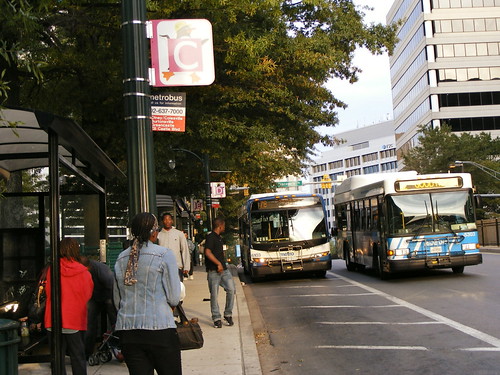
Waiting For A Bus, Wayne at Dixon
On Tuesday, WMATA held a public hearing to discuss changes to the Metrobus Q2 line between Silver Spring and Shady Grove. Kathy Jentz, East Silver Spring resident and frequent Q2 customer, testified at the meeting. In this guest blog, she argues that the reconfigured line will reduce service in the Downcounty, where ridership is the highest.

Tuesday night was a hearing at First Baptist Church in Wheaton to explain how WMATA is "breaking" the Q2 into two segments starting late this December and to get the public's feedback. "Breaking" being the operative word, as the proposed "improvements" will do nothing to alleviate the current line problems but could do much to worsen it. Unfortunately, only two bus riders including myself testified at the hearing. We were outnumbered ten-to-one by WMATA staff and other area transit employees. If you would like to comment (and I very much urge you to do so), you may send an email by 5pm Friday, October 16 to WMATA's public outreach contact.

The Q2 currently runs twelve miles from Shady Grove to Silver Spring, passing through Wheaton and Rockville along Georgia Avenue, Veirs Mill Road, and Rockville Pike. It carries 10,200 riders a day and is one of the most heavily used bus lines in the region. The segment between Silver Spring to Wheaton carries over 50% of those Q2 riders. In the new proposal, there will be a Q2A bus that runs from Shady Grove to Wheaton and a Q2B bus from Rockville to Silver Spring, allowing the Veirs Mill section between Wheaton and Rockville to be served most frequently.

One of the problems many Q2 riders pointed out at previous meetings was the detour into the Rockville campus of Montgomery College, which was often totally unnecessary when the campus is closed. That remains as part of the QA route with a minor adjustment to switch campus entrances that will save mere seconds off the bus route. They are also looking into saving time at Shady Grove, Rockville, and Wheaton metro stations by reconfiguring how the buses enter and exit them.

I'd suggest they more clearly mark which buses are going in which direction as most delays I experience are the bus drivers repeatedly telling illiterate riders "Shady Grove" or "Silver Spring" as they block others from boarding. I can only imagine how this will play out on the overlapping Q2A/Q2B lines along Veirs Mill with the poor driver having to explain to folks not only the destination but if they are not going all the way as well.

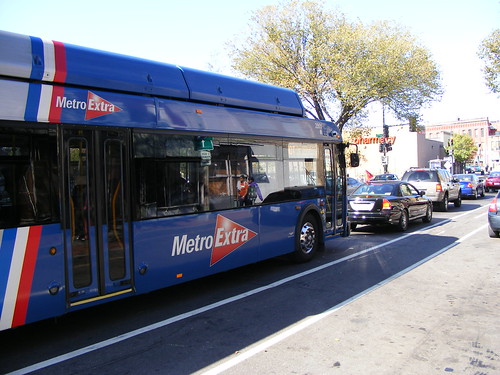
MetroExtra Bus Headed Towards Silver Spring
WMATA officials say express service along the Q2 route, like this MetroExtra bus on Georgia Avenue in the District, has been postponed indefinitely.

A Q9 Express version of the Q2 line was requested by many of the attendees at past Q2 meetings as the logical solution to the current bus-bunching and schedule problems. I was informed by WMATA & Ride-On staff after the meeting that the Express line "just missed funding" in the current budget by a tiny margain and has been shelved for now. Just as well, as it only went from Shady Grove to Wheaton, inexplicably leaving off the most traveled section of the Q2 line from the Wheaton to Silver Spring stations. When I asked why the Express was not including this segment, I was given no explanation or reason.

One official later said that "we hoped this would steer more folks to take the Red line" for that portion. He was not joking. So those of us who want to get upcounty from downcounty are not only forced to transfer between multiple buses, but also between Metro and back and to also then to pay the 3-5x price increase for using rail for a portion of our travels.

No mention at all was made of the Y line buses that run north-south on Georgia Avenue and whether they will be increased to absorb this excess passenger load shifted to them by the planned decrease in Q2 service from Silver Spring to Wheaton. When I brought this up in my testimony the officials present looked surprised. The fact is when a Y bus runs late (which is often), the Q2 takes on all those extra passengers and then the bottleneck shifts to the Q2. This is the domino effect that is choking both bus lines. A Georgia Avenue express bus on the Y line, say from Silver Spring to Glenmont, would greatly relieve that pressure on both lines now and would be the ideal solution to most of all of the Q2 bus bunching as well as the Y bus schedule problems.

Kathy Jentz is editor and publisher of Washington Gardener magazine and can be reached at WGardenermag at aol dot com. If you've got something to say about East County, say it here! Send any contributions to justupthepike at gmail dot com.

Wednesday, July 8, 2009

guest blog: flavorless

Eighteen months after burning down in a mysterious fire, the original location of El Pollo Rico on Ennalls Avenue in Wheaton is slowly being razed. First time guest blogger/long-time photo contributor Chip Py writes this paean to the purveyor of Peruvian rotisserie, which just hasn't been the same since it reopened late last year.

The old El Pollo Rico lies in ruins.

I have tried to eat at the new El Pollo Rico several times but it doesn't have the same flavor. It seems the flavor must have come from the years of grease that had built up in old place. Federal Marshalls, the IRS and Immigration authorites couldn't put and end to that flavor but a fire in February 2008 did.

R.I.P., El Pollo Rico. Your flavor is gone from Wheaton.

We can look for more of our small, flavorful Mom and Pop Restaurants to close up and be knocked down by the wrecking ball as the County moves forward with a plan based on the Downtown Silver Spring development moves forward and these small immigrant owned businesses are replaced with tax payer funded national chain stores.

Does Wheaton really want this?

For more about Wheaton, check out Chip's guest post and all the regular posts on the Scenic Wheaton blog.

Tuesday, June 2, 2009

guest blog: community life, handmade

Necklaces on display at last Sunday's Handmade Mart on Ellsworth Drive in Downtown Silver Spring. Photo by ohmeaghan.

The following is a guest post about last Sunday's Handmade Mart on Ellsworth by friend of JUTP Hans Riemer. This blog is always looking for contributions - if you have something to say, shoot it to justupthepike at gmail dot com.

Although I missed the Silver Spring Dance Party, this past Sunday I attended the Handmade Mart on Ellsworth in downtown Silver Spring along with my wife Angela and our 20-month old baby Henry. We had a great time!

Highlights for me: superb shopping for unique and affordable eclothes, kids endlessly splashing at the fountain and only 50 feet from the music stage, fish kabobs at Moby Dick (don't let the cafeteria vibe fool you, its slow and tasty), a ton of edgy/creative types prowling Ellsworth, and a memorable band called Yell County--bravo to whoever booked them, I think they were one of the best bands I've seen perform in a while.

At home that evening I considered how lucky we are to have this kind of community life right here in downtown Silver Spring. Having a young kid, I am there at least once every weekend, and sometimes, four or five times. Having all of this within such a short trip from the house is a real boost for our quality of life---and not having to drive as many miles is clearly an environmental benefit. Teenagers, families with kids, hipsters, new immigrants, neighborhood busy-bodies---there's something here for everyone.

Improving community life is an important goal for sustainable growth in our rising downtowns---Silver Spring, Rockville, North Bethesda/White Flint, Wheaton---rather than carving up the agricultural reserve with more sprawl developments that are a 25 minute drive from anywhere.

Sometimes these heated, protracted debates over growth and development can be wearying and too abstract. Good, civic-minded people can find themselves wondering, does any of this really matter? Last weekend, walking through a vibrant downtown with my wife and my son, there was no doubt in my mind the answer is yes.

Tuesday, November 16, 2010

guest blog: complete street smarts

The following comes to us from guest blogger Alex Hutchinson, a Takoma Park resident and intern at the Planning Department. He last wrote for JUTP about the proposed Silver Spring Library pedestrian bridge. If you have any questions or bones to pick, please contact him at alexanderehutchinson at gmail dot com.

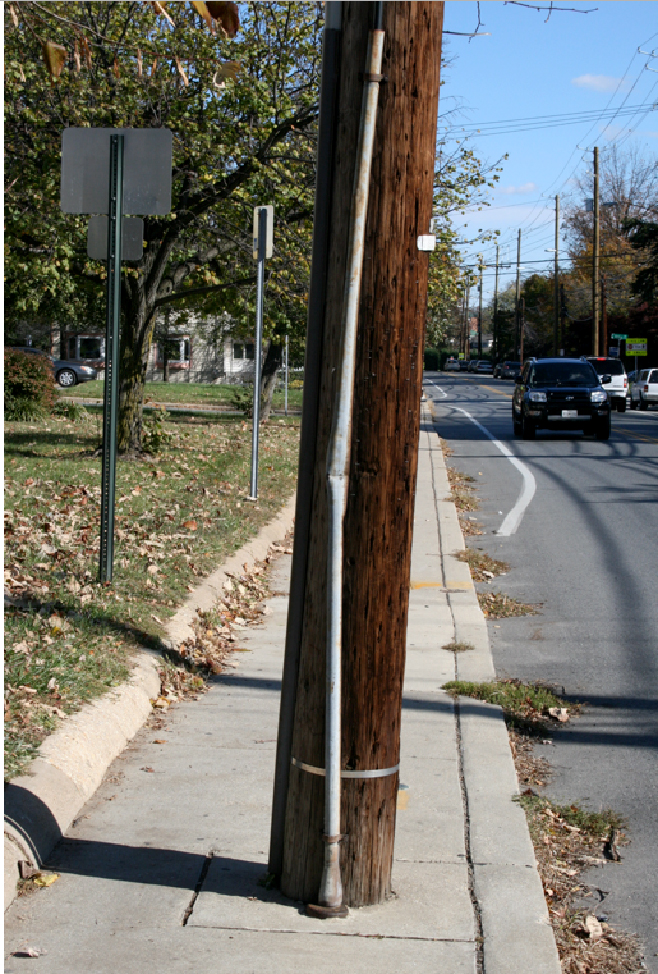
Photo by the author.


If a car were blocking a major intersection, it would be towed within minutes. Yet this telephone pole gets a free pass despite being directly in front of the Silver Spring Police Station.

Walk around Silver Spring and you’re likely to notice the numerous light poles, parking meters, and electrical boxes inconveniently placed in the middle of sidewalks and curb ramps.

Through a comprehensive set of sidewalk and street improvements, we can restore equal access while promoting healthy walkable communities.

Planners and traffic engineers are spreading the gospel of complete streets, which provide equal access to bicycle, pedestrian, transit, or car users regardless of age or ability. Complete streets include wide sidewalks, bike lanes, frequent crossing opportunities, median islands, and more.

A few weeks ago, The Coalition for Smarter Growth hosted Ian Lockwood, a transportation expert who talked about complete streets and the communities in the United States and Canada he has helped fix. Lockwood was a consultant on the recently approved White Flint Master Plan.

One of Lockwood’s counterintuitive ideas is the concept of shared streets. Streets that seemingly lack any organization: no signs, lanes, crosswalks, speed limits, stop lights or curbs.

Lockwood doesn’t say that we should take all the street signs down. Rather, roads must be strategically redesigned for slower, but better-flowing travel. This requires a new set of cues. Raised brick crosswalks are a common shared-space method for slowing cars at intersections because they provide a visual and tactile signal for motorists to brake and watch for pedestrians. Lockwood explains that changes in textures, paving materials, trees, or colors allow streets to dictate the rules of the road better than any sign.

Ellsworth Drive Open, Nov. 2009 (1)
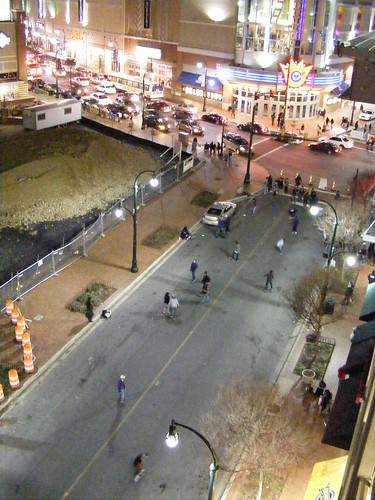
Cars and people share Ellsworth Drive in downtown Silver Spring. Photo by Dan Reed.

Silver Spring’s Ellsworth Drive is a great example of this. When the street is open to traffic on weekdays, cars move at a leisurely pace creating a safe environment for pedestrians of all types. The varying surface from brick to asphalt keeps drivers alert and aware of their surroundings.

Downtown Silver Spring has many of the critical features that Lockwood emphasizes for successful shared spaces: a good street network, buildings that hold the street, lots of pedestrians and cycling, and a vibrant environment for entertainment and social contact.” This idea of shared spaces could very well be applied to the Fenton/Wayne intersection.

Many curbs and sidewalks across Silver Spring are being repaired to better accommodate wheelchairs and pedestrians of all types. But awkwardly placed telephone poles, light posts, and even bus stops show many are still in need of work.

William Smith is a Silver Spring resident who has taken matters into his own hands. Smith, who is legally blind, is the founder of the blog Montgomery Sideways, which documents the shortcomings of Silver Spring sidewalks. Smith meticulously records and posts the locations of problem areas on Google maps in hopes that improvements can be made for the disabled. “Crossing the street in this town is downright dangerous,” he says. “The simple act of walking down the street can be an ankle-busting experience for anyone - especially a blind guy.”

The complete street approach is the most sensible and effective option for improving accessibility. By continuing to improve the sidewalks, removing thoughtlessly placed infrastructure, creating shared spaces, slowing down traffic speed and improving our public transportation we can restore equity to those who are less mobile.

It might be simple, but Silver Spring’s solution to the future is the oldest form of transportation: walking.

Crossposted at The Straight Line.

Thursday, August 6, 2009

guest blog: chevy chase on the purple line

The following is a guest blog by Pat Burda, Chevy Chase Town Councilmember, in response to a guest post JUTP ran last week by Jon Prater-Lewis of North Chevy Chase. Prater-Lewis lives on Jones Bridge Road - a proposed alignment for the Purple Line that the MTA rejected in favor of one running through the adjacent Town of Chevy Chase along the Capital Crescent Trail.

JUTP encourages anyone to submit guest posts, even on topics we don't agree on. (See our disclaimer below.) Send your thoughts to justupthepike at gmail dot com.

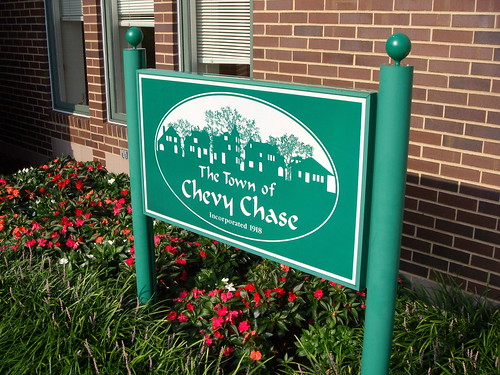
Chevy Chase Sign


On behalf of the Town of Chevy Chase, I appreciate the chance to respond to Mr. Prater-Lewis’s recent posting. I, and all Town Councilmembers, welcome any opportunity to debate the facts or merits of the Purple Line project. It is unfortunate that Mr. Prater-Lewis felt the need to go too far with many of his accusations and particularly of his characterizations of the Town.

Let me be perfectly clear, the Town of Chevy Chase feels strongly about providing a Purple Line east-west connection for all the reasons other supporters of the Purple Line do. Yet, we feel equally as strong about saving the trail. The fact of the matter is that the right of way behind the town and adjacent to the communities of East Bethesda and Edgevale is so narrow (narrower than most other locations) that the all mature trees will be clear cut (and cannot be replanted due to catenary wire and track issues), construction will require the removal of trees outside the right of way on private property, the trail itself will be narrower here than elsewhere unless private property is taken, and trains will be running at 35-50 mph within 7-10 feet of trail users. The pretty MTA-generated pictures folks have seen do not reflect the right of way behind the town. In fact, the one posted on JUTP of “the Purple Line in Chevy Chase” shows trains running through Columbia Country Club where the right of way is 34 feet wider and the terrain is flatter.

We wanted help analyzing the state’s alternatives. When we hired them, we knew and appreciated that they were transit advocates. Being from New York, they brought a new eye to the discussion, and they immediately identified that two parallel conversations were taking place in our region: BRAC’s relocation of Walter Reed to Navy Medical with a projected 4,000 new trips per day to the facility and the Purple Line which at a proposed $1.68 billion was planned to miss that site altogether.

As they looked more closely at the state’s Purple Line alternatives, they saw that there actually was one on the table that could kill the two birds with one stone, but it quickly became clear to them that something was amiss in the analysis of that option: the Jones Bridge Road bus rapid transit line as proposed by the state ran slower than the current buses along Jones Bridge Road. The more they looked, the more problems they found in the state’s analysis. Therefore the town asked the State to take a harder look at that alternative and to optimize its potential so that the greater community could evaluate its potential fairly.

so much more AFTER THE JUMP . . .

Yes, the Jones Bridge Road alternative was added to the Purple Line alternatives years ago under Governor Ehrlich’s direction; I, too, have heard he did so in order to appease Columbia Country Club. And, it probably would have died a natural death except for the rather significant BRAC issue that dramatically changed the equation. The BRAC DEIS itself states that traffic on Jones Mill Road between Connecticut Avenue and East West Highway will increase 15-17% due to the relocation. That is east-west traffic, not north-south as Mr. Prater-Lewis suggests all the increased BRAC traffic will be.

We all feel for the people on Jones Bridge Road – they are frankly between a rock and a hard place. Something has to change on that street to accommodate what is coming. Yet, when Mr. Prater-Lewis chastises the Town for suggesting that transit is needed on his “quiet residential neighborhood” street, he needs to be more up front: Jones Bridge Road has morphed over the years into a heavily trafficked four-lane road that is a major cut-through to the Beltway and over into Bethesda from East-West Highway. He notes that it has already reached “maximum sustainable levels.”

Others have criticized the Town because “you can’t put bus rapid transit on such a heavily used road.” But, isn’t that exactly the point of transit – provide a good transit alternative and you’ll get people out of their cars? If bus rapid transit can work in mid-town Manhattan, I am perplexed as to why it cannot work on Jones Bridge Road. For that matter, if bus rapid transit or light rail can work on Wayne Avenue in Silver Spring, why can’t it work on Jones Bridge Road? The fact of the matter is, it probably can . . . but we’ll never know because the state refuses to give it a fair analysis.

Mr. Prater-Lewis suggests that “scores of homes would have to be pulled down” in order to accommodate the bus rapid transit. SSE shows that not only will no homes have to be removed, but any widening would not have to go beyond the sidewalks in the already-owned state right of way. Unfortunately, in not embracing a transit alternative for that area, the state has recently recommended condemning six houses in Mr. Prater-Lewis’s community.

It is frankly outrageous to suggest that we think our school children are more important than those that live in the North Chevy Chase community and that we are “indifferent” to the threat to the safety of “their” children. Of course we want all children to be safe. I’m sure it is a constant worry now to parents who live along Jones Bridge Road that their children have to traverse this busy four-lane road at morning rush hour in order to get to school. Again, though, without providing a transit alternative, there will be approximately 125 more cars in front of the school between 8:15 and 9:15 each morning according to the BRAC DEIS calculations. In fact, the state has already floated widening the road in front of the school to accommodate those cars. It seems the neighborhood has fought that off for the moment, and rightly so. It is a bad idea.

BRT would reduce the number of cars in front of the school, is safely used near schools in other cities and locations, would not run any faster than current speed limit, and would abide by any traffic precautions. Not so, however, the light rail on the narrow right of way into Bethesda that runs within several feet of homes, backyards, a community park, and even a day care playground. Students walking from the town to Bethesda-Chevy Chase High School or Our Lady of Lourdes will be expected to cross the trail at-grade, often in the morning darkness, with trains running at high speeds on the open right of way (the light rail needs to make up time here that it loses in Silver Spring). We’ve seen the state’s drawings . . . there are no precautions for crossings on this section of the right of way. Again, we want all children to be safe, including our own.

Unlike what Mr. Prater-Lewis said in his letter, the National Naval Medical Center did not oppose BRT on Jones Bridge Road. It did, however, raise many questions for the state, including how the state came up with such a low number of potential riders for a transit line to that location. The fact of the matter is that the state relied on old MCOG projections that did not include adjustments for the upcoming BRAC realignment. This is just one of the issues raised by the town in our public comments. And, the town has said that with a single employer of such significance at NNMC and NIH – the federal government, you’d have even greater opportunities to provide incentives for employees to use a transit for commuting than with the multiple small disparate businesses in Bethesda.

The town has not paid for any lobbyists or public relations help – maybe we should have because it certainly worked for Purple Line Now! The real benefit of their lobbying, however, goes not to communities but to developers like the Chevy Chase Land Company. Thanks to them, we’re spending a billion more of taxpayer’s money than we have to in order to raise the value of CCLC’s Chevy Chase Lake property by hundreds of millions. Thanks to them, we’ll also be putting more traffic on Connecticut Avenue near that development making commutes for people north of Chevy Chase far worse while they get to pay for it with a hiked gas tax. (Fun fact: the former president of Chevy Chase Land Company and founder of Purple Line Now!, Ed Asher, is a neighbor of Mr. Prater-Lewis in his “less affluent” community.)

We truly believe that BRT on Jones Bridge Road will help alleviate problems, not exacerbate them. And, we see clear benefits to the entire region by supporting a cheaper bus rapid transit Purple Line that could allow easy linkages to Councilmember Elrich’s proposed system in the County, MCOG’s Transportation Planning Board’s metropolitan area proposal, and we can dream, a Corridor Cities Transitway. If the state decides to push hard to fund the expensive light rail, there will be no money left for these other important projects. Do we really want to spend all our transit money on just the Purple Line, an orphan line at that?

And, finally, I have to address the issue of political donations. Chevy Chase Land Company worked so hard and, I have to give it to them, effectively over the years to build political support. Does anyone really think that they, and other developers, didn’t support any political campaigns in this area? So, if by “overwhelming public support” for light rail Mr. Prater-Lewis means elected officials in this area, he’s probably right. If he means developer and business interests, he’s again right. If he means residents in the Bethesda-Chevy Chase area, he is flat wrong, and the public record shows it.

Let’s face it, NIMBYism can be applied to this project in many instances, and yes, to the town which loves its trail. But it can also be applied to the founder of the Action Committee for Transit who told me he started the light rail movement for the Purple Line 20 years ago because he didn’t want buses running next to his house in Silver Spring and to Mr. Prater-Lewis who doesn’t want transit near his home which is adjacent to Jones Bridge Road. Yet, it is not NIMBYism to try to save the state $1 billion, get cars off the road throughout the region, and save an important urban greenspace – the most popular trail in Maryland – from environmental destruction.

I’m sorry this letter is so lengthy, but Mr. Prater-Lewis’s accusations and distortions could not go unanswered. And, I hope I have explained more clearly the town’s concerns and frankly, our frustrations. The Town Council has not yet decided what next steps, if any, we’ll be taking. We do not take any of this lightly.

Pat Burda, Councilmember, Town of Chevy Chase

Disclaimer: the statements above are those of Pat Burda and belong to her alone. I am an aide to Councilmember George Leventhal, an ex-officio board member of Purple Line Now!, a group advocating the project's completion.

Monday, January 28, 2008

frequently asked questions

A long-overdue list of questions and invitations to the bar I've received since beginning this blog six years ago. Feel free to submit more if you have any.

1) What is this called? Up The Pike?

One day, I will think of a less confusing name. In the meantime, this is Just Up The Pike. I lived "up the pike" - meaning Columbia Pike, or Route 29 - from Downtown Silver Spring, but not too far up, if you will. Thus, "Just Up The Pike."

2) What do you . . . do?

I write. About our elected officials. About development and traffic. About our schools. About local arts and music, and occasionally food. Anything and everything affecting East County.

Are you having a community meeting? An open house? Are you running for office? Starting a business? Do you have any tips or story ideas? Would you like to write guest posts? Let me know. I'm open to anything. E-mail me at justupthepike at gmail dot com.

Just Up The Pike is updated a few times each week, though that schedule might occasionally give way to work, a social life and, of course, sleep.

3) How did you get started?

Blogs beget other blogs. I started by reading The Silver Spring Scene and Silver Spring, Singular in early 2006. Honestly, back then I thought the idea of a Silver Spring blog was kind of silly. I was working at an architecture firm in Bethesda that summer with a lengthy, two-bus commute. When the bridge on Route 29 flooded that June, I found myself without a way to work. That's when I started thinking about all of the missed connections in East County - not just the roads, but mentally. How often do you hear about the east side? Not much, and the things you hear are rarely good. Suddenly, a Silver Spring blog didn't seem so silly after all. You know the rest . . .

4) Say, we should have a drink sometime!

Yes! As of April 2009, that is totally possible.

5) Are you on Facebook? Twitter? MySpace?

Facebook: Yes. Become a fan! Twitter: Follow me! Flickr: Ditto! MySpace: Too creepy.

6) What do you do for a living?

In May 2009, I graduated from the University of Maryland-College Park with a double degree in Architecture and English. After that, I worked for Montgomery County Councilmember George Leventhal. And in May 2012, I graduated from the University of Pennsylvania with a master's degree in City Planning and a concentration in Urban Design. Currently, I'm looking for work. If you'd like to know more, check out my LinkedIn page.

7) Where do you live?

Save for two years at school in Philadelphia, I've lived in the D.C. area my entire life. I've had brief stays in Suitland, Germantown, College Park and Petworth, but spent most of my childhood in downtown Silver Spring. I currently live with my parents and brother in Calverton, right off of Columbia Pike.

8) Can't anyone start a blog?

Yes. And I invite you to start your own by creating an account at www.blogger.com.

Anyone can write a blog. That means I can - we can - write about issues and places that aren't being noticed by local newspapers, TV stations, and so on. And we can elaborate on what local news outlets are covering without worrying about space or time limits. And I could be anyone. I'm not an elected official or a developer. I'm just someone living in your community writing about what's happening here.

Friday, March 13, 2009

guest blog: a letter to neighbors

The following is a post by John Haslinger, a resident of Bonifant Street for thirty years, that appeared on the Seven Oaks-Evanswood Civic Association listserv about last weekend's violence on Ellsworth. He urges his neighbors, many of whom have stopped coming to shop or hang out in Downtown Silver Spring, to keep supporting local businesses as a means of keeping the area safe and vibrant.

Neighbors,

....Fear itself!

Mr. Gurwitz said it: "IT'S NOT THAT BAD". Yes, Saturday's concert behavior was way beyond what we can allow but try to remember that even that scary happening ended without anyone hurt. And yes, accountability for bad decision making must be demanded. Take the lessons learned, act and move on, living your lives happily and securely right here in the ever improving Silver Spring.

The general behavior of these kids in town is not nearly as bad as the fearful voices here have made it. I walk into downtown nearly every day. While I hear the occasional loud teenaged voice and witness mild rudeness form time to time, that seems to be the worst of it. And I'm not sure that any of us acted too much differently at that age. Take note while you're there, 99% of the teens are well behaved kids. We, the villagers who collectively share the responsibility for raising this bunch, are the ones who need to be there in numbers to model the appropriate behavior. WE set the norm and avoiding the area only allows the expected behavior to be modified downward.

The answer is not to run to Bethesda with noses in the air. WE stood up to demand that Silver Spring be developed to a scale appropriate for the neighborhood, refusing to accept the Silver Triangle and the MegaMall. WE now need to refuse to accept Saturday night's behavior or anything close to it. WE have to see that the responsible authorities, from the county executive to the cop on the beat, act responsibly for the good of the community.

It was US, the relatively well paid demographic of the surrounding neighborhoods that was the impetus for the private/public infusion of monies that brought the Silver Spring redevelopment. WE need to be the force that keeps it here. Spreading fear about Silver Spring ("it could be you or your child who is the first one murdered in DTSS") and taking our dollars to Bethesda is counterproductive. To retain what we've worked for all these years, BUY LOCAL. To lose it, let the teenagers be the spenders to whom the merchants will cater. Do you want Adega, Ceviche, Borders and McGinty's here? Then support them. It is NOT dangerous for you to walk in downtown; you and your children will be fine. Our being there is what makes it a safe place; not being there destroys it.

There have been many good ideas raised in this discussion and we may disagree on which one are the best ones. But I can't believe that the fearfulness we've heard here is helpful. I can't believe that running from the problem will do anything but diminish the value of our own homes. The problem is relatively small and manageable if we collectively direct ourselves to it. Call your representatives and county leaders and attend community forums to express your concern. Be the squeaky wheel as Alice Gilson suggested. And BE THERE in downtown to show what Silver Spring expects as appropriate behavior.

John Haslinger
Bonifant St.

If you've got something to say, Just Up The Pike is always looking for guest bloggers. While I don't always agree with the statements made, guest blogs offer an opportunity for all sides to be heard on East County issues. Contact me at danreed at umd dot edu if you're interested in contributing.

Wednesday, March 18, 2009

guest blog: can't have it both ways (updated)

The following is a guest post by Brent Gilroy, a Seven Oaks resident for over two decades. He contacted the Peterson Companies after the violence following last weekend's "Stop the Violence" concert and has a simple message for them: either clean up the scum or watch them take over.

Read our previous related guest blogs by Pershing Road and John Haslinger.

I chose to live adjacent to downtown Silver Spring 24 years ago to be part of a livable urban community – walking distance from shopping, entertainment and transit. Silver Spring was struggling amidst the remains of its vibrant post-war life, but with promises of revitalization.

As residents bickered over the kind of community they wanted, the one they had became a wasteland of abandoned storefronts, litter and aggressive “street people.”

Eventually, revitalization came to Ellsworth Drive – a bookstore, high-end grocer, a mainstream movie house and the “art” offerings of AFI, plus restaurants generally cleaner and more comfortable than the ‘90s’ shabby eateries. Some complained about the chains, but they proved people would dine here – paving the way for Jackie’s and Nicaro and bringing new customers to the Quarry House and Tastee Diner.

Early on, we who saw Silver Spring through its downslide warned, “You gotta get the nasty, belligerent people off the streets so that decent folks – upper, middle or working class – will stay.” City Place – an attractive discount mall that became ultra-low end, frequented by surly young men loudly proclaiming their sexual needs to buddies nicknamed (fondly) “muthafucka” – was a cautionary tale.

Others decried the “sterile” nature of the new Ellsworth and warned authorities not to deal harshly with ANY visitor. “Everyone has a right to be here,” they said. “THAT is diversity…Foul language is part of city life...Crime happens wherever there are people.”

Montgomery County and its revitalization partner, the Peterson Companies, listened to those “more tolerant” voices. The Majestic Theater became infamous for littering and outrageous behavior. Sidewalk diners with children found fresh air and strolling families came with a dose of passersby declaring, “Bitch, don’t fuck with me or I’ll kick your goddamn ass!” The walk to the parking garage or home included confrontations with belligerent beings whose stance said, “Wanna get by me? Kiss my ass!” All amidst the litter they dropped.

(This, I MUST be clear, is a separate issue from the gaggles of sometimes annoying but seldom vile or abusive teenagers often seen downtown. That IS just part of urban life.)

Many complained to the county and Peterson – our pleas for order growing in proportion to the disorder. We said: “Clean it up or we’ll take our money elsewhere.” Last summer, our discontent boiled over on blogs and neighborhood list serves.

“We hear you, and we’re acting,” county and Peterson officials assured.

Then, March 7, a concert honoring a youth violence victim itself turned violent. Thirty-five arrests (according to the March 18 Gazette), confused and frightened shoppers fleeing down Ellsworth, pepper spray in the air.

The county and Peterson say, “We still hear you.” But they make no promises; they downplay the seriousness of March 7 and how much worse it could have been.

Nationwide radio accounts (reported by people in other cities) of “a riot at an anti-violence concert in Silver Spring, MD” can’t be good for business as Peterson struggles to fill retail space that remained vacant even when the economy was good. (Silver Spring’s past of decay and bad behavior always made it a hard sell.)

Yes: “We told you so.”

You (Montgomery County and Peterson) heeded the other guys. From both political and economic standpoints, it was just easier

Maybe you figure those who like peace and order along with convenience and diversity will just keep coming no matter how much filth and profanity (and now, it’s been proven, violence) you tolerate.

WRONG.

Many are ready to vote with our feet – not only by not shopping and eating in Downtown Silver Spring, but by moving to Bethesda, Arlington and other truly LIVABLE urban communities. That exodus – once publicized – won’t be good for business.

So the question to government and business leaders is this: Do you want decent, law-abiding people to SPEND MONEY in Silver Spring, or do you prefer to have potty-mouthed, violent scumbags who might buy a Coke or a t-shirt (if they don’t strong-arm it from someone else!)?

You can’t have both.

Monday, January 26, 2009

bonifant street: the anti-ellsworth

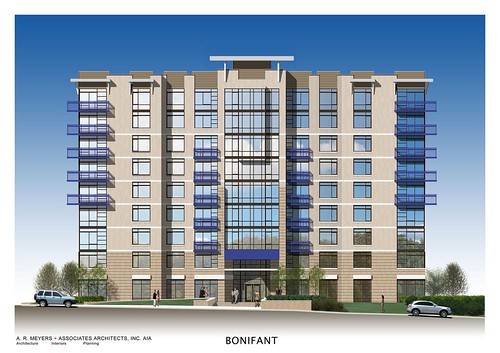
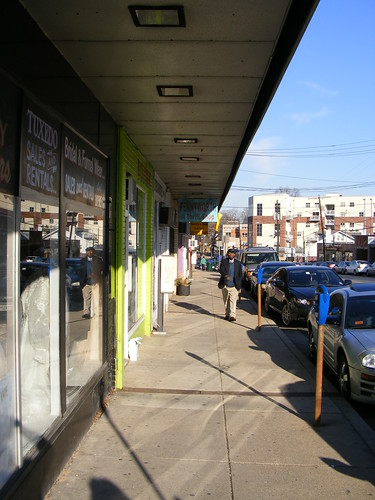
A developer proposes replacing these stores on Bonifant Street with a nine-story apartment building.

If you were on Bonifant Street around 2:30pm last Friday, that kid you saw counting his steps on the sidewalk with his head down was me. Three of my friends/classmates and I are designing a mixed-use building for a student design competition sponsored by AARP, and we chose the parking lot of the Chevy Chase Bank at Bonifant and Georgia as our site. On Friday, we had to pace out the lot's dimensions.

Were I on Ellsworth Drive, I would have been quickly and efficiently carted away by security, but just two blocks away, I was nothing more than a mere curiosity. "Interesting," one woman said a little-too-loudly as she walked by. A man in a green knit cap who seemed to work for the bank snapped a picture of me with a disposable camera and ran off. Jim Dandy, of the dry cleaner across the street that bears his name, pulled my friend and I aside and had a long conversation with us.

This street embodies everything I love about Silver Spring - this "quirky grit" that you can't get rid of, no matter how hard you try to clean it up as has been done on Ellsworth Drive. Bonifant Street resident and musician Lisa Null calls it "micro-neighborhood" in a 2007 guest blog for JUTP, listing dozens of businesses here and on neighboring that you'll be hard-pressed to find anywhere else in this area.

The proposed Bonifant Plaza would replace the block of shops shown above.

We should be celebrating this kind of vibrancy in Downtown Silver Spring, but instead we've been stifling it - with apartment towers like The Crescent, The Portico or The Veridian, whose vapid "pocket parks" and miserable (or nonexistent) retail offerings kill street life, or with "urban renewal" projects like the Silver Spring Library project, which allowed the County to buy and raze several businesses at the corner of Bonifant and Fenton with eminent domain years before the library will even be finished.

The biggest threat to Bonifant Street has yet to arrive. A proposed apartment building, Bonifant Plaza would rise just east of Georgia Avenue, on a site currently home to the dry cleaner, a nail salon, a karate school, an art gallery, and quite a few other businesses I failed to mentioned. The plans have been kicked around for the past couple of years due to worries about accessing the adjacent alley and the Purple Line, but according to the blog DCmud, Bonifant Plaza could come before the Planning Board next month.

so much more AFTER THE JUMP . . .

With paltry retail offerings and unnecessary pocket parks, new buildings like the Crescent on Wayne Avenue make the business district less vibrant.

Developer Theo Margas says that his new building won't include retail because the zoning "doesn’t allow for ground floor retail," which sounds questionable given he's displacing several retail and office spaces. The site (like the site we're working on) is currently zoned CBD-2, which requires at least 5% retail or service uses, which for Bonifant Plaza would be less than 6,000 square feet, the size of a 7-Eleven. So not only are we knocking out a considerable portion of the retail space that gives Bonifant Street its character, convenience and street life, but we aren't replacing it at all.

Silver Spring, Singular made it very clear that the Ellsworth urban renewal project did not displace any local businesses, a standard we should keep to in future development. I would say that Ellsworth's glitz and bustle is an effective counterpoint to the grit and warmth of Bonifant Street and, together, they one cool effing place to be. Why would anyone come here if it was just glitz or grit? There are plenty of suburban town centers that can outdo Ellsworth's carefully planned excitement and plenty of D.C. neighborhoods that would make Bonifant's quirkiness look downright staid.

Outside the dry cleaners, Jim Dandy (at left) gestures to the his picture in last year's Gazette pasted to the window of his store. "I looked pretty good when I was younger," he says, laughing. 93 years old, Jim Dandy has been here a long time, he says, and he's happy. "You can make yourself happy. People claim what they don't want . . . why don't they claim what they do want?"

I claim Bonifant Street. Our group's got a challenge in designing a mixed-use building for this street, but we're going to do what MoCo and the development community should be: taking an approach to redevelopment that seeks to preserve what currently exists while also accommodating additional growth. The businesses along Bonifant would, I'm sure, welcome the additional traffic that came from new apartments or library patrons or Purple Line riders. That is, if they remained to see any of it.

Wednesday, April 28, 2010

what's up the pike: today's number is 287

- From the listservs: the Chelsea School, a small private institution on Pershing Drive near Downtown Silver Spring, may have shelved plans to build a library on their campus designed by starchitect Daniel Libeskind due to a lack of funding. The school's plans to build 75 condos on the land instead came up at a recent meeting of the neighboring Seven Oaks-Evanswood Citizens' Association. The school's website for the library project has a picture of Libeskind but no mention or images of the library.

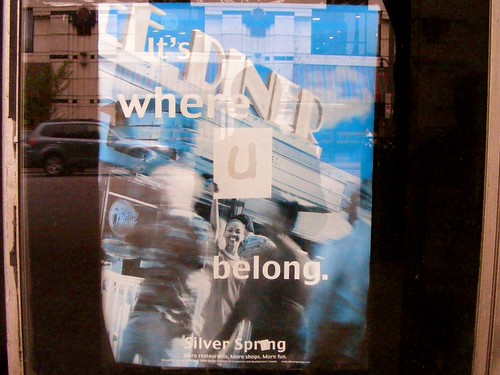
Where 'U' Belong

- Remember this? Double points if you can tell me where you'll find this 2004-vintage "Silver SprUng" sign. (It's in a pretty prominent place, so don't make fun of me if it's obvious to you.)

- Good Eatin' in Wheaton finishes what I started and explores Peruvian food in Wheaton, to many the epicenter of the pollo a la brasa phenomenon. Since he can write better about food than me, I might just outsource the rest of our Great Peruvian Taste Test to him.

- Eric Luedtke - Burtonsville resident, middle-school teacher, member of the East County Citizens Advisory Board - is running for state delegate in District 14, says Maryland Politics Watch. With two seats open, the district - which includes everything from Burtonsville to Damascus - could be one of the year's most interesting races, MPW's Adam says. Check out Eric's guest blog from last fall on the need to revitalize the Burtonsville village center.

- When JUTP attempted to post flyers in local stores two summers ago, Dawn Spencer - owner of gift shop Patches in Colesville at New Hampshire Avenue and Randolph Road - was one of the few who offered me a patch of her window, despite not being totally clear what a "blog" was. Like many local retailers, she's losing business, but friends and customers threw a fundraiser last weekend to keep the shop open, says the WaPo's John Kelly.

(He and I had the same journalism teacher, 25 years apart; I remember being assigned to read his high school columns, which were - IMO - much funnier than anything he's produced since. Today's title is a reference to one of them, which of course makes no sense to you unless you read the Rockville High School paper in 1981.)

Wednesday, July 2, 2008

sick of emo kids on ellsworth: how to walk without driving downtown

UPDATE: Greater Greater Washington, as always, explains what I was getting at below in far fewer words.

Downtown Silver Spring: Why does "pedestrian-friendly" have to mean "shopping mall"?

Downtown Silver Spring is a nice place to be, and even nicer if you can walk there. And while the definition of "walkable" seems to be getting bigger (County Councilmember George Leventhal says he walks downtown from his home a mile away), Downtown still isn't walking distance for a lot of people. How can we create these kinds of pedestrian-friendly places outside of Montgomery County's major "downtowns"?

Thomas Hardman talks extensively about this in a string of comments following yesterday's post about Wheaton that could merit their own guest blog post - hell, its own blog. He makes several major points, among them: 1) that the County's "Downtowns" are only for those who can afford to live there, and everyone else just dreams they could too and 2) that a lot of people would gladly walk to their own neighborhood business district if they could, or if there was anything there.

At every single community event I've been to in the past two years, I've heard someone talk about "neighborhood scale," about the hardware shop and the corner grocery store. It seems like a nice idea to take those things and put them in a place you can walk to, so you can leave your car at home, if only once in a while. Say you don't always want to visit Wheaton or Silver Spring or Rockville when you want to walk, because you'll be bombarded by crowds and strangers and, of course, emo kids, if there are still any around in 2008.

So why do our "Downtowns" end up becoming malls? And how could we get the corner grocery store in our own neighborhood, within walking distance? I think I have an answer, though it's a lot more complicated than many people would like it to be.

so much more AFTER THE JUMP . . .

Rockville Town Square: a lack of foot traffic in the immediate neighborhood means high-end shops and big events (like Hometown Holidays, pictured) to attract customers from a wider area.

I work at a store in Rockville that sells four-dollar-a-scoop ice cream, across from a store that sells forty-dollar laundry hampers, and down the street from a store that sells four-hundred-dollar clothes. Rents in the apartments above push $1,800 for a one-bedroom; there are cheaper apartments, but they're heavily subsidized. The Rockville Town Square is a pretty, high-end shopping center, and it's tenanted the way it is to draw customers from a wide area - the standard for most malls is about 250,000 people within a fifteen-minute drive.

Densities push forty homes an acre in the complex, but the surrounding neighborhood is all single-family homes, and they won't be enough to sustain the shops here. So you have to make it like a mall, because people aren't going to drive fifteen minutes for a hardware store, and that means one thing: The Mall People.
The county in its "wisdom" has decided that it only supports The Mall People and their kin. Thus, you can't have walkability as they have it in almost every comparable jurisdiction; you're stuck with "centers". I do occasionally go to Wheaton to do some shopping and that's out of necessity alone. It takes me literally days or weeks to get over it. - Thomas Hardman
The "mall mentality" happens in neighborhood shopping centers as well, because miles and miles of single-family homes won't be enough to sustain them. The developer's still working on a smaller variation of the "250,000 people within fifteen minutes" rule, which means Super Fresh and Home Depot and Starbucks, and even they are barely hanging on in some areas. It happens in Aspen Hill, in Burtonsville, in Montgomery Hills, everywhere. You can make these places easier to walk to; you can build sidewalks and slow cars down, but you won't get that corner grocery or hardware store to move in.

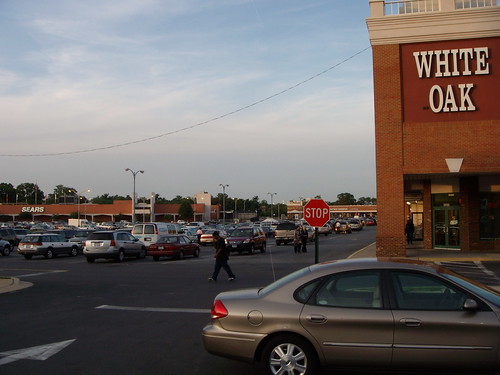
The White Oak Shopping Center: a dense neighborhood means lots of people to walk around and support local retail.

Neither of those things exist at the White Oak Shopping Center, but there are a slew of locally-owned shops, including a clothing store, a bowling alley, and an ice cream store selling two-dollar-a-scoop ice cream. White Oak is surrounded by thousands of apartments, creating a base of shoppers who can all reach it by foot. It's an imperfect example - there's a Sears, which is both big and a chain; the demographics skew lower-income; and there are issues with crime - but it points us in the right direction.

If we're going to be at least partially reliant on pedestrian traffic, we need to increase the density at our neighborhood shopping centers. That means throwing in civic buildings, offices, and housing - ten, twenty, even forty homes an acre - that can sustain little shops pushed up against the sidewalk. Instead of talking about people within a fifteen-minute drive, you have people within a fifteen-minute walk. There are also people here at all times - office workers during the day, residents in the mornings and evenings - giving businesses a steady stream of customers.

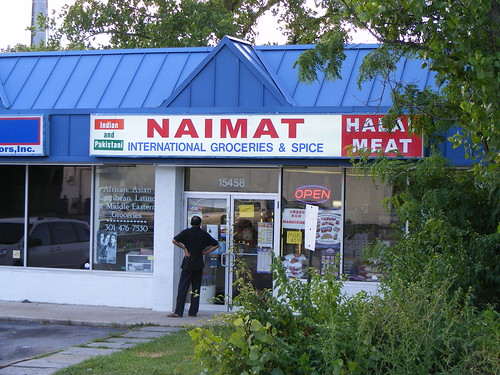
Burtonsville: Practically invisible from Route 198, this Indian/Pakistani grocery is dependent on the Indian/Pakistani community for business. In a pedestrian-oriented center, sidewalk traffic would provide another source of customers.

There will be traffic, but also more alternatives to driving for those who wish to take advantage. At these densities, walking becomes viable, along with transit - real, usable transit, not just one bus every half-an-hour that goes twenty places you don't want to go before reaching your destination. A lot of people will drive here to walk, as these kinds of places are still a novelty in MoCo, or if you're disabled, for whom accessible parking suddenly becomes a serious issue.

From the looks of last month's charrette, it seems like Burtonsville has already answered this proposition with a resounding "hell, no. " It's clear that there are a lot of issues to deal with, like how to make sure that the complex isn't reliant on chains like Downtown Silver Spring, or how to prevent development from encroaching on surrounding residential neighborhoods. But the benefits are clear: stronger communities reinforced by local business; smaller-scale alternatives to so-called "town centers," and, of course, avoiding the Mall People.

Nobody likes the Mall People, but nobody said that sidewalks are only for the hip, either. But in many of our neighborhoods, it seems like we've already given them up.