Showing posts sorted by date for query purple line hearings. Sort by relevance Show all posts

Friday, September 23, 2016

scarred by urban renewal, lyttonsville could get a second chance

Silver Spring's Lyttonsville neighborhood has a rich history, but urban renewal nearly destroyed it. With the Purple Line coming, this historically-black community could get a second chance, but not everybody looks forward to it.

Lyttonsville
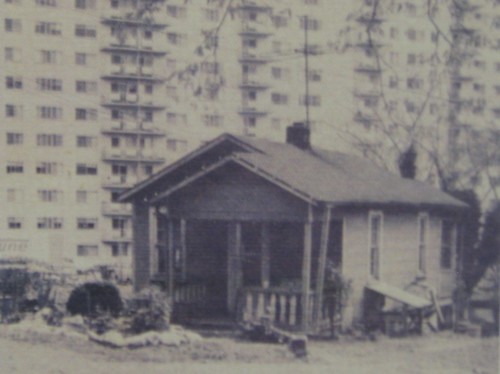
Urban renewal nearly destroyed Lyttonsville in the 1970s. Photo by Alan Bowser.

Located west of the Red Line tracks from downtown Silver Spring, Lyttonsville is one of Montgomery County's oldest neighborhoods, founded in 1853 by freed slave Samuel Lytton. The area could soon be home to a Purple Line station if the light-rail line between Bethesda and New Carrollton opens as scheduled in 2022.

Over the past two years, Montgomery County planners crafted a vision for a small town center around the future Lyttonsville station, bringing affordable housing and retail options the community lacks. Some residents are deeply skeptical of what's called the Greater Lyttonsville Sector Plan, though it could restore the town center Lyttonsville lost long ago.


confessions of a NIMBY (guest post by abe saffer)

Lyttonsville is one of Silver Spring's oldest neighborhoods, but a new plan from Montgomery County calls its future into question. Check out this guest post from local resident and friend of JUTP Abe Saffer. We happily accept guest posts, and if you've got something to say, send an email to just up the pike at gmail dot com.

I have a confession; I am a NIMBY. The term sounds like a mix between a character on a show for children and some incurable disease. In reality, it’s an acronym, standing for Not In My Back Yard. It’s shorthand to describe someone who objects to any project that, while the larger community wants or needs it, could have personally negative repercussions for that person. These negative repercussions include everything from being unsightly, dangerous, or likely to lower property values.

That description fits me exactly.

DSC_0055
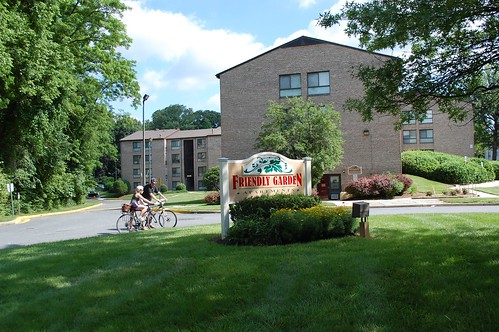
Affordable apartments in Lyttonsville today. All photos by Thomas J. Leonard on Flickr.

Former Speaker of the House, Tip O’Neil liked to say, “all politics is local,” now one of the most used political clichés. Former-President Ronald Reagan asked the now famous question at a 1980 debate, “are you better off now than you were four years ago?” Both are another way of asking the status of your backyard. As a NIMBY, I don’t think there’s anything wrong with this frame of reference when I consider for whom to cast my vote in any election, for any level of government.

I am a strong advocate for increased affordable housing, increased public transportation, and increased opportunity for people to live in my beloved community. However, because I wear the NIMBY label with pride, I can voice my serious reservations about the Lyttonsville sector plan currently under consideration by the Montgomery County Council. The plan covers an area including the Summit Hills apartment complex, the Rosemary Hills neighborhood, and two planned Purple Line stations. At its heart sits the Coffield Community Center.

As I have admitted, I am a NIMBY. Historically, policy makers find it easier to dismiss the concerns of people like me. They say their focus is on the “greater good.” However, to ignore the concerns of my neighbors and I is shortsighted. The residents shared proposals, both self-serving proposals as well as selfless, with County employees at multiple working sessions. and public hearings. The proposals would allow Lyttonsville to grow in a reasonable and responsible way, while maintaining its unique character.

Since its creation in 1853 by a freed slave for other free slaves, Lyttonsville has become incredibly diverse. It has a history of residents tackling challenges together, as a community. It took until the late 1960s and early 1970s, after years of citizen lobbying, that the community got running water, and paved roads. During the Purple Line’s initial planning, the massive rail yard and maintenance shop’s location was Lyttonsville. Yet again, unified community lobbying achieved the relocation of the maintenance shop to Prince George’s County, but the train storage yard will remain.

DSC_0060
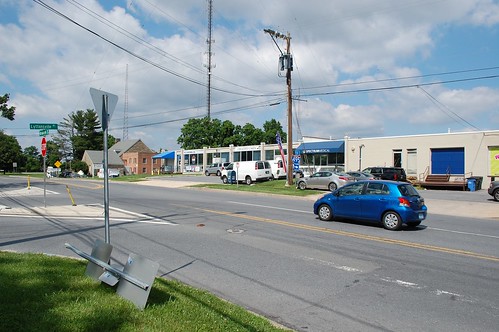
Lyttonsville's main street, Brookville Road, was replaced by an industrial park in the 1970s.
However, the planning board feels they can put the added density in Lyttonsville, because while it's a smaller area, it has room for growth and has historically not had as much political power. I just feel they are packing density in Lyttonsville and not really doing it in a responsible way.

However, as has seemingly been the historical trend, the solution has a vastly disproportionate effect on the greater Lyttonsville area. The current proposal is to increase the number of households from 780 to 3500. As anyone who has visited the area, it’s hard to see how the community could withstand the massive influx of new residents. This is what worries me about the proposed density increases in the latest sector plan draft.

However, the community used their knowledge of the area, and the Westbard sector plan as a guide on how much of an increase to expect and accept. While Westbard is larger in area, the proposed density increase was less than in the Lyttonsville sector plan. Ultimately, the County Council approved just half the density of Westbard.

Even though I am a NIMBY, I understand the need to keep focus on the greater good. This ensures that some communities will face added inconvenience by civic projects from time to time. I believe I share this understanding with my neighbors. In a recent community meeting, residents did agree density would, and should increase.

I see the intention of this plan. While the number of people who want to live inside the beltway in Montgomery County increases, the land area is constant. Therefore, density must increase. I like that the plan wants to add a little retail, and they want to highlight the history of Lyttonsville.

If EYA can execute its plan, there are more upsides, but since they don't have any letters of intent or partnerships firmly in place, I remain nervous.

The focus of my testimony to the Planning Board was this community is a model for diversity. Lyttonsville should be a point of pride for Montgomery County. Sadly the County’s actions have shown it does not share this view. Given the dramatic density increase proposal, it forces consideration of an important question for a majority-minority community; does the county assume they can saddle Lyttonsville with a disproportionately greater amount of inconvenience compared with other areas?

Though, I’m a NIMBY, so what do I know?

Friday, January 10, 2014

chevy chase digs in its heels to fight purple line

After almost 30 years, the pieces are finally falling into place to build the Purple Line. But as it decides whether to keep fighting the project, will the Town of Chevy Chase see the writing on the wall?

Purple Line Rally, August 5 2013 (cropped)
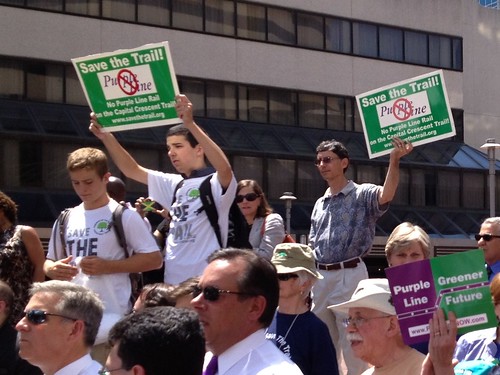
Protesters at a Purple Line event in Bethesda in August. Photo by the author.

This week, the Maryland Transit Administration narrowed down the list of private partners to help build and operate the $2.2 billion, 16-mile light rail line between Bethesda and New Carrollton. But on Wednesday night, Chevy Chase held a public hearing about whether to spend $360,000 on legal representation to keep fighting the Purple Line, which passes through it for a half-mile.

During the hearing, residents of the affluent town of less than 3,000 people debated the merits of continuing to fight a project that even opponents admit is basically a done deal. Matilde Farren compared the Town Council to change-resistant aristocrat Lord Grantham on the TV show "Downton Abbey." "Trying to keep our town the way it was in the '20s is not realistic," she said. "Times change and we must too."

Thursday, February 14, 2013

scaled-down BRT plans presented at transit forum

Bus Approaching, Reseda Station
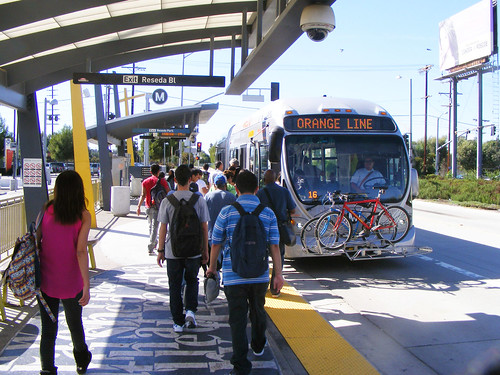
BRT in Los Angeles. Photo by the author.
On the heels of a report suggesting Montgomery County's Bus Rapid Transit plans are too ambitious, county planners are recommending reducing the number of lines and having less of the system use dedicated lanes.

Planners discussed these recommendations last night at a forum hosted by the Coalition for Smarter Growth, "The Next Generation of Transit," which discussed how Montgomery County needs to expand its transit network.

Featured speaker Geoff Anderson from Smart Growth America talked about the social, economic and environmental benefits of public transit and compact, walkable development, while County Councilmember Roger Berliner discussed how transit is integral to attracting young people and entrepreneurs to the county. Mike Madden, project manager for the Maryland Transit Administration, offered a quick update on the Purple Line.

However, the biggest news came from Larry Cole, transportation planner with the Montgomery County Planning Department. Cole presented their latest recommendations for a countywide Bus Rapid Transit network, which would be included in a master plan for future transit expansion.

The county has been studying Bus Rapid Transit since 2008, though a recently-released study from the Institute for Transportation and Development Policy, considered to be international experts on BRT, argues that it may not work in all parts of the county.

Planners looked at current land use and travel habits, along with changes proposed in the county's existing plans, and compared different scenarios for building BRT. They found that while a larger system would draw more riders and reduce driving, physical and economic constraints meant that a smaller network was more feasible.

The approximate corridors recommended by ITDP.

BRT corridors currently recommended by county planners. Click here to see their proposal from last November.

The current recommendation is for a 79-mile network, to be built in two phases, with 8 routes on Route 355, Colesville Road/Columbia Pike, Georgia Avenue, New Hampshire Avenue, Randolph Road, Veirs Mill Road, University Boulevard, and the North Bethesda Transitway. It's a smaller system than previous proposals, but it's still more than the 4-route system recommended by ITDP.

As proposed, buses would run in mixed traffic on many corridors just as they do today . Last November, Cole suggested that in order to give buses their own dedicated lanes, considered a must-have for successful BRT, space may need to be taken from cars.

Buses would have dedicated lanes in the median on all of Route 355 between Friendship Heights and Clarksburg, where it will support the redevelopment of White Flint and other areas along the corridor, along with portions of Georgia Avenue, New Hampshire Avenue, and Columbia Pike. Combined, these sections make up 31 miles of the system.

On other roads, like Veirs Mill Road and Randolph Road, buses would travel in a single-lane median that would change directions based on rush hour traffic, in "managed lanes" where buses would have some priority over other vehicles, or in mixed traffic.

Cole cited "difficult operational issues" for places where buses wouldn't get their own lanes, such as Columbia Pike and Colesville Road south of Lockwood Drive in Silver Spring. Though the corridor has six lanes and is home to some of the most heavily-used bus routes in suburban Maryland, homeowners in Four Corners have expressed opposition to taking away lanes from cars at several public meetings, including this one.

Instead, Lockwood Drive, a two-lane road roughly parallel to Columbia Pike and lined with apartment buildings, would be widened to give buses their own lanes, though it doesn't go all the way to downtown Silver Spring.

"Is the desire [for transit on Colesville and Columbia] there? Yes," said Cole. "Is the ridership high enough to justify taking a lane? Yes. When we looked at how that would actually work, we decided we needed additional study."

Colesville and Georgia


Though Montgomery County's Bus Rapid Transit plans are being trimmed down, they're moving in the right direction. ITDP recommended that the county focus on areas where transit use is already high, which the 8 routes as proposed do cover. It's also good to focus on the right solution for the right area, allowing limited resources to be spent where they're most needed.

At the same time, we can't fall prey to "BRT creep," or when BRT systems are watered down to the point where they don't work anymore. County planners need to take a stand for transit even when there's some opposition to it. It's good that they've stood by dedicated lanes on Route 355 even in areas like downtown Bethesda and White Flint where space may have be taken from cars, but it's disappointing that they've chosen not to endorse doing the same on equally constrained Georgia Avenue or Colesville Road in Silver Spring.

Transit is most effective when it can give riders a reliable commute, and buses simply can't do that when they're stuck in traffic with everyone else. And without reliable transit, our region's growth and prosperity is at risk.

Stewart Schwartz, executive director of the Coalition for Smarter Growth, echoed these concerns. "We have to make some hard choices," he said. "We've got to figure out a better way to grow. If we do it without adding transit and without adding more walkable neighborhoods, we will just die in our traffic."

Planners are currently working on a draft of the Countywide Transit Corridors Functional Master Plan, which will be presented to the Planning Board in March. In May, the board will hold public hearings before taking a vote later this spring. If approved by the Planning Board and later the County Council, the county will start doing more detailed studies in addition to preliminary engineering for the Bus Rapid Transit network.

Wednesday, October 28, 2009

what's up the pike: locke, demosthenes and you


- The website of MC's new Performing Arts Center shows the new facility with buildings that don't yet exist. Next to the venue is the historic National Institute of Cleaners and Dryers at 8021 Georgia, slated to be redeveloped with 210 condominiums. A site plan was approved in 2006, but it's still years away from putting a shovel in the ground. The phantom building also appears on the websites of Silver Spring Downtown and the Bach Sinfonia, which will be performing at the music hall.

- Tomorrow, the Planning Board reviews a draft of the Purple Line Functional Master Plan, which seeks to guide how local neighborhoods will adapt to the proposed transitway between Bethesda and New Carrollton. The plan isn't making development or zoning recommendations but rather suggestions about the appearance of and access to the line's ten planned stations within Montgomery County.

- Six dollars to drive the InterCounty Connector sounds like highway robbery to some and totally justified to others. Both sides get to make their case to state transportation officials at public hearings on the proposed tolling plan this week. The first is tonight at High Point High School in Calverton followed by another tomorrow at Shady Grove Middle School in Gaithersburg. Both events run from 6 to 9pm.

- Over on The Other Pike, Cindy from Rockville Central and others are hosting a Zombie Walk of their own. That'll be this Friday at 7:30pm outside the Apollo Bar at 12 N. Washington Street before lurching through Rockville Town Square.

- And the Rocky Horror Show - a theatrical version of the 1976 cult-film Rocky Horror Picture Show has its second local run this month with the Kensington Arts Theatre. There'll be performances this Friday and Saturday and continuing well into November at the Kensington Town Hall, 3710 Mitchell Street. Check out KAT's website for more info.

Monday, January 26, 2009

ervin asks MTA to study wayne avenue tunnel further

Councilmember Ervin (center) at a Purple Line Now! fundraiser in 2007.

When it comes to the Purple Line, Councilmember Valerie Ervin (D-Dist. 5) has been caught between the needs of her constituents and the needs of her neighbors in Park Hills, which sits along the Wayne Avenue route of the proposed transitway. At the MTA's Purple Line hearings in November, she said the issue has "literally divided" her community. In a letter to Maryland Secretary of Transportation John Porcari sent last week, Ervin asks the State to "conduct a detailed analysis" of a tunnel underneath Wayne, citing the potential impact of an at-grade Purple Line on the surrounding neighborhoods.

Dear Secretary Porcari:

After reviewing hundreds of resident's comments, the Maryland Transit Administration's Draft Environmental Impact Statement, the County Executive and Planning Board's recommendations, the Montgomery County Planning Board's Staff Report, and reviewing similar projects, it is my opinion that the Purple Line will provide Montgomery County with much needed long-term transportation infrastructure and environmental benefits. However, I want to ensure that the development and implementation of the Purple Line does not negatively impact District 5 residents who live along the alignment. For more than two years, I have been meeting with numerous residents in my own neighborhood who have raised several issues that need to be addressed by MTA staff as the project moves forward.

I would like to request that in addition to the at-grade option for Wayne Avenue, that the MTA conduct a detailed analysis of the community's request for a tunnel (from the Silver Spring Metro to Mansfield Road) as part of the locally preferred alternative and preliminary engineering process. Considering the scale and impact that this project will have on downtown Silver Spring and its surrounding communities, I believe that a detailed analysis of both options merits consideration. With either option, at-grade or tunnel, I concur with the recommendations made to date that a stop at Dale Drive is not currently justified.

All alignment options through Silver Spring must include a detailed plan to improve pedestrian safety and bicycle accessibility, account for future automobile growth, address access to existing and new residences, public facilities and private businesses, encourage long-term transit usage and ensure vibrant long-lasting communities.

I am a strong advocate for mass transit improvements and building the infrastructure that the County needs for its future, but this cannot be done in a manner that impacts residents' quality of life. Thank you in advance for considering this request and for working with my office on issues that my constituents have raised. I look forward to continuing to work with your staff as new issues and concerns arise throughout the design, planning and implementation of this important project.

Sincerely,
[signature]
Valerie Ervin - District 5

Monday, December 29, 2008

2k8: this year in east county

2008 will be remembered as an epic year for our nation, with an economic meltdown and the election of our first black president merely the icing on the cake. It's been an epic year for East County as well, with the tragic loss of a County Councilmember and the beginning of construction on the ICC - two things that many people wouldn't have predicted even last year. Here's a look at some of the big stories we've reported on over the past twelve months:

JANUARY:

- Washington Adventist Hospital unveils its plans to build a new facility in Calverton, which will bring over two thousand jobs to East County according to president Jere Stocks.

- Montgomery County signed a lease with concert promoter Live Nation to build a Fillmore music hall in the former J.C. Penney building on Colesville Road, making the controversial nightclub more or less a done deal. It should open in 2010.

FEBRUARY

- Four-term Councilmember Marilyn Praisner, a resident of Calverton for forty years, and Planning Board commissioner Gene Lynch, who was instrumental in the revitalization of Downtown Silver Spring, pass away on the same day.

- A fire breaks out at El Pollo Rico, the popular Peruvian restaurant in Wheaton, damaging several other neighboring businesses.

MARCH:

- The campaign to fill Marilyn Praisner's former County Council seat is on, with four Democrats and four Republicans vying for the position. Many elected officials throw their support behind Praisner's widower, Don, though he faces stiff competition from School Board president Nancy Navarro.

- After his defeat in the Democratic primary to Donna Edwards, Congressman Al Wynn (D-Dist. 4) steps down to take a position at a law firm with less than a year left in his term.

- The Dutch Country Farmers' Market, an institution in Burtonsville, signs a twenty-five-year lease for a space in Laurel after being evicted from their current location by Chris Jones, who planned to redevelop the shopping center it was located in.

APRIL:

- In the primary election to fill the recently-departed Marilyn Praisner's County Council seat, the Democratic nomination goes to her widower Don. Aided by political gadfly Robin Ficker, Mark Fennel wins the Republican nomination.

- The Planning Board adopts the Silver Spring CBD Green Space Plan, which seeks to create new, higher-quality parks and squares throughout the business district.

MAY:

- Don Praisner wins the County Council District 4 election, replacing his wife Marilyn. In keeping with one of her favorite traditions, Don throws an ice cream social at Seibel's Restaurant in Burtonsville.

- The Planning Board approves the Ashton Meeting Place, a proposed mixed-use shopping center in Ashton, the result of a compromise between the developer and residents of the three-hundred-year-old village, who were concerned about the project's scale and context.

JUNE:

- South Silver Spring holds its second-annual Block Party, attempting to re-cast the former industrial neighborhood as a place for arts, music and great food.

- The Fairland Recreation Center and Fairland Library are re-named after former Councilmember Marilyn Praisner, who fought to have both facilities funded and built in the 1990's.

- Burtonsville residents debate traffic, "undesirables" and the future of their community at a charrette for the Community Legacy Plan, which will use state funding to revitalize the beleaguered Burtonsville business district.

JULY:

- International Downtown Associates, a worldwide network of urban planners and designers, propose building a library and town square to revitalize Wheaton's business district, while the Planning Department begins revising the twenty-year-old Wheaton CBD sector plan.

- WMATA proposes expanding their MetroExtra network of rapid buses with a series of new routes throughout the region, including lines along Route 29, Georgia Avenue, New Hampshire Avenue, University Boulevard and East-West Highway. The East County routes could be up and running as early as 2012.

- Montgomery County throws a "farewell party" for "the Turf," the popular fake-grass hangout at Fenton and Ellsworth in Downtown Silver Spring. Over the next two years, it will be transformed into Veterans' Plaza, a paved square featuring a new civic center and ice rink.

AUGUST:

- Construction of the InterCounty Connector begins in earnest as trees come down along Route 29 in preparation for a new interchange. Dogwood Drive in Briggs Chaney is closed to accomodate the toll road, which is set to be completed by 2012.

- Despite making plans to move to Laurel, the Dutch Country Farmers' Market says it will remain in Burtonsville for the time being - which it later revises to "indefinitely." Chris Jones, who plans to redevelop the shopping center the market is located in, is reportedly unable to get the necessary building permits.

- The kids who used to congregate on "the Turf" instead move to the adjacent block of Ellsworth Drive, while landscape architects wonder if the unexpectedly-popular expanse of fake grass could cost them their jobs.

SEPTEMBER:

- The Planning Board decides not to landmark Falkland Chase, instead approving plans to redevelop a third of the New Deal-era apartment complex.

- County Executive Ike Leggett's "Pedestrian Safety Week" gets off to a rough start as he stumbles upon the crime scene for a pedestrian killed on Fairland Road. In response, the county Department of Transportation launches an in-depth examination of pedestrian safety along the road.

- East County residents flock to the eighteenth-annual Burtonsville Days festival, featuring a parade, a food court, local vendors and the first-ever Burtonsville Fashion Show.

OCTOBER:

- Following last June's charrette, consultants propose new landscaping, reconfigured parking lots and minor aesthetic improvements for Burtonsville's struggling village center in the Community Legacy Plan, which can be used to apply for State funding.

- The County Council approves a raft of new amendments that give developers increased leeway in exchange for building the Fillmore music hall and similar amenities in the downtowns of Silver Spring, Bethesda and Wheaton.

- Silver Spring, Singular and Thayer Avenue host Silver Spring's first Zombie Walk, drawing hundreds to Ellsworth Drive and landing a feature in the Gazette.

NOVEMBER:

- Fourteen-year-old Tai Lam, a student at Blair High School, is murdered on a Ride-On bus while coming home from Downtown Silver Spring. While the neighborhood listservs light up with fears that the Purple Line and development will contribute to a rising crime rate, friends and well-wishers set up a memorial to Lam on Ellsworth Drive.

- A bank robbery in Clarksville leads to a police chase across the river into East County, resulting in roadblocks, schools under lockdown and a violent shootout in the Greencastle Lakes neighborhood of Burtonsville.

- Elected officials and local residents alike make themselves heard at Montgomery College for the last of four public hearings on the Purple Line's Alternatives Analysis/Draft Environmental Impact Study.

- Over Thanksgiving weekend, a middle-aged woman vandalizes the exterior of City Place Mall, breaking the windows of the Ruby Tuesday restaurant on Colesville Road with a baseball bat.

DECEMBER:

- JUTP does a series profiling Paul Stregevsky, writer of Tracks, the world's first musical about the Purple Line.

- Ten months after its original location on Ennalls Avenue in Wheaton burned down, Peruvian chicken eatery El Pollo Rico re-opens a block away on University Boulevard, though I still have yet to eat there.

- Councilmember Marc Elrich unveils his plan for a 100-mile Bus Rapid Transit system in Montgomery County, which would create a reserved, reversible lane for buses on major roads like Georgia Avenue, Route 29 and Randolph Road.

- The County's Office of Legislative Oversight says that the Northeast and Downcounty consortia, which offer East County students a choice of "signature programs" at one of eight different high schools, has failed its originally stated goal of racial integration.

- Two months after it opens, the Montgomery Cinema 'N' Drafthouse in Wheaton closes, citing financial difficulties, a lack of help from Montgomery County, and very unrealistic expectations from their landlord, the Westfield Group.

- The Planning Board endorses light-rail as their preferred mode for the Purple Line, and suggests using both the Georgetown Branch Trail in Chevy Chase and Wayne Avenue in East Silver Spring for the route.

- A man is shot outside of Wheaton Plaza two days before Christmas, marking the fourth serious crime that has happened at the mall since its multi-million-dollar renovation in 2005.
Monday, December 8, 2008

what's up the pike: thrown under the bus

We might as well call this blog Just Up The Purple Line, because there's been no shortage of transit-related brouhaha these past few weeks. (We have a story about the ICC to post, though.) Anyways:

- Dist. 18 Delegate Al Carr's review of bus rapid transit in Cleveland has caused quite a stir among MoCo's light-rail pushing transit advocates. Purple Line Now!, whose goal needs no explanation, sent Carr a fiery response over the weekend, calling up a former Ohio transit commissioner to debunk the delegate's conclusions about the HealthLine, a new BRT route in East Cleveland. It would've been surprising if Delegate Carr had come away from his trip with a negative impression of the project, given his testimony in favor of BRT for the Purple Line at the public hearings last month.

- As much as he knows about urban planning, Richard Layman - of Rebuilding Place in the Urban Space - never has much to say about Montgomery County, living in the District and focusing primarily on issues down there. This week, however, he posted a presentation dubbed "Transit Beyond the Purple Line," all about how MoCo needs to create a real plan for mobility, not just rapid bus lines as Councilmember Elrich is proposing. (By the way: Elrich's plan was featured in yesterday's Post.) It's definitely something worth checking out, as Layman knows his stuff - even if he's not a big fan of Silver Spring.

Monday, December 1, 2008

what's up the pike: you've got that purple pallor

Residents say the County's preferred scheme for the Silver Spring Library at Fenton and Wayne ignores the neighborhood context.

Are you getting tired of the Purple Line debate? Then you'll love what we have to show you later today, but in the meantime, here's a look at what happened while you were gone for Thanksgiving:

- As we reported over the weekend, a woman wielding a baseball bat broke all of the windows of the Ruby Tuesday in City Place Mall Friday night. She was apprehended by MoCo police and the windows were boarded up, but questions remain as to the motive behind her actions.

- Residents say the County Executive and County Council weren't listening to their concerns when they picked a preferred scheme for the new Silver Spring Library that went against their wishes. At a meeting held last week, the elected officials endorsed placing the library at Wayne and Fenton and putting a ten-story apartment building behind it, along Bonifant Street. It was one of several options (warning! PDF file) proposed by local architecture firm RTKL - which designed the Downtown Silver Spring complex - for the mixed-use development.

Those who live near the site say the County's proposal is out of scale with the low-rise homes and shops along Bonifant Street and would prefer another option in which the apartment building was moved to Wayne Avenue, closer to other tall buildings. Residents will have an additional chance to view and discuss the proposals at a meeting this Tuesday at 7pm in the existing library at 8901 Colesville Road.

- The Washington Post writes up Purple Line hearings in College Park and Chevy Chase, leading most of our readers to conclude that the hearing in New Carrollton was probably just a myth. Not surprisingly, everyone in College Park is on board with the proposed transitway - save for the University of Maryland itself, which is still clinging to the argument that the trains will disturb their scientific experiments - while in Chevy Chase, it's still fire and brimstone if the line comes through the Capital Crescent Trail in their town.

- They must have had a lot of pent-up Purple Line emotions to get out, because another story appears today about the project and the perceived "east-west divide" of race and class between Montgomery and Prince George's counties. Councilmember Valerie Ervin refers to it as the "browning" of MoCo (perhaps she was thinking about her Thanksgiving turkey), while former Prince George's County Councilmember Peter Shapiro calls the racial issue "the smelly fish under the table - everyone knows it's there, but not everyone is talking about it openly." It's a frank assessment, albeit one that many of the politicos interviewed seem to reject, if only to keep up appearances.

The article suggest that people east of Silver Spring aren't opposed to the Purple Line because it won't run through residential neighborhoods there, which I didn't think was particularly fair. There are a number of homes and apartment buildings along Piney Branch Road in Takoma Park, along University Boulevard in Langley Park, and along East-West Highway in both Riverdale Park and New Carrollton that will have to put up with the line in addition to the noise, traffic and pollution they currently deal with along those roads. Whether people there are okay with the Purple Line or, perhaps, still haven't heard about it, there remains to be no organized opposition from those communities, which is worth noting.

Monday, November 24, 2008

purple line hearing: east county pols hop on board

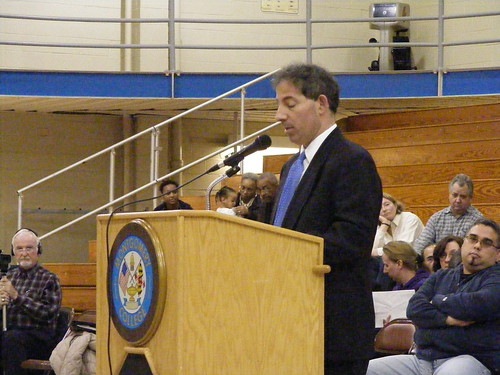
Part ONE of a re-cap of last Saturday's Purple Line hearing in Takoma Park. Later today, we'll look at what local residents had to say. Also check out this slideshow of the hearing.

School Board president Nancy Navarro testifies.

At the last of four hearings on the Purple Line Alternatives Analysis/Draft Environmental Impact Study last Saturday, East County residents made it clear they're all for transit, but are still split on how and where it should be built. The meeting, held in Falcon Hall on Montgomery College's Takoma Park/Silver Spring campus, was well-attended by elected officials, civic leaders and a wide cross-section of area residents who came to testify, to listen, and to learn about the proposed sixteen-mile transitway between Bethesda and New Carrollton.

According to Webb Smedley from the Action Committee for Transit, a local Purple Line advocacy group, nearly half of the fifty-five individuals who spoke were in support of using light-rail trains instead of bus rapid transit. Those alternatives - of which there were eight altogether, including a no-build option - would route the Purple Line along the popular Georgetown Branch Trail between Bethesda and Silver Spring that bisects one of the region's most exclusive country clubs. While that alignment raised controversy at an earlier hearing in Chevy Chase, the debate at Saturday's hearing was about where the line should go east of Silver Spring.

The elected officials who testified were uniformly in support of the Purple Line, citing the need for more reliable transit and a return to higher gas prices. "Commuters are more ready to leave their cars home and take transit than since World War II," said State Delegate Heather Mizeur (D-Dist. 20). Nancy Navarro, school board president and former County Council candidate, testified about seeing a "young Latino mother try to cover her infant child as she ran to catch a bus," calling her "the face of who will benefit" from the Purple Line.

so much more AFTER THE JUMP . . .

At-Large County Councilmembers George Leventhal and Nancy Floreen, who testified at other hearings, watch the proceedings.

County Councilmember Valerie Ervin.

State Sen. Jamie Raskin (D-Dist. 20) talked about being "thrilled" as a kid to ride the just-opened Metro by himself, and offering those same opportunities to today's youth. "We have to fear for the future if we don't deal with the transportation issues we have now," said Raskin.

Bruce Williams, Mayor of Takoma Park, said the current economic downturn made now an even better time to start building the Purple Line. "We know money is tight, but this is the best time to invest in infrastructure," said Williams. "By the time developers are ready, the Purple Line will be finished."

County Councilmember Valerie Ervin (D-Dist. 5) hadn't prepared any statements before she took the podium, but she immediately launched into poetics in her endorsement of the Purple Line. "We all drink deeply from wells we did not dig," said Ervin. "We do this for all those people who built the roads and bridges for ourselves and our children." A Park Hills resident, she noted she could see the Purple Line's possible Wayne Avenue alignment from her house. "Our community is literally divided" by the proposal, she lamented.

State Sen. Jamie Raskin.

A frequent target by those spoke was Chevy Chase, where the Columbia Country Club and Save The Trail Coalition have been working to stall the project, which would run along the Georgetown Branch Trail. Elected officials representing that area who spoke at a hearing there on Tuesday - State Sen. Rich Madaleno (D-Dist. 18), State Del. Al Carr (D-Dist. 18) and Chevy Chase Town Councilman David Lublin - all testified in support of a Bus Rapid Transit line along Jones Bridge Road that bypassed both the town and the country club.

"We cannot let the recreational needs of a few wealthy golfers supercede" the needs of transit riders elsewhere, said Del. Tom Hucker (D-Dist. 20). "If more buses were the answer, we would've done it years ago."

College Park Mayor Stephen Brayman chided Montgomery County for its "controversies" with the Purple Line in Chevy Chase and East Silver Spring. "While in Prince George's County we have some decisions to make with the alignment, I don't know anyone who's opposed to the Purple Line," he said.

Friday, November 21, 2008

purple line hearings wrap up tomorrow

Trail advocate Wayne Phyllaier on the Georgetown Branch Trail in Silver Spring, one of the proposed routes for the Purple Line.

As always, Maryland Politics Watch doesn't fail to get the whole story. Following up their posting of testimony from Chevy Chase Town Councilman David Lublin, State Delegate Alfred Carr and State Senator Rich Madaleno at Tuesday's Purple Line hearing in Chevy Chase, they've also got comments from rail advocate Ross Capon, MoCo Chamber of Commerce president "Gigi" Godwin, and County Councilman George Leventhal.

While the first three individuals expressed support for either a) the use of bus rapid transit and b) a routing away from the Town of Chevy Chase, the last three support light rail and the master-planned route along the Georgetown Branch Trail. Not to toot my own horn, but if you're interested in learning more about the Purple Line, check out JUTP's series from last summer on the proposed transitway, in which we interviewed local activists on both sides of the project - both physically and emotionally.

The very very last Purple Line hearing will be Saturday from 12:30 to 5pm in Falcon Hall, 7600 Takoma Avenue, Takoma Park. It's on the Montgomery College Silver Spring-Takoma Park campus. For more info, check out the MTA's website.

Thursday, November 20, 2008

what's up the pike: way too much on my plate

So . . . didn't get to go to the first three Purple Line hearings, though Greater Greater Washington has a fairly positive re-cap of the Chevy Chase event, and Maryland Politics Watch has testimony from town councilman David Lublin, state Delegate Alfred Carr and state Senator Rich Madaleno, both from District 18. Hopefully, you'll find me at this Saturday's hearing in Silver Spring. Here's a look at some non-Purple Line related things happening in East County:

Before the hearing, hit up the Montgomery County Thanksgiving Parade in Downtown Silver Spring. With seven floats, ten marching bands and eleven dance troupes, this year's parade promises many excellent photo ops for Chip Py, though it'll be hard to follow up this shot from last year of mounted cops riding horses as they pee on Ellsworth Drive.

- The Dutch Country Farmers' Market is still in Burtonsville, and will remain there through the winter, according to the Gazette. Developer Chris Jones, who plans to redevelop the Burtonsville Shopping Center - containing the so-called Amish Market and other now-closed shops - is still waiting for building permits. Anticipating their eviction last summer, the market already leased space for a new location in Laurel.

- Today, the Planning Board reviews the proposed White Oak Community Recreation Center, which would be built at the corner of April and Stewart lanes in White Oak. With over 33,000 square feet of space, the facility would be one of the County's largest recreation centers, featuring two gyms, a social hall, and a "skate spot." It'll also be going for LEED certification, a rating system which acknowledges the use of environmentally-friendly design and construction techniques.

- And as always, check out my weekly column in the Diamondback, the University of Maryland's independent student newspaper. I'm following up last week's column about the Purple Line with a look at how transportation affects the way we build and design our communities.

Monday, November 17, 2008

what's up the pike: two questions

While Just Up The Pike hopes to make an appearance at (and write a subsequent post about) the Purple Line hearings this week, it'll be tough to maintain the regular posting schedule over the next few days. So, in the meantime: I'll give you a topic. Or two. Discuss:

- Now that "gadfly in the ointment" Robin Ficker's thirty-four-year anti-tax campaign has finally been vindicated, will I ever wake up early enough to run up the stairs of Cole Field House with him before I graduate?

- While talking about Scumbag Nation tonight, my roommate (who you may remember from the Purple Line diaries in August) and I had an argument this evening about where the real "Montgomery County" is. According to him, places like Bethesda, Silver Spring and even Colesville (where Scumbag Nation is located) are functionally part of D.C., while upcounty locales like Gaithersburg and Germantown are independent of The City and can be considered "just plain MoCo."

What do you think? Where do you think D.C. stops and MoCo begins, if not at the city line? Can we say such a boundary really exists?

See you later this week!

Thursday, November 13, 2008

what's up the pike: transit transit transit zombies

- As the MTA holds public hearings next week for the Purple Line's Alternatives Analysis/Draft Environmental Impact Statement, I'm wondering how they can make an appeal for the transitway in a manner that attracts people who are scared away by hefty reports and jargon. Can the MTA make the bus and train look fast, easy - and, most importantly, sexy? We might want to head up to Cleveland, where their transit agency is aggressively marketing their newest service, a rapid bus route called the HealthLine. The HealthLine's snazzy new website explains what BRT is, how to use the system, and what it can do for Euclid Avenue, which was one of Cleveland's premier shopping streets and is slowly being revitalized.

- Speaking of BRT: Councilmember Marc Elrich has a new proposal for several bus rapid transit lines across Montgomery County, including one up Route 29. At last week's East County Citizens Advisory Board meeting, he presented his plan, which would create a reversible lane for buses in the median of 29 and other roads. Hopefully, we can get a better look at the Councilmember's proposal, which would finally deliver the rapid transit East County's been promised for nearly thirty years.

- As always, check out my weekly column in the Diamondback, U-Md.'s independent student newspaper. This week and next week, I'm writing about - what else? - the Purple Line in preparation for the public hearings, one of which will be held right on campus in College Park. For locations and dates, check out the Purple Line website.

- Speaking of school: it looks like zombies aren't being as well-received on campus as they were in Silver Spring last month. The Humans vs. Zombies game, a weeks-long campaign in which students posing as humans must defend themselves against player-zombies with NERF guns, was halted after a professor thought someone was carrying an actual firearm.

Friday, October 17, 2008

purple line hearings: get your voice heard, share some laughs (updated)

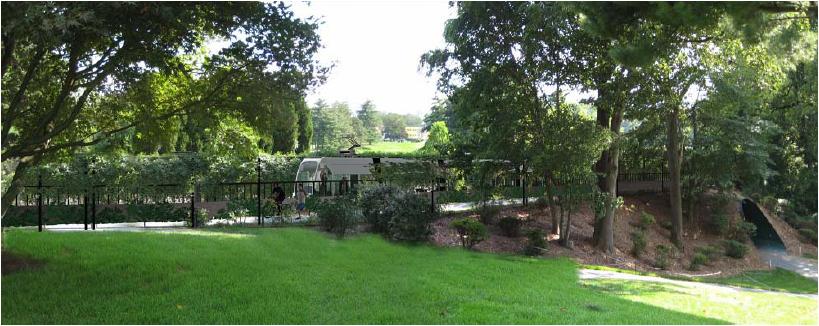
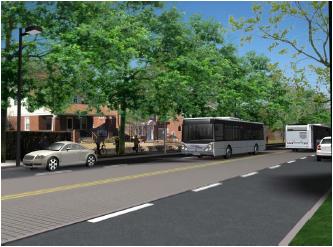
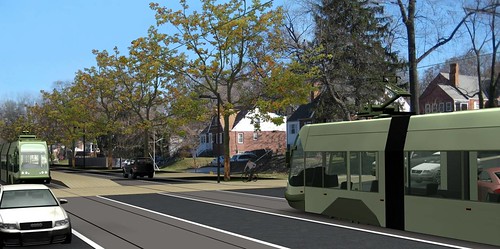
An MTA visualization of the Purple Line as it could look passing through Columbia Country Club in Chevy Chase. BELOW: A rendering of the line along Wayne Avenue near Cedar Street in Silver Spring.

The MTA's released its Alternative Analysis/Draft Environmental Impact Study for the Purple Line in anticipation of public hearings to be held next month. Weighing in at a few thousand pages, the report includes detailed information and analysis of proposed routes and modes for the transitway, along with any effects the MTA believes it'll have on the 16-mile corridor. The document (warning! PDF file) also includes several computer renderings of how the Purple Line may look when built.

Whether you're for the Purple Line, against the Purple Line, or completely oblivious, this is your opportunity to make your voices heard on what could potentially change the face of Montgomery and Prince George's counties. For you spectators out there hungry for another sober shitshow, these hearings offer a great opportunity to see civic involvement at its very best - and worst. The tour begins in New Carrollton on Nov. 15, followed by Chevy Chase on the 18th and College Park on the 19th before it stops in Silver Spring on the 22nd. For more information about the hearing times or how they're run, check out the Purple Line website.

Friday, May 16, 2008

more info means stronger opinions at purple line open houses

WHAT'S UP THE PIKE: What are local high schoolers doing to show their support for the Purple Line? We'll find out next week.

A computer-generated image of Purple Line trains running along Wayne Avenue. The Maryland Transit Administration is releasing more visuals of the project to give local residents a better idea of what it will look like.

A new round of information on the Purple Line released at a series of open houses this week is giving some Downcounty residents more reason to support or question the controversial proposed transitway between Bethesda and New Carrollton.

Representatives from the Maryland Transit Administration said there was a "steady flow" of visitors to an open house Wednesday evening at East Silver Spring Elementary School, with approximately fifty people in their guestbook at 6:10, an hour after the meeting started.. Transit advocate Don Slater, whom with his wife Tina lives "six doors off" the Wayne Avenue alignment, was excited about the turnout. As we reported last winter, the Slaters have printed out bumper stickers reading Purple Line/Green Transportation for supporters of the project. The Purple Line is "absolutely necessary to the Maryland suburbs," says Slater.

Gary Stith from the Silver Spring Regional Services Center noted that the project's slow pace has tested the patience of local residents, but only because they're so hungry for information. "The more you keep people informed, the better," says Stith. "They're smart, well-educated. They expect to get good information."

so much more AFTER THE JUMP . . .

The State's newest ridership figures estimate that as many as 68,000 people will ride the Purple Line each day, depending on which of six alternatives is built. It's a large increase from the 47,000 daily riders anticipated last December. At this month's open house, MTA has also produced estimates of how many automobile trips will be removed in different parts of the region. According to the latest figures, the greatest traffic impacts will be seen in College Park, where as many as 7,000 trips could be replaced by the line, while an additional 5,900 trips may disappear in Downtown Silver Spring.

Another new feature was a series of video simulations depicting different parts of the route, the early versions of which have appeared in neighborhood meetings over the past several months. Standing a few feet away from a screen showing trains flying down Wayne Avenue, Sligo-Branview resident Rose Polyakova said she hoped that MTA would pick light-rail vehicles over Bus Rapid Transit, a cheaper technology that can be compared to a train on rubber tires.

"Most [people] want to build a Purple Line," says Polyakova, but "a lot of people would ride a rail that would not ride a bus . . . there's a perception that buses are not nice."

One possible BRT design would cut across the front yard of her home at Wayne and Flower avenues, where she's lived for nine years. "Sitting on my front porch would not be as pleasant as it is today" with a bus running through it, she says.

East Silver Spring resident Karen Roper, who sits on the Purple Line Advisory Committee, had already seen most of the information presented at the meeting. "Don't expect to see anything new," she says. "I just expect to keep them honest."

Roper made headlines two years ago for taking elected officials on walking tours of the Purple Line route in East Silver Spring to convince them to re-route the line away from her neighborhood. Learning more about the MTA's plans haven't changed her opinion, she says, especially as the project's focus has changed and more stops were added. "I think you have to look at what this was supposed to be," says Roper, "and it was supposed to be rapid transit."

"It's an end game," she adds. "Politicians are stuck between a rock and a hard place . . . to prove that they can make it work."

The next step will be the publication of a Draft Environmental Impact Statement, a several-hundred-page document outlining the Purple Line's direct effects on the region, later this spring. They'll also make a decision on which form the project may take - what routes and whether light-rail or BRT will be used. In September, the MTA will hold public hearings where residents can speak about the project.